



The Power of AI in Shaping the Future World Order
By Muhammad Umar Tahir ||
A few nights ago, I was scrolling through my phone when I came across a video that immediately caught my attention. It showed a group of drones moving together in the sky. At first, it looked simple, almost like a normal swarm show. But then something interesting happened. The drones were not just flying; they were coordinating with each other. They moved in formation, changed direction together, and adjusted their positions in real time. It felt less like separate machines and more like a single system working as one.
Then I realized something even more surprising. If one drone stopped or got damaged, the others did not stop. They quickly adjusted in the same formation, and another drone took its place. The system continued without confusion, without delay. That is when it stopped feeling like a simple video. It started to feel like a glimpse of something bigger. It was not just a show. It was a scene of war, where these machines could be carrying weapons and making decisions in real time.
(Freepik)
For a long time, we have thought of artificial intelligence as something that helps us in small ways. It writes messages, answers questions, and makes everyday tasks easier. It waits for us to give instructions, works only when we ask, and helps us.
But now, something is changing. AI is no longer just waiting. It is acting.
Today, machines are learning how to work together. They can share information, make quick decisions, and respond to situations in real time. Systems like drones and mobile robots are no longer operating alone. They are connected, and they support each other. In many situations, they do not need constant human control. They can adjust, react, and continue on their own.
This kind of technology has already been used in serious situations. Systems are able to monitor, react, and even take action faster than humans can. In such environments, speed becomes the most important factor. The system that reacts faster gains the advantage. This is where things become more important to understand.
But speed is not the only change. Another important change is coordination. Machines can now share what they learn almost instantly. If one system finds a better way to do something, that knowledge can be used by others immediately. Humans take time to learn, practice, and improve. Machines connected through intelligent systems can improve much faster.
In the past, power depended on people, resources, and physical strength. Today, another factor is becoming just as important, and that is intelligence. Not just human intelligence, but machine intelligence.
A system that can learn faster, adjust quickly, and make better decisions will naturally move ahead. And slowly, this begins to shape how the world works. It is no longer only about how strong you are but how smart your systems are, how fast they respond, and how well they are connected.
We are also moving toward a world where decisions are supported by data. Systems can analyze large amounts of information and suggest actions in seconds. In many cases, humans may not even see all the data being processed. They only see the result. This creates a new kind of dependency on intelligent systems.
But this is only one side of the story. Because the same technology can also be used in a very different way. Imagine using this level of intelligence not for difficult situations but for improving everyday life.
In farming, AI systems can help farmers understand exactly what their crops need. Water, soil conditions, and weather can all be managed more carefully. This can help increase food production and reduce waste. Farming can become more predictable, more efficient, and less dependent on guesswork.
Machines can also explore places that are hard for humans to reach. Deep oceans, rough lands, and dangerous environments can be studied more safely. New resources can be discovered, and knowledge can grow. These discoveries can help improve life in ways we do not fully understand yet.
Cities can become smarter. Traffic can move better, energy can be used more efficiently, and services can respond faster to people’s needs. Instead of reacting after problems happen, systems can act before problems grow.
In healthcare, AI can support doctors by analyzing large amounts of data. It can help detect problems early and suggest better treatments. This does not replace doctors, but it helps them make better decisions. In many cases, early detection can save lives.
Even beyond our planet, intelligent systems can explore places where humans cannot easily go. They can travel further and send back valuable information. They can help us understand environments that are currently beyond our reach.
“The technology that is becoming stronger is also becoming a source of power.”
In all these ways, AI is not taking away human ability. It is expanding it. It allows humans to go further, think deeper, and act faster. That is why this moment is so important. Because AI itself does not decide what it will be used for. It depends on us. The same system can be used in different ways. It can be used in difficult situations, and it can also be used for peaceful purposes and for the betterment of humanity.
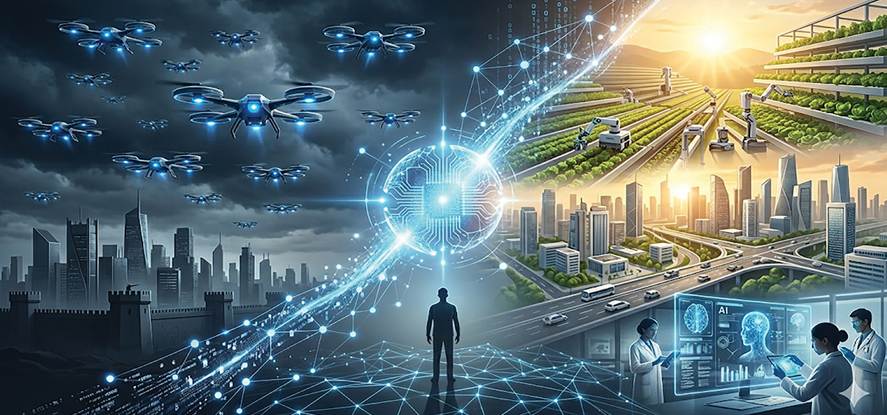
(GN with Google Gemini)
At the same time, we also need to understand another important reality. The technology that is becoming stronger is also becoming a source of power. The one who is ahead in AI will not only have an advantage in difficult situations but may also have better access to resources, stronger control over systems, and greater influence over decisions. This influence does not always appear in a direct way. It can be slow and quiet. Systems become more efficient, decisions become faster, and gradually control shifts toward those who have better technology.
This is where AI begins to connect with something even bigger. It is not only changing technology; it is slowly shaping the future world order. Until now, the world order has been influenced mainly by human strength, resources, and control. But now, artificial intelligence is becoming a major factor. The systems that are more intelligent, more advanced, and more connected can influence how decisions are made and how systems operate.
This means that the power of AI is not limited to one area. It can affect many aspects of life at the same time. From systems to resources, during both war and peace, from decisions to influence, everything can be connected through intelligent technologies.
And that is why the role of AI in shaping the future world order is becoming so important. The direction depends on human choice. At the same time, one thing is becoming clear: In the future, those who understand and use AI will move forward faster. Those who ignore it may find it difficult to keep up. This applies to countries as well as individuals.
This is not something to fear. It is something to understand. Looking back at that video, it no longer feels like just a simple example. It feels like a small sign of a bigger change. A change where machines can work together, think faster, and act without waiting. The power of AI is not only in what it can do today; it is in what it is slowly becoming. And the future it shapes will depend on how we choose to use it.
Because in the end, the question is not whether AI will shape the future. It is already doing that.
The real question is how will we choose to use it, and who will be the ones using it?
The Author
Muhammad Umar Tahir is an electrical engineer pursuing his PhD in the Artificial Intelligence Convergence Department at Gwangju Institute of Science and Technology (GIST). He is interested in applying AI to healthcare devices, particularly in advancing medical imaging technologies and brain stimulation. Outside research, he enjoys exploring new places, meeting people, and exchanging ideas on how innovation can improve the quality of life.