






Nature Under Attack
By Siddhant K. ||
The hidden environmental catastrophe of modern warfare, from the steppes of Ukraine to the shores of Gaza.
When we speak of war, we usually speak of human suffering, of lives lost, families shattered, and cities reduced to rubble. But war has another casualty, one that cannot file a report, cast a vote, or give testimony before the international courts: the natural world. Soil, air, water, forests, wetlands, and the creatures that inhabit them are silently and systematically destroyed in every armed conflict. Today, with two of the largest wars in decades being in Ukraine and Gaza, alongside ongoing conflicts in Sudan, the Sahel, Myanmar, and Iran, the ecological toll of organized violence demands urgent attention.
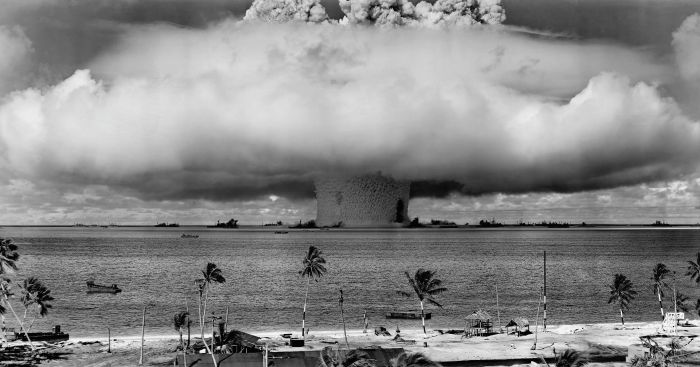
Explosion on the Marshall Islands.
This is not a secondary concern. According to the Conflict and Environment Observatory (CEOBS), a UN-accredited watchdog, the world’s militaries are responsible for an estimated 5.5% of all global greenhouse gas emissions, more than civil aviation and the shipping industry combined. Yet military emissions remain entirely exempt from mandatory reporting under the Paris Agreement, a loophole that scientists increasingly describe as a “critical black hole” in global climate accounting. The world is currently experiencing its highest number of active conflicts since the Second World War, and the ecological price tag is staggering.
“If the world’s militaries were a country, they would have the fourth largest carbon footprint on Earth–larger than Russia’s.” (Conflict and Environment Observatory, 2024)
Ukraine: A Continent’s Lungs at War
Russia’s full-scale invasion of Ukraine, launched in February 2022, represents the most ecologically devastating land war in Europe since the 1940s. Ukraine is a nation of extraordinary ecological significance: Though it covers just 6% of Europe’s land area, it harbors 35% of the continent’s biodiversity. The war is now threatening this disproportionate natural wealth at every level.
According to a 2024 peer-reviewed study published in Frontiers in Sustainable Resource Management, military operations have severely degraded Ukraine’s soil, air, water, and biodiversity through multiple simultaneous pathways. The detonation of explosives compacts soil and reduces its water absorption capacity, while the intensive use of military vehicles releases toxic elements, including lead, mercury, and arsenic, that penetrate the food chain. These heavy metals do not dissipate; they bind to soil particles and accumulate in plants, passing upward through every trophic level of the food chain.
Fire has been among the most visible and dramatic ecological consequences. According to a 2025 report from the European Commission’s Joint Research Centre, Ukraine suffered record-breaking wildfires in 2024, with approximately 965,000 hectares burned, more than twice the area burned across the entire European Union combined in that same period. The majority of these fires occurred along the frontlines during periods of hot, dry weather, incinerating not only forests but also unique steppe and wetland ecosystems that had no fire-adapted ecology to recover from.
“Ukraine occupies 6% of Europe’s land area but holds 35% of its biodiversity, and the war now threatens every part o fthat natural inheritance.”
The cumulative greenhouse gas burden of the Ukraine war is similarly alarming. Ukraine’s Ministry of Environment calculates that the mobilization, fighting, and reconstruction will produce approximately 175 million tons of CO₂ equivalent, a figure comparable to the entire annual emissions of the Netherlands. This estimate encompasses direct military fuel combustion, emissions from fires, and the enormous quantities of steel and concrete required for rebuilding.
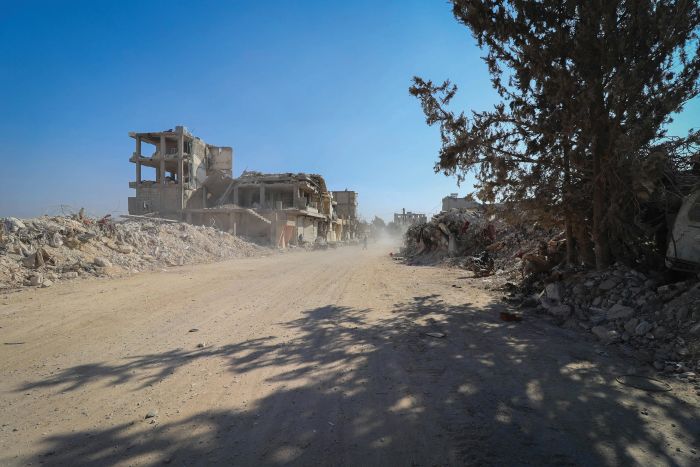
Ruins of city buildings. (Ahmed Akacha on Pexels)
Gaza: Ecocide in a Coastal Strip
If Ukraine represents an ecological war of attrition across a vast landscape, the war in Gaza since October 2023 represents an environmental catastrophe compressed into an extraordinarily small and densely populated space. The Gaza Strip, 365 square kilometers, roughly the size of the city of Detroit, has been subjected to one of the most intense bombardments per unit area in documented military history, with consequences for the natural environment that may prove irreversible within human generational timescales.
In June 2024, the United Nations Environment Programme (UNEP) published its preliminary environmental assessment, concluding that the war had exposed the Gaza population to rapidly growing soil, water, and air pollution, with risks of irreversible damage to natural ecosystems. A follow-up assessment published later that year found that, by almost every measure, conditions had deteriorated dramatically: The volume of conflict-related debris had increased by 57% and now stands at over 40 million tons, twenty times greater than all debris generated by conflicts in Gaza since 2008. This rubble contains human remains, asbestos, unexploded ordnance, and a cocktail of hazardous industrial chemicals.
The agricultural landscape of Gaza has been effectively erased. By September 2024, UNOSAT and FAO satellite analysis found that 67% of all cropland had been damaged, including 71% of orchards and tree crops.
“80% of Gaza’s trees damaged or destroyed by January 2025, with losses exceeding 90% in the north.” (Kent State University satellite analysis)
Gaza’s coastal and marine ecosystems have also been devastated. The collapse of sewage treatment infrastructure has resulted in the discharge of at least 130,000 cubic meters of raw wastewater into the Mediterranean Sea every day. This effiuent has contaminated much of the territory’s drinking water.
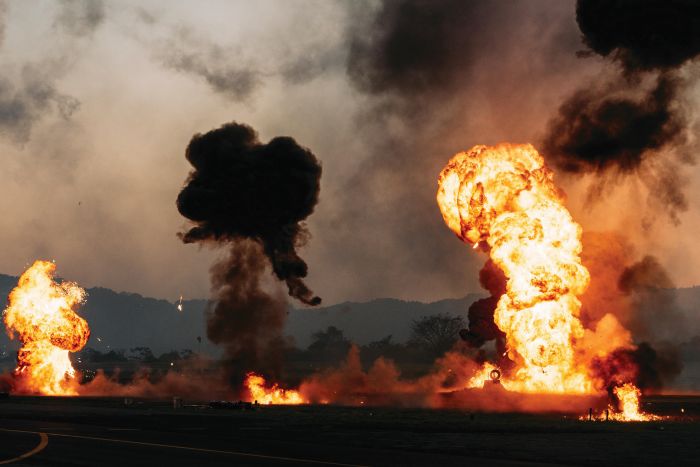
Fireball explosion. (Edu Raw on Pexels)
What the Science Demands
The ecological cost of modern warfare is not an unfortunate side-effect that can be minimized with better technology. It is a systemic and predictable consequence of armed conflict, one that compounds over time and across borders. Dolphins washing up on the shores of Turkey and Bulgaria carry within them the acoustic trauma and heavy metal contamination of a war being fought hundreds of kilometers away. Fish kills in the Dnipro Delta affect the food security of communities far downstream. Raw sewage discharged into the Mediterranean from Gaza’s shattered treatment plants does not stop at any political boundary.
Scientists and international bodies are increasingly calling for a suite of urgent measures: mandatory and standardized reporting of military greenhouse gas emissions to the UNFCCC, the formal recognition of ecocide as an international crime, independent environmental monitoring in conflict zones, and the integration of ecological restoration planning into post-conflict reconstruction from the earliest stages. Ukraine’s reconstruction, already estimated to require hundreds of billions of dollars, offers both an obligation and an opportunity to rebuild not only buildings and bridges, but soils, wetlands, forests, and the biodiversity they contain.
The task is immense, but the precedents are instructive. Decades after the end of the Vietnam War, parts of the Vietnamese landscape are still contaminated by dioxin from Agent Orange. The Kuwaiti oil fires of 1991 took years to extinguish and left a toxic legacy across the Gulf. The lesson is consistent: The environment does not recover by itself on the timescales that matter for human civilization. Recovery requires deliberate, funded, science-led intervention, and a political will that has so far been almost entirely absent.
The Author
Siddhant Kumar is a geochemical oceanographer and researcher at TMBL at the Gwangju Institute of Science and Technology (GIST). His work focuses on marine minerals, sediment chemistry, and paleoenvironmental change. He is passionate about communicating ocean science to broader communities in Korea.