

Gwangju and Yancheng Upgrade Their Relationship
By Li Aoding ||
Just a 90-minute flight southwest from Incheon International Airport, Yancheng, China, is the city often referred to as “Koreans’ Paradise.” With affordable prices, beautiful scenery, well-maintained golf courses, and a climate similar to that of South Korea, Yancheng offers a welcoming atmosphere to all international visitors, especially Koreans.
With their initial 2014 friendship agreement, Gwangju’s Internationalization Promotion Council started its partnership with Yancheng. The most recent international collaboration endeavors between the two cities have included the 2025 World Archery Championships, the 2025 World Para Archery Championships, and the 2025 Gwangju Design Biennale.
Yancheng, located in China’s southeastern Jiangsu Province, covering the largest land area and longest coastline, literally meaning “salt city.” The city’s namesake references the numerous salt fields and saltworks that once encircled the city. As one of China’s most remarkable coastal landscapes, Yancheng’s geographic contours reveal its transformation from proximity to the sea to retreating more inland. Over thousands of years, the city’s coastline has shifted repeatedly in response to changes in climate, sea levels, and sediment deposition, the latter of which has added to its current land area. This extraordinary geological history is part of what makes Yancheng so distinctive today: a city whose landscape is, quite literally, the product of a centuries-long dialogue between rivers, sea, and land.
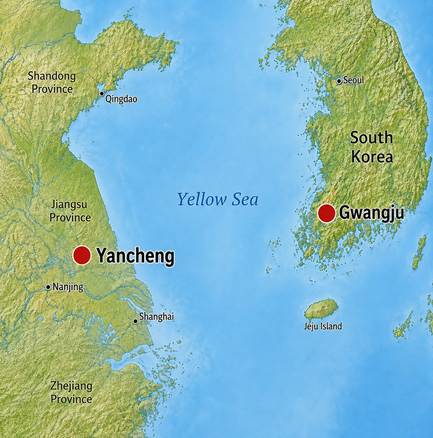
Sister City Yancheng, China, almost directly west of Gwangju. (GN with ChatGPT)
Yancheng is also renowned for its extraordinary wildlife, with centuries-old sea salt reserves. The city’s must-visit attractions include the UNESCO-listed Yancheng Red-Crowned Crane Wetland Ecotourism Area, home to one of the world’s most important wetland ecosystems. The China Milu National Nature Reserve provides a protected environment for once-endangered species to thrive. Also, within Yancheng’s city limits is included the enchanting Yellow Sea Forest Park, often described as a fairytale woodland, and the Dutch Flower Sea, a spectacular floral landscape inspired by the Netherlands.
Separated from South Korea by only a narrow stretch of sea, Yancheng’s relationship with Gwangju has become one of the strongest international city-to-city ties of any in China. Today, Yancheng is home to nearly a thousand Korean enterprises. Their presence has shaped a distinctly Korean-friendly environment, as the city’s dual-language road signs, with Korean alongside Chinese, welcome the international community. Even more surprisingly, Korean cuisine has become an integral part of Yancheng’s local food culture.
Back in May of 2017, the two cities signed their original international and friendship cooperation memorandum in Yangcheng, establishing their official “friendship-city” status. This protocol focused heavily on aligning Yancheng’s industrial needs with Gwangju’s friendly-with-China policy, targeting sectors like automotive manufacturing, renewable energy, and medical tourism. In February of 2025, a high-level delegation from Yancheng visited Gwangju City Hall to advance the framework from a friendship agreement to a full sister-city status. During the meetings, Zhou Bin, secretary of Yancheng, invited a Gwangju delegation to attend the 2025 China–Japan–South Korea Friendship Cities Conference in Yancheng. This visit to Gwangju culminated in the signing of the official Sister-City Cooperation Agreement during the Gwangju city delegation’s trip to the Yancheng conference in November, making Yancheng Gwangju’s eighth sister city.
In April 2026, a delegation from Yancheng visited Gwangju Metropolitan City and Namwon in South Korea for a series of cultural exchange activities. The delegation visited such Gwangju landmarks as the Asian Culture Center, the Namwon International Campus of Jeonbuk National University, and the Kim Byung-jong Art Museum. Both delegations benefited from learning how the latest developments in local-level opportunities existing presently in Gwangju could lead to further strengthening Gwangju–Yancheng cooperation in future exchanges regarding culture, education, and youth engagement.
“Yet perhaps Yancheng and Gwangju’s most meaningful connection lies in the people.”
What connects Gwangju and Yancheng goes beyond a formal sister-city agreement. One city, Gwangju, is looking toward the future through artificial intelligence, culture, and next-generation mobility; the other, Yancheng, is building its future on green industries, advanced manufacturing, and a unique coastal heritage shaped by the sea. Each aspires to benefit through cooperation with the other to further and more robustly build their futures.
Yet perhaps Yancheng and Gwangju’s most meaningful connection lies in the people who move between the cities for business development, education, culture, food, art, and everyday living. As exchanges continue to grow, the distance across the Yellow Sea becomes less of a physical sea boundary and more of a collaborative bridge.
From smart industries to artificial intelligence and from cultural heritage to innovative ideas, Gwangju and Yancheng are truly benefitting from each other, realizing how their proximity will allow for future cooperation to exponentially grow.
The Author
Li Aoding, originally from China, is a PhD student at Chonnam National University. She loves to lead a vivid life and cares about lives. She has lived in South Korea for more than seven years, and has four cats to keep her live happy.
¹ CC BY-SA 3.0, https://commons.wikimedia. org/w/index.php?curid=15227497
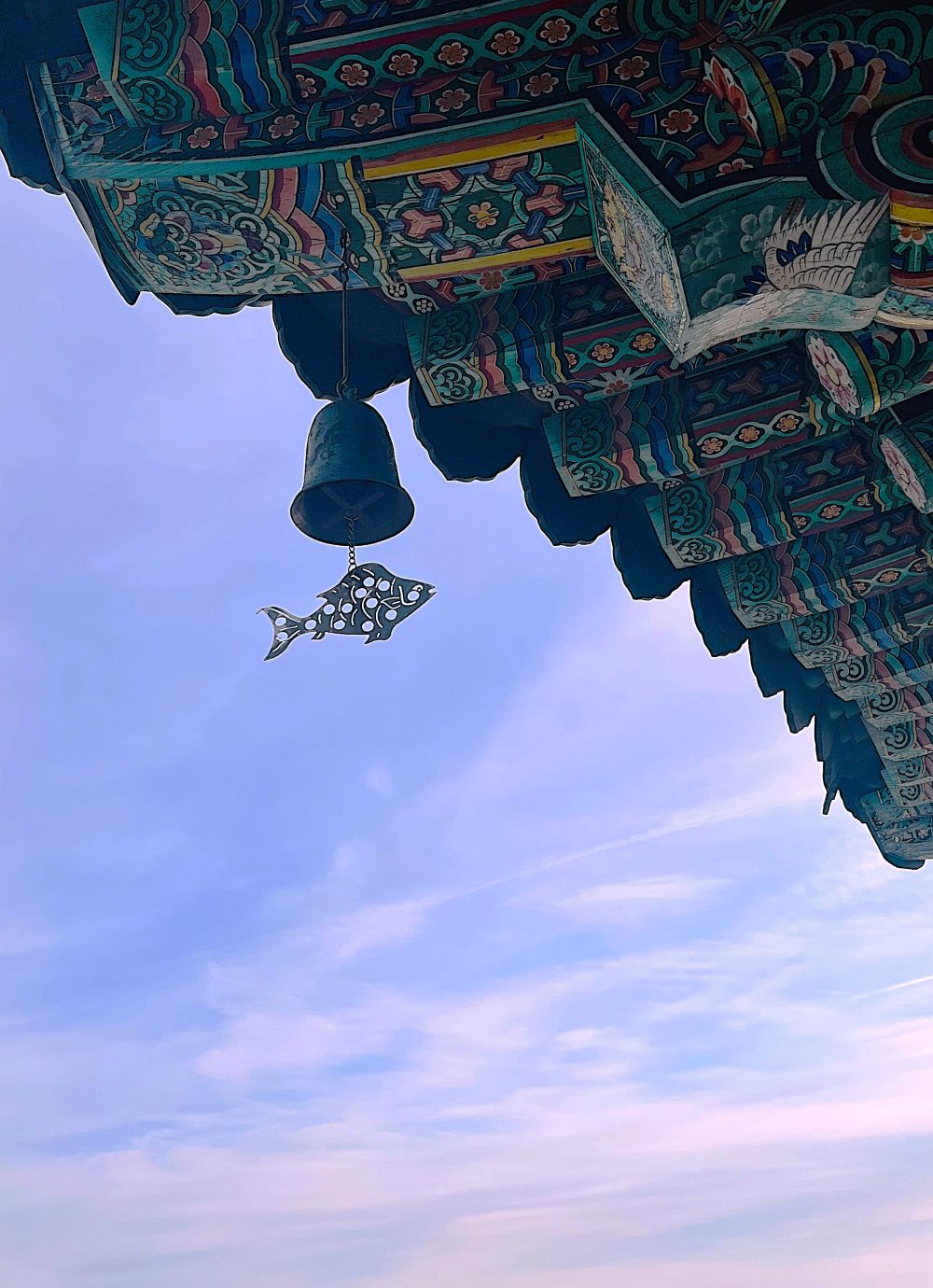
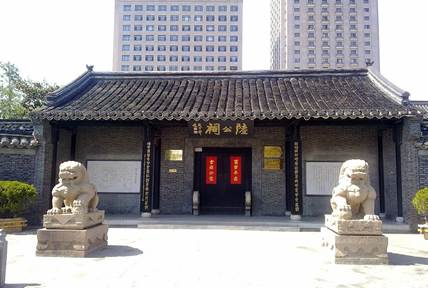
Cover Photo: Lu Xiufu Temple in Yancheng. (风之清扬¹)