



Martial Law Crisis in South Korea: Does the Past Help the Present? – May 2025
By Shin Gyeonggu
In December 2024, as South Korea faced a political crisis with the declaration of martial law by President Yoon Seok Yeol, the nation was confronted with a fundamental question posed by Han Kang, the recent Nobel Prize- winning author: “Can the past help the present? Can the dead save the living?” Han Kang, whose literary work has long explored the trauma and legacy of South Korea’s turbulent modern history, particularly the 1980 Gwangju Uprising, found her question answered in real time. The people’s resistance to the president’s attempted self-coup on December 3, 2024, offered living testament to the enduring power of historical memory and civic courage.
This article examines the martial law crisis of 2024, the mechanisms behind the attempted coup, the extraordinary civic and institutional response, and how the lessons and memories of the past – especially the Gwangju Uprising – shaped the outcome. Ultimately, it asks: Does the past help the present?
The Anatomy of a Crisis: Coup Preparation and Execution
South Korea, renowned for its robust democracy, was stunned when Yoon declared martial law in a televised address on December 3, 2024. Citing alleged “anti-state activities” by the opposition Democratic Party, Yoon suspended political activities, banned gatherings, and ordered the arrest of political opponents. The National Assembly building was surrounded by police and elite military units.
Yet, as shocking as the declaration was, history shows that self-coups – where a sitting leader uses emergency powers to override democratic institutions – rarely fail. Globally, such coups have a high success rate, with some studies suggesting up to 93 percent succeed, especially when military and police forces are thoroughly prepared and loyal. In this case, Yoon’s administration had meticulously planned for months: Loyalists were installed in key military and intelligence posts, special forces were mobilized, and lists of political opponents to be detained were prepared. The operation included (a) deployment of 500 police officers to surround the National Assembly building, (b) mobilization of elite military units, including the Special Mission Group and airborne brigades, (c) plans to seize the National Election Commission and detain opposition leaders, and emergency budget allocations and logistical preparations for mass detentions.
The Shadow of Gwangju
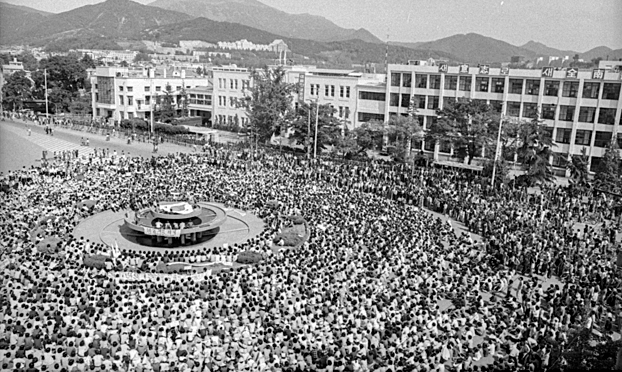
The martial law declaration was not without precedent. In May 1980, the military regime of Chun Doo-hwan brutally suppressed the Gwangju Uprising, killing and injuring hundreds of pro-democracy protesters. The trauma of Gwangju has haunted Korean society for decades, serving as both a warning and a rallying cry against authoritarianism. Han Kang’s novel Human Acts brought this history to a global audience, portraying the pain and resilience of those who suffered under martial law.
Resistance and Reversal: How the Coup Failed
Institutional and Civic Resilience: Despite the thoroughness of the preparations, the coup lasted only six hours. The sudden failure was due to a combination of institutional resilience and extraordinary civic action.
Swift Legislative Action: Within two hours of the declaration, 190 lawmakers – forewarned by internal networks and social media, especially by opposition leader Lee Jaemyeong – gathered at the National Assembly, risking arrest and violence. Despite military attempts to block their entry, they unanimously passed a resolution to annul martial law at 1:01 a.m. on December 4.
Military and Police Reluctance: Crucially, many military and police officers hesitated or outright refused to enforce orders. Some commanders delayed deployments, while others kept their units away from confrontation points. There were reports of soldiers learning of their mission only en route, and some expressed feelings of betrayal by their superiors. Lieutenant general Gwak Jonggeun evacuated his troupe from the Assembly without seeking the permission of his superiors immediately after the resolution. Colonel Jo Seonghyeon, commander of the 1st Security Group of the Capital Defense Command, stopped his unit from approaching the Assembly building. This show of insubordination may have definitely blocked the secondary coup attempt by Yoon.
Civic Mobilization: Ordinary citizens played a decisive role. Thousands gathered outside the National Assembly, physically blocking armored vehicles and forming human shields. Social media and messaging platforms enabled rapid mobilization and coordination, with citizens bringing food, supplies, and even strollers to support the demonstrations. The atmosphere was tense yet marked by acts of solidarity and even humor – protesters waved satirical banners. Citizens and soldiers, pushing each other, did not violently confront each other. A man who served in the special forces, disclosing his military service, admonished the martial law soldiers to behave themselves properly for democracy. All these strange confrontations coordinated to de- escalate tensions, ultimately causing the coup to fail.
Citizen Support and Solidarity: The civic movement after the annulment of martial law continued in a deeply communal way. Millions of people gathered to request a ruling by the Constitutional Court upholding impeachment. Some young people staged a so-called “kisses demonstration,” an outdoor sit-in demonstration even during snowy, freezing nights.
Some citizens provided food, warm clothing, and financial support to those on the front lines. Some people mobilized heater buses as a brief shelter to warm the bodies of demonstrators. Some provided a babysitting bus. The demonstration was not only serious but also fun with witty posters and cheering light sticks and K-pop songs.
The protests were marked by a spirit of mutual aid and determination, with families, students, and elders participating side by side. The sense of shared purpose and historical continuity was palpable.
The Power of Memory: Why did so many people risk their safety to resist? The answer lies in the living memory of Gwangju and subsequent democratic struggles. Han Kang, observing from abroad, noted the difference between 1980 and 2024: “I saw people trying to stop armored vehicles with their bodies, restraining armed soldiers by hugging them with their bare hands, and standing ground though soldiers were approaching with guns. When the troops were retreating, I also saw some elderly citizens shouting ‘goodbye’ as if they were talking to their sons.” The trauma of past state violence had become a source of collective resolve. Citizens and soldiers alike remembered the cost of silence and inaction.
“The past is not merely a shadow; it is a guide…”
The Role of Civil Society and the Rule of Law: The opposition Democratic Party and civil society organizations had anticipated the possibility of martial law. Lawmakers with military and intelligence backgrounds used their networks to gather information and prepare contingency plans. When the crisis erupted, these preparations enabled rapid, coordinated action, demonstrating the importance of institutional memory and vigilance.
Legal and Political Aftermath: Once martial law was lifted, the National Assembly moved quickly to initiate impeachment proceedings against Yoon. The Constitutional Court launched investigations into the legality of the martial law declaration, and several top officials resigned in protest or disgrace. The episode reaffirmed the importance of the rule of law and the independence of democratic institutions.
The Past as a Guide and a Warning: The martial law crisis of 2024 was a defining moment for South Korean democracy. It demonstrated that the past does indeed help the present – not as a distant memory but as a living force that shapes collective action and moral judgment. The memory of the Gwangju Uprising, kept alive through literature, education, and commemoration, provided both a warning against complacency and a source of inspiration for resistance.
Han Kang’s question, “Can the past help the present? Can the dead save the living?” was answered in the affirmative by the actions of millions. The sacrifices of 1980 were not in vain; they became the foundation upon which a new generation stood to defend democracy. The resilience of South Korean institutions and the courage of its citizens offer a model for other societies facing democratic backsliding and authoritarian threats.
As the Nobel Committee observed, “In her oeuvre, Han Kang confronts historical traumas and in each of her works exposes the fragility of human life…. She has a unique awareness of the connections between body and soul, the living and the dead.” The events of December 2024 proved that these connections are not just literary metaphors but vital threads in the fabric of a resilient democracy.
The lesson is clear: The past is not merely a shadow; it is a guide, a warning, and most importantly, a source of hope and strength for the present. South Korea’s experience shows that democracy is never guaranteed, but with vigilance, memory, and courage, it can be defended – even against the odds.
Photograph courtesy of MBC TV.
The Author
Shin Gyonggu has served the Gwangju International Center as its volunteer director for the past 26 years. He served as a professor for more than 30 years at Chonnam National University until his retirement in 2013. Dr. Shin is also the publisher of the Gwangju News.