

Chuseok FAQ: Your Holiday Questions Answered
By David Shaffer
Though it is considered one of the most important holidays in Korea, Chuseok’s origins and traditional practices are not widely known among the international community in Korea. This article of FAQs (frequently asked questions) hopes to make more transparent the particulars of this significant autumnal observance.
FAQ 1: Is “Chuseok” the same holiday as “Hangawi”?
Yes, “Chuseok” (추석, 秋夕) and “Hangawi” (한가위) are two different names for the same holiday. It is also often rendered in English as “Korean Thanksgiving Day.” I never really liked “Korean Thanksgiving Day” as a moniker for the holiday in question because adding “Korean” seems to suggest that whatever follows is not actually Korean. Also, Thanksgiving Day in the U.S. is a post-harvest celebration, whereas in Korea, it is a pre-rice-harvest observance. I much prefer “Harvest Moon Festival” as the English rendering, since it was the harvest moon – the biggest and brightest full moon of the last half of the year – to which supplications were offered for a bountiful harvest.
When I first came to Korea, “Chuseok” was the term is use. Since then, however, there has been a trend to use pure Korean terminology whenever an alternative is available. “Chuseok” is derived from Chinese characters (see above), while “Hangawi” is not. “Chuseok” is still the more common term is spoken language, but in writing both are common nowadays.
Over the centuries, this observance has gone by a variety of other names: Gabae (Silla Kingdom, 1st century C.E.), Gabae-il, Gawi (derived from “Gabae”), Jungchu (“mid-autumn”), Jungchu- jeol, and Jungchuga-jeol.
FAQ 2. Why does Chuseok occur on a different date from year to year?
It depends on your perspective. If your perspective is Gregorian (solar) calendar-based, Chuseok’s date will vary from mid-September to early October (on Oct. 8 this year). However, Chuseok follows the Oriental lunar calendar, where it is always on the 15th day of the 8th lunar month, which is always a full moon. Though the lunar calendar has twelve months like the solar calendar, the lunar year is usually a few days shorter. In order to recalibrate with the seasons, an extra month of 30 days is occasionally added to the lunar year, causing Chuseok’s solar calendar date to vary.
FAQ 3: What are the origins of Chuseok?
Chuseok’s beginnings most certainly date back to long before recorded history – back to early agrarian society where reverence was paid to that occasional large, bright orb appearing in the dark, night sky. With time, this developed into shamanistic ritual.
According to popular belief, the first official recognition of this observance took place during the reign of King Yuri of the Silla Kingdom in the early part of the 1st century C.E. The court in the capital organized a competition of two groups of womenfolk to determine which could weave the most cloth in 30 days. The event was known as “Gabae,” which later morphed into “Gawi,” and to this, “han” (meaning “great”) was later added, giving rise to “Hangawi.”
FAQ 4: How is Chuseok observed?
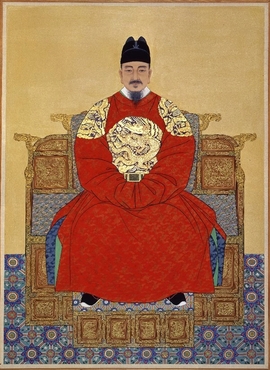
Present-day Chuseok traditions are rooted in the Neo-Confucianism of the Joseon Dynasty (1392–1910), where filial piety to one’s elders and reverence to one’s ancestors was paramount. In 1412, King Taejong performed a Chuseok rite at the gravesite of his father, Taejo, the founder of Joseon. In 1419, King Sejong made his first offerings to his father, Taejo, and a decade later, declared Chuseok as an important holiday. In 1504, King Yeonsan-gun performed rites at the graves of his ancestors, held a banquet for his senior ministers, and directed other ministry officials to “find a cool place to observe the moon” on Chuseok. The commonfolk soon followed suit, with extended families gathering for meals together and performing rites to their ancestors.
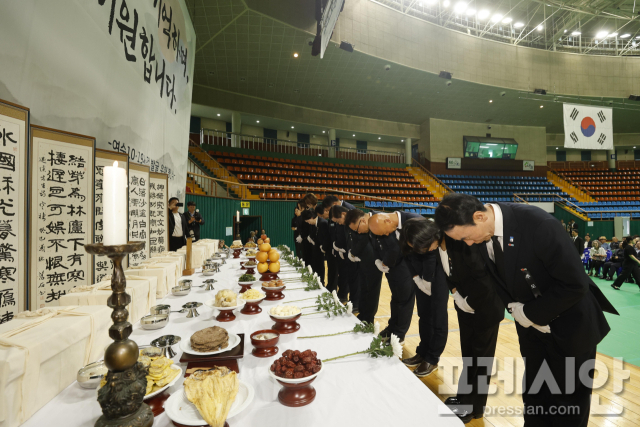
Charye – In the wee hours of Chuseok morning, extended family members would gather in the home of the head of the family to perform a rite offering a table of foods to their most recent departed generations of ancestors. This is charye, performed twice a year – on Chuseok and Seollal, the lunar new year’s day. Notable is the specified arrangement of the foods on the table: rice and soup placed to the north, fruits and vegetables to the south, meat dishes to the west, and rice cakes and drink to the east. These days, with family heads living in smaller homes – city apartments rather than more spacious countryside homes – fewer people can be accommodated at one time.
This means fewer people to prepare the foods for charye and fewer people to perform the rite.
Seongmyo – Later on Chuseok day, members of the extended family would trek to the mountain burial sites of one or more departed ancestors to present an offering of foods at the gravesite in a rite known as seongmyo. After bowing and paying they respects, the family members would often retrieve the foods for a brief picnic before making their way back to the home of the family head. Related to seongmyo is beolcho, a trip made to the ancestor’s hillside grave to cut the grass, remove unwanted materials, and make the graveside appear more presentable for the seongmyo rite. A small offering of food and drink was often offered on this visit also. Today, more and more interments take place in large cemeteries, where burials are made or cremated ashes are inurned, rather than at individual or family hillside plots. This has changed and simplified the nature of the seongmyo rite, making the visits shorter, with small groups of family members visiting separately.
FAQ 5: There are always special foods associated with Korean holidays. What are the ones associated with Chuseok?
There are a multitude of foods associated with Chuseok. Many appeared on the charye and seongmyo offering tables. Interesting, though, none of these foods contained the red pepper paste or red pepper powder that Koreans are so well known to love. This is apparently because it was believed that spirits feared red; for example, the king wore red robes to ward off evil spirits. And since family members wished to invite their ancestors’ spirits to the offering tables, they freed the foods of red.
Three representative Chuseok foods are songpyeon, yakgwa, and cheon.
Songpyeon – Chuseok isn’t Chuseok without songpyeon rice cakes. These steamed rice cakes are crescent-shaped or round and filled with beans, bean powder, adzuki bean paste, mugwort, chestnuts, or honey. They were originally white or green, but today they come in many colors, thanks to the availability of food coloring.
Yakgwa – This traditional confectionery is a sweet honey cookie made of fried rice-flour dough, formed into a flat, round shape with a flower design on it.
Jeon – These savory “pancakes” are made with a flour or egg batter and often contain vegetables, such as scallions, garlic chives, and even kimchi, and then skillet fried.
FAQ 6: Korean traditional holidays are also associated with games and entertainment. What are the main ones associated with Chuseok?
Representative Chuseok games and entertainment are jul-darigi, ssireum, ganggang- sullae, neol-ttwigi, and yut nori, among others.
Jul-darigi – This is a large-scale version of tug-of war. The long, thick rope is made of rice straw, with the two teams often being neighboring villages or east and west sides of the same village. The winning team is assured that their upcoming harvest will be bountiful.
Ssireum – Ssireum is a type of wrestling somewhat similar to Japanese sumo. Menfolk from different teams were pitted against each other in outdoor Chuseok tournaments. These tournaments live on today as made-for-television broadcasts, with the overall winner receiving a trophy with the figure of an ox on top. This is a remnant of the practice of originally awarding the winner a live ox.
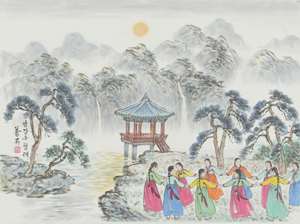
Ganggang-sullae – This combination of song and circle dance was performed by the womenfolk of the village under the light of the Chuseok full moon. It originated along the south coastal area of Jeollanam-do and is said to have been used by Admiral Yi Sunsin as a deceptive tactic in his battle with the invading Japanese fleet.
Neol-ttwigi – This form of “see-saw jumping” was enjoyed mainly by girls. The equipment consisted of a wooden plank and a rolled-up straw bag as the fulcrum. One girl would stand on each end of the plank to see who could jump the highest.
Yut Nori – This board game today consists of a small paper or rubbery playing board and sticks to serve as dice. The game, however, has shrunk is size and popularity from the time I saw it played in the countryside decades ago – not by children but by the menfolk. They rolled out a large, two-meter-square straw mat with the yut playing board marked on it. The wooden sticks were rather short and stubby; the playing pieces were somewhat rounded stones. And of course, the game involved gambling and drinking.
FAQ 7: Is the traditional Korean hanbok worn on this traditional Korean holiday?
Yes, and no. When I came to Korea, the hanbok was commonly worn among adults – particularly on traditional holidays, though more commonly among older adults and more commonly among women. As wedding attire for both bride and groom has shifted from away from hanbok to Western-style suit and wedding dress, fewer people had their own hanbok to wear. Today, however, Western-clothed parents often clothe their young children in colorful hanbok to allow the traditions of Chuseok to live on.
The Author
David Shaffer, PhD, has spent more than 50 Chuseok holidays in Gwangju. He has eaten more than his share of songpyeon rice cakes and consumed more than his share of Chuseok libations. Dr. Shaffer is the author of Seasonal Customs of Korea (2007, Hollym) and is the editor-in-chief of the Gwangju News.
Cover Photo: Ganggang-suwollae by Lee Eok-yeong. (National Folk Museum of Korea)