






Korea Is on Fire, and the Records Prove It
By Siddhant K. ||
How a peninsula that kept weather logs for over a century is shattering them one by one.
Imagine keeping a daily weather diary for your entire life, from the moment you were born until today. Every summer heat, every cool autumn breeze, every winter freeze, all recorded faithfully. Now imagine that the last couple of years in that diary are the most alarming pages you have ever written. That, in essence, is the story South Korea’s meteorologists found themselves telling after 2024.
South Korea has been keeping official temperature records since 1907, more than 117 years of data. That long history is exactly what makes the recent numbers so striking. In 2024, the country did not just have a hot summer. It broke nearly every significant heat record in the books, all at once, in a single year.
“Korea is warming roughly twice as fast as the world as a whole.”
The Numbers Behind the Heat
According to the Korea Meteorological Administration (KMA), the national average temperature in 2024 was 14.5°C. That might not sound alarming on its own, but consider this: The long-term average for previous years was around 12.5°C, meaning 2024 ran 2°C hotter than the historical norm. For climate scientists, a gap of 2°C is not a minor variation. It is a loud, unmistakable signal.
What made 2024 especially extraordinary was the back-to-back nature of the record-breaking. The year before, 2023, had set the record with an average of 13.7°C. Then 2024 came along and smashed even that. Two consecutive record-hottest years: It is the kind of sequence that makes climate scientists reach for words like “unprecedented.”
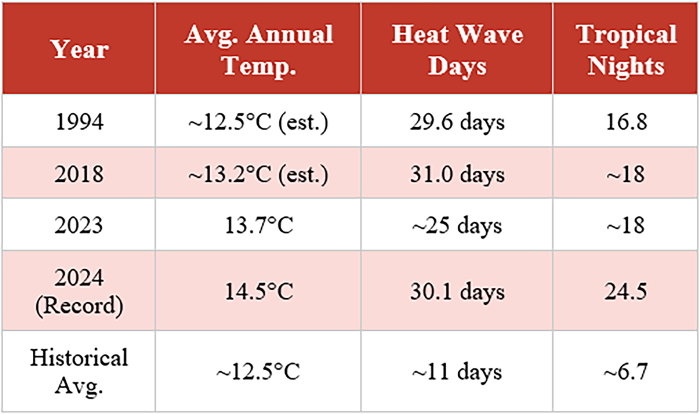
Key heat statistics for South Korea’s notable hot years vs. historical averages. Source: Korea Meteorological Administration (KMA).
Nights That Won’t Cool Down
Beyond just daytime highs, the nights themselves have been changing worryingly. Meteorologists use a term “tropical nights,” evenings where the temperature never drops below 25°C between 6 p.m. and 9 a.m. the following morning. Think of it as a night too hot to sleep comfortably, even with the windows open.
In 2024, South Korea recorded an average of 24.5 tropical nights, nearly 3.7 times more than the historical average. Seoul experienced 34 straight tropical nights. The island of Jeju, in the country’s south, endured an almost unimaginable 47 consecutive tropical nights starting from mid-July. That means for nearly seven weeks, the temperature on Jeju never truly fell to a comfortable level after sunset.
These are not just inconveniences. Medical experts warn that when nights stay hot, the human body never fully recovers from the day’s heat stress. For elderly people, young children, and anyone with a heart or lung condition, prolonged tropical nights can be genuinely dangerous.
A Century of Slow Creep, Then a Sprint
Korea’s heat problem is not entirely new. Over the past 100 years, the peninsula’s average temperature has risen by approximately 1.5°C. That is already higher than the global average increase of around 0.74°C over the same period, meaning Korea has been warming roughly twice as fast as the world as a whole.
For most of that century, the change was gradual. People adapted, largely without noticing. Summers got slightly longer; winters got slightly shorter. Cherry blossoms began blooming a few days earlier each decade. The heat was creeping up but slowly enough that it felt normal.
Then, in the last decade or so, the pace accelerated. The three hottest summers on record, 1994, 2018, and 2024, each broke the record for the one before it. The all-time single-day temperature record for the entire Korean Peninsula was set on August 1, 2018, when the town of Hongcheon in Gangwon Province hit 41°C (nearly 106°F). On that same day, Seoul itself reached 39.6°C, breaking its own record of 38.4°C that had stood since 1994.

(GN with OpenAI ChatGPT)
Why Is This Happening?
Climate scientists point to several interlocking causes. The most fundamental is the global build-up of greenhouse gases, carbon dioxide and methane released by burning fossil fuels, which trap heat in the atmosphere worldwide. But local factors in and around Korea are amplifying the global trend.
The sea surface temperatures around the Korean Peninsula have been rising dramatically. In 2024, the average sea surface temperature was 18.6°C – 1.3°C above the 10-year average. In September, ocean temperatures hit 27.4°C, a full 3.2°C above normal. Warm seas pump extra moisture and heat into the air, creating conditions that allow heat waves to linger far longer than they otherwise would.
Meteorologists also note that large atmospheric pressure systems, the Tibetan High and the North Pacific High, have been combining in new ways, essentially “locking” hot air over the peninsula for extended periods. It is a pattern seen in 1994, 2018, and 2024. Each time it happens, the results are more severe than the last.
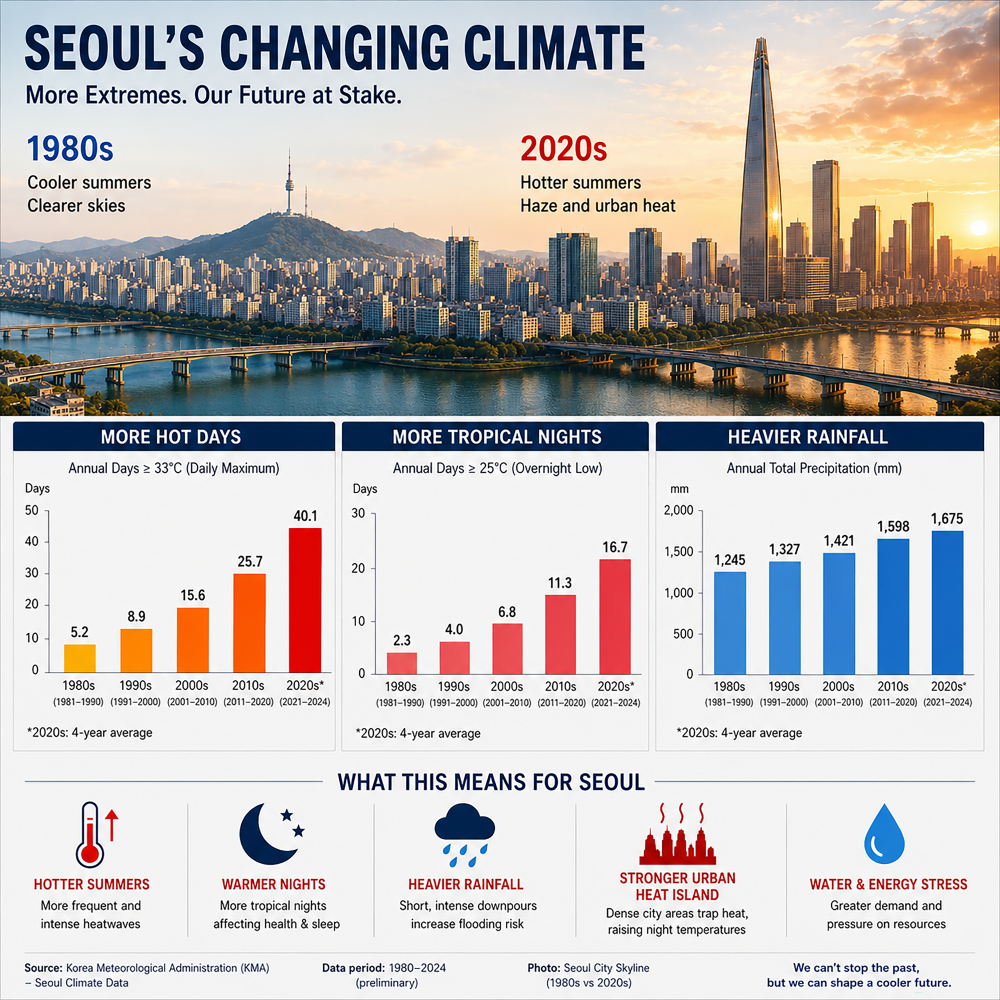
(GN with OpenAI ChatGPT)
What It Means for Everyday Life
The effects are not just about discomfort. In 2024, prolonged extreme heat damaged up to 3,477 hectares of farmland and 17,732 hectares of rice paddies across the country, a blow to farmers and food supplies alike. South Korea’s agriculture, which is already under pressure from an ageing rural workforce, is increasingly at the mercy of weather extremes.
“For climate scientists, a gap of 2°C is not a minor variation. It is a loud, unmistakable signal.”
For city dwellers, the heat concentrates in urban neighborhoods where concrete and asphalt absorb and re-radiate warmth, a phenomenon known as the “urban heat island” effect. In some parts of Seoul on the hottest days of 2024, all of the capital was simultaneously under a heat wave warning, something that had not happened so late in the season since the heat warning system was introduced in 2008.
Public health concerns are mounting, too. Research published in scientific journals projects that if current trends continue, heat-related deaths in South Korea’s major cities could reach between 500 and 2,320 additional deaths per year by the latter half of this century, depending on how aggressively the world addresses climate change in the decades ahead.

(UNFCCC)
What the Future Holds
The KMA’s own long-term analysis, tracking records from 1973 to 2024, shows a clear and accelerating trend: Heat wave days are increasing, cold wave days are decreasing, and the extreme events at either end of the thermometer are becoming more extreme. If global greenhouse gas emissions continue at their current pace, scientists warn that the kinds of summers Korea experienced in 2018 and 2024 could become routine rather than exceptional.
Sea levels along South Korea’s coastline have already risen about 10 centimeters over the past 40 years, at an average rate of 2.4 millimeters per year. Coastal cities and low-lying agricultural areas face a growing risk from flooding, especially when intense summer rainfall, which is also increasing, coincides with higher sea levels and storm surges.
The World Meteorological Organisation, in its global review of 2024, specifically flagged South Korea as having experienced its hottest summer on record. Korea’s heat story, in other words, is not invisible to the international scientific community. It is being closely watched.
Sources
Byers, E., Malessane, H., Gasparini, P., Rubinyi, S., Tye, M., Satoh, Y., Kahil, T., Tang, T., Burek, P., Gronlund, C. J., Burrows, M., & Izquierdo, L. (2021). G20 climate risk atlas: Impacts, vulnerabilities, and risks – Republic of Korea. International Institute for Applied Systems Analysis. https://www. g20climaterisks.org/republic-of-korea/
Choi, G., & Kwon, W. T. (2020). Changing human-sensible temperature in Korea under a warmer monsoon climate over the last 100 years. International Journal of Biometeorology, 64, 1287–1303. https://doi.org/10.1007/s00484-020-01862-8
Cho, H. (2025, January 9). 2024 was S. Korea’s hottest year on record: KMA. The Korea Herald. https://www.koreaherald.com/article/10386717
Cho, H. (2025, April 1). 2024 recorded as South Korea’s hottest year in half-century. The Korea Herald. https://www.koreaherald.com/article/10455476
Climate change in South Korea. (2025, December 5). In Wikipedia. https://en.wikipedia.org/wiki/Climate_change_in_South_Korea
Climate Reality Project. (2023, August 14). How the climate crisis is impacting South Korea. Blog. https://www.climaterealityproject.org/blog/how-climate-crisis impacting-south-korea Erdman, J. (2018, August 2). Hottest day in Korean history. Weather
Underground. https://www.wunderground.com/cat6/Hottest-Day-Korean-History
Korea Meteorological Administration. (2025). Annual climate report 2024. Republic of Korea Ministry of Science and ICT. https://www.kma.go.kr
Lee, J. (2025, July 31). Is South Korea on track for its hottest summer yet? The Korea Herald. https://www.koreaherald.com/ article/10543222
Lee, W., Bell, M. L., Gasparrini, A., Armstrong, B. G., Sera, F., Hwang, S., & Hong, Y. C. (2014). The impact of climate change on heat-related mortality in six major cities, South Korea, under representative concentration pathways (RCPs). Frontiers in Environmental Science, 2, Article 3. https://doi.org/10.3389/fenvs.2014.00003
National Institute of Environmental Research, Ministry of Environment, Korea. (2010). Climate change in Korea: Observations and projections. Ministry of Environment.
World Meteorological Organization. (2025). Significant weather and climate events 2024. https://wmo.int
Yoon, M. (2025, July 31). Seoul hit with longest nighttime heat wave ever for July. The Korea Herald. https://www.koreaherald.com/ article/10543952
The Author
Siddhant Kumar is a geochemical oceanographer and researcher at TMBL at the Gwangju Institute of Science and Technology (GIST). His work focuses on marine minerals, sediment chemistry, and paleoenvironmental change. He is passionate about communicating ocean science to broader communities in Korea.
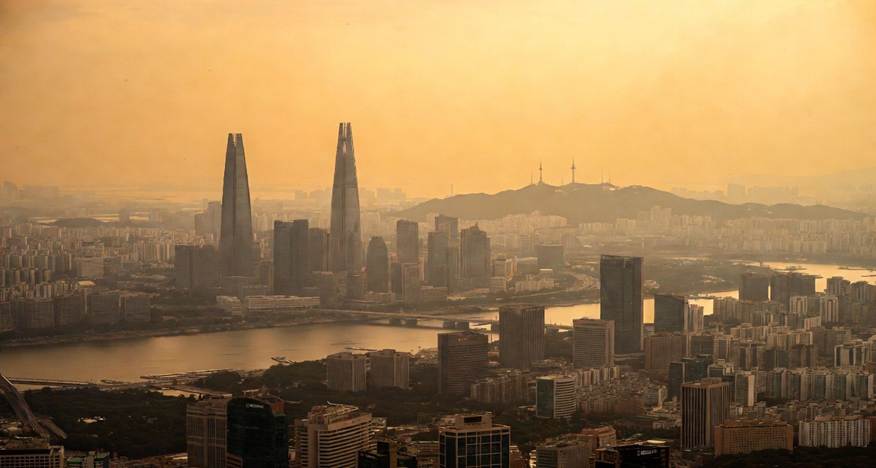
Cover Photo: Seoul skyline imagined under future extreme heat and temperature. (GN with xAI Grok)