



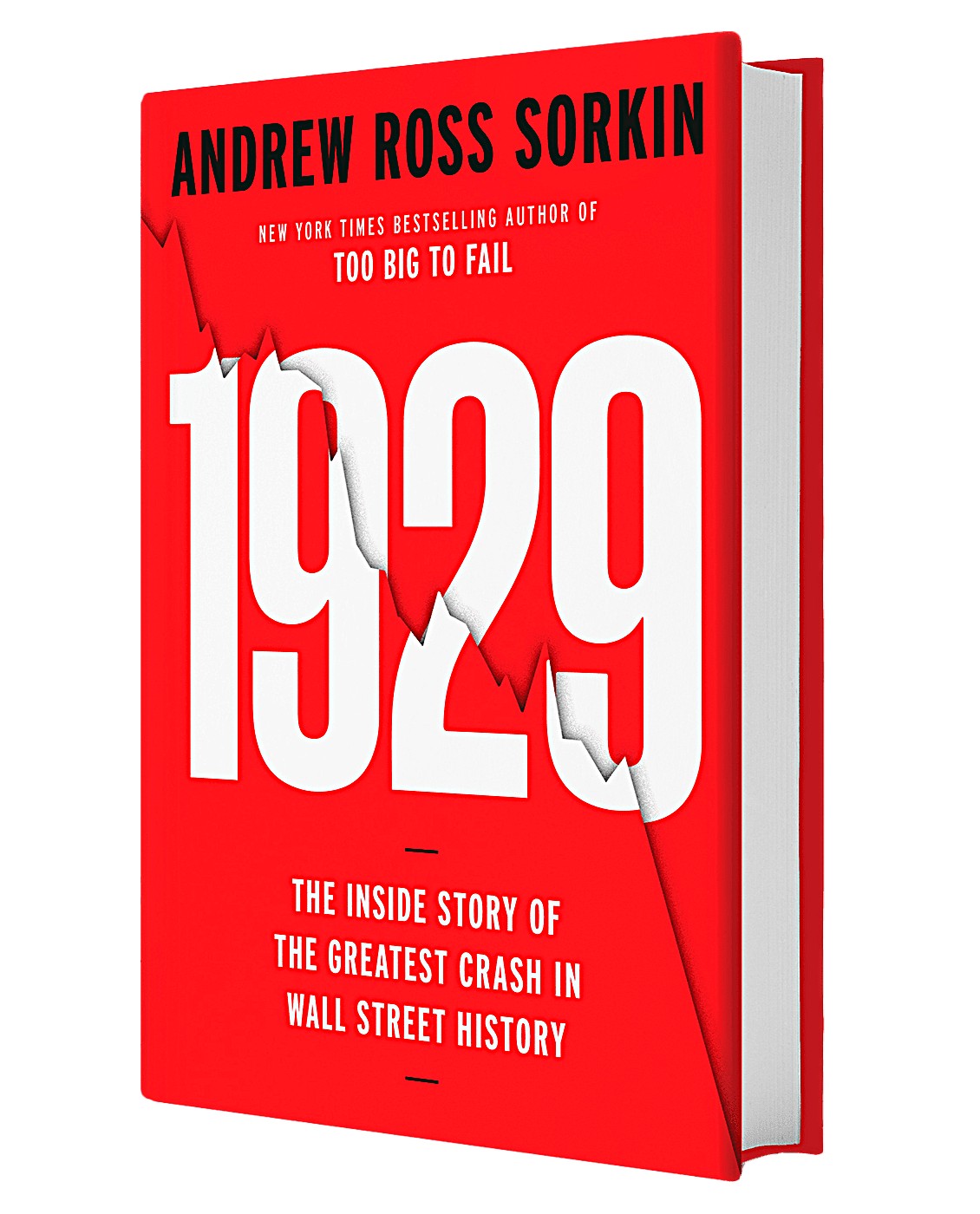




1929
Reviewed by Michael Attard ||
1929: Inside the Greatest Crash in Wall Street History – And How It Shattered a Nation
By Andrew Ross Sorkin
567 Pages, Viking Press, 2025
Many people will see the title and immediately think of the great stock market crash. For others this is simply a date, almost 100 years ago. Either way, Andrew Ross Sorkin in his book 1929 tells the story of a financial crisis that not only had serious consequences for everyone at the time but still reverberates within the modern Western financial system. Thus, this historical narrative told in an easy-to-read style can enlighten, advise, and warn those without money or interest all the way to those who think their financial wealth is untouchable.
In essence, the story of 1929 needs to be understood with respect to preceding events, and like all great stories, there is the what-happened-after. The author explains both by sticking to the main themes and characters, not allowing the minutia of detail to bog down the clarity of events and consequences.
There is a long list of characters, and they are all painted with the same brush and strokes. While their ideas and activities broadly vary, the author does not ascribe to anyone, strength or failures of moral character, selfishness, or prejudice of any kind. The author has a story to tell, and he does not lead the reader to any preferred conclusion or judgement.
It is the characters who make this book most appealing in my view. There are the business leaders, stock brokers, speculators, members of the government, including presidents Herbert Hoover and Franklin Roosevelt. There are members of the Federal Reserve, investigators, economists, and the journalists. Each plays an important and intricate roll in telling the story of how the great crash of 1929 came to be, and how it forever changed finances and economies.
For simplicity, the one date of Tuesday, October 29, also known as Black Tuesday, is pointed to as the day of the crash. The crash actually took place over several days, but Black Tuesday was the most devasting day of the panic. A record number of shares were traded and the market completely collapsed. Billions of dollars of wealth were erased and motion toward worldwide depression was inexorable.
“When it comes to the actual causes of the crash, Sorkin is lenient in affixing blame.”
Charles Mitchell, president of National City Bank, believed in the power of borrowed money, and this was exemplified in his actions. Mitchell aggressively expanded lending to investors. He viewed investing in the stock market with borrowed funds as a legitimate way to build wealth. Often only a small percentage of a stock’s purchase price was paid in cash. Mitchell never changed his tune. At a Senate investigation, where he was accused of encouraging speculation, Mitchell argued that credit and securities were integral to economic growth. The role of borrowed money in the markets is a major theme of the book.
At total odds with Charles Mitchell was the senior senator from Virginia, Carter Glass, who in 1929 was already 71 years old. And one of his passions was the banking system. Glass believed that the actions of Mitchell, and others like him, and the Federal Reserve itself “amounted to malfeasance.” Glass referred to Eastern bankers as “money devils.” His “core belief was that Wall Street speculators did nothing to help the country’s economy but rather siphoned off capital that should go to building manufacturing plants and providing jobs.” The author does a tremendous job of breaking down the conflict into easily discernable parts. And while incorporating the struggle into the views of historical figures, the crisis of 1929 comes alive to the reader as the animated characters shine larger than life.
The worst came after 1929. “Stocks ended 1930 down by a third for the year, then fell by half the following year. The collapse … was a relentless unraveling.” Interestingly, in hindsight now, some of the actions taken after the collapse can be seen as having been detrimental to the reviving of the economy. “Midway through the summer of 1930, Washington was still running a budget surplus…” But calls for public spending went unheeded. Tariffs were introduced “to an average of nearly 60% … Hoover had reservations about the bill… But in the end, it came down to the heartland versus Wall Street, and he [Hoover] knew which side he owed his political debts to.”
When it comes to the actual causes of the crash, Sorkin is lenient in affixing blame. “Could the 1929 crash have been avoided? The short answer is yes.” But “the long answer is that it would have taken almost divine prescience to look beyond the short-term incentives for making money and focus instead on the long-term consequences.” It should be noted that in a criminal trial, Mitchell was found not guilty of income tax evasion. Although the government pursued him in a civil tax fraud proceeding and recovered substantial taxes and penalties.
Rather, the author is sanguine. He reminds us “No cities were bombed or torched in the fall of 1929, and no armies marched on Washington. There were no revolutions or attempted assassinations.” In fact, probably the simplest answer as to what happened in 1929 is human nature. People like to believe that the good times will last forever. “They will dress up hope with certainty.” The antidote: “humility.”
The Reviewer
Michael Attard is a Canadian citizen but has lived in Gwangju for over twenty years. He has taught English as a second language in academies and within the public school system. He is officially retired and spends time reading, writing, hiking, and spending time with friends.
Michael has informed us that this will be his last book review for the Gwangju News. We are deeply grateful to Michael for the dozens and dozens of reviews that he has provided to the Gwangju News over the years. — Editor
Cover Photo by Penguin Random House.