




A Room, a Desk, and a Forest: Finding Time to Write in Wonju
By Reeti Roy ||
Virginia Woolf arrived at what sounds like a rather prosaic conclusion in A Room of One’s Own: If a woman was to write fiction or poetry, she needed “five hundred a year and a room with a lock on the door.”
I have been thinking about this since arriving in Wonju. I have the room, the key, the desk, and the forest.
This is my second Korean life this year. Earlier, I was here as a language student at Yonsei University, with the structure that comes with classes, schedules, attendance, and vocabulary lists, and the daily negotiations of inhabiting a language that is not your own. Now I have returned under entirely different circumstances. I am here as a writer. There is no classroom, attendance sheet, or syllabus telling me what to do with the next few hours. There is simply a room, a desk, and time.
At Yonsei, every sentence had to be constructed with a certain defensive correctness. You learned where to put the particles, how to mark the subject, and how to make your intentions legible to an instructor with a red pen. You were begging the language to let you in. But here at the Toji cultural center, the grammar changes. No one is grading the syntax of my thoughts. The forest doesn’t care about particles. The language required here is not about correctness so much as endurance: finding the precise, unhurried shape of a sentence that has survived the journey across two versions of yourself.
The desk is remarkably prepared for a writer: large, pale, and uncluttered, with a lamp, notebooks, pens, and water. Everything seems to have been arranged by someone who understands what a writer might need and has decided not to interfere further.
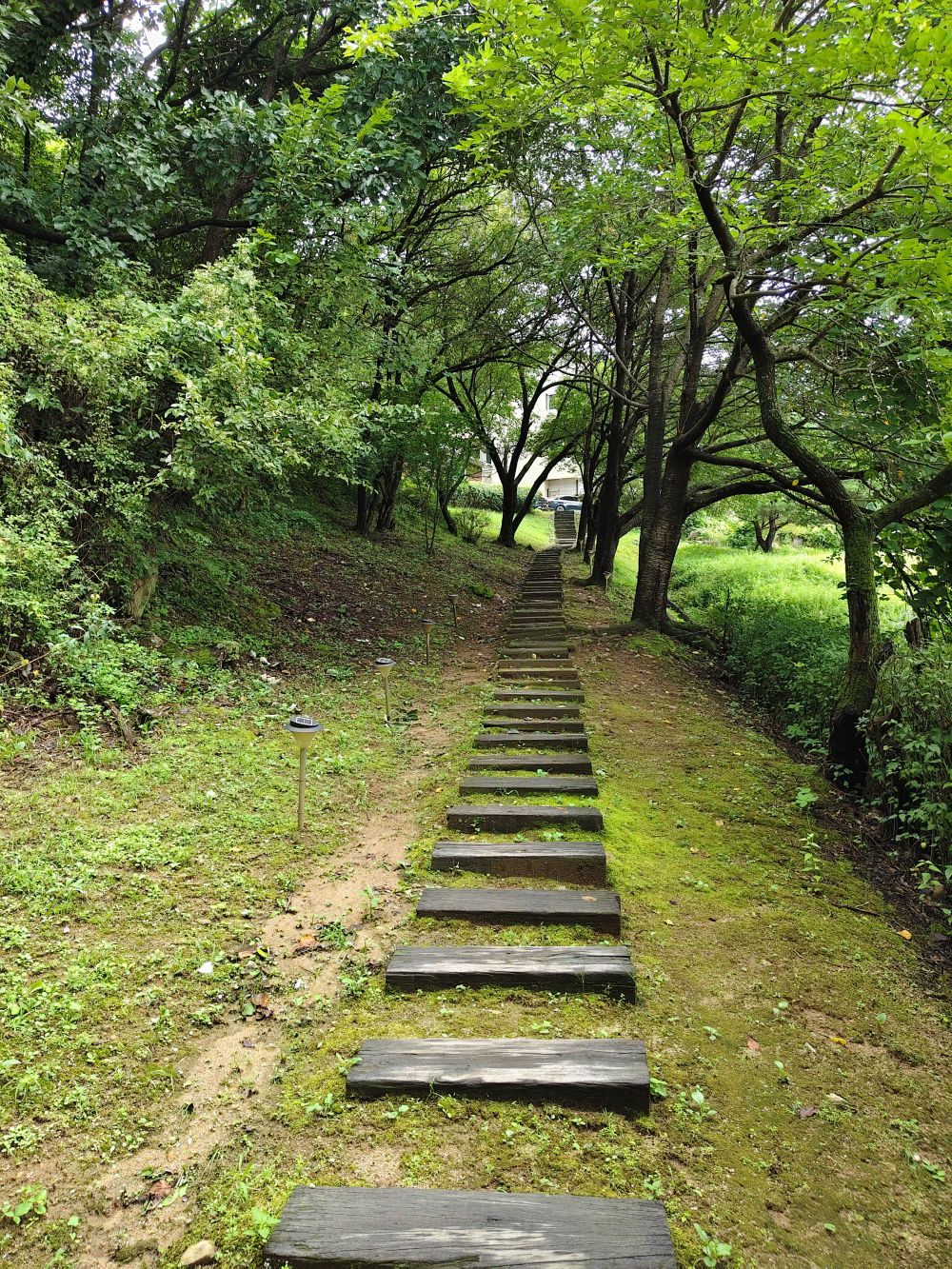
Beyond it are trees. Not the decorative kind planted at respectable intervals in cities, but trees left largely to their own devices. They climb over one another, lean at improbable angles, make dense green ceilings, and allow the occasional shaft of light through. Paths disappear into vegetation; beyond them are clearings and hills.
The forest is not silent. Cicadas shrill from the trees, frogs and toads call from somewhere beyond the paths, and the occasional rustle in the undergrowth makes you wonder whether you have encountered a snake. There are also onggi (옹기), the large Korean earthenware jars used to ferment and store doen-jang (된장, bean paste), gochu-jang (고추장, red pepper paste), and soy sauce. They sit around the grounds, rounded, brown and almost impossibly patient.
I like them. Perhaps because they seem to understand something about time that writers routinely forget: Some things cannot be hurried into becoming themselves.
I have only just arrived at Toji and am still adjusting to another time zone. Fixed mealtimes give the day a pleasant structure. There is enough routine to keep time moving but not so much that the day disappears into obligations. Freed from some of its usual clutter, my mind has started doing what I came here hoping it would do: thinking about stories.
Plots appear in fragments. An idea suggests another idea; something I have read returns, or something I saw years ago suddenly seems useful. I walk through the grounds, notice the trees and the light, return to my room, and think some more. I am, in other words, writing before I am writing.
There is something lovely about being surrounded by other writers while this happens. We pass each other on stone paths or nod over coffee, each carrying private ghosts and half-finished chapters, guarding our silence as if it were a fragile vessel. We do not need to ask what the other is working on. The air is heavy with the understanding that much of the day’s work happens behind closed doors, where sentences quietly refuse to behave.
One of the other writers made coffee and sat down to talk with me about their writing. It was a small thing but immediately familiar: the pleasure of speaking to someone who understands that a conversation about a half-formed story can be
a perfectly legitimate use of an afternoon. You can simply say, “I am thinking about this,” and someone understands.
Perhaps this is another version of Woolf ’s room. The room is physical, certainly, but the conditions around it matter too: the freedom to think, the presence of other people who are thinking, and the possibility of following a thought simply because it interests you.
For most of my adult life, my days have been organized around usefulness. There is always something to deliver, someone to reply to, an application to complete, a client to attend to, a class to prepare, an institution to write to or a project to move forward. Work multiplies around you when you are willing to do it.
A residency interrupts that machinery. It does not necessarily tell you what to do instead. It simply gives you time.
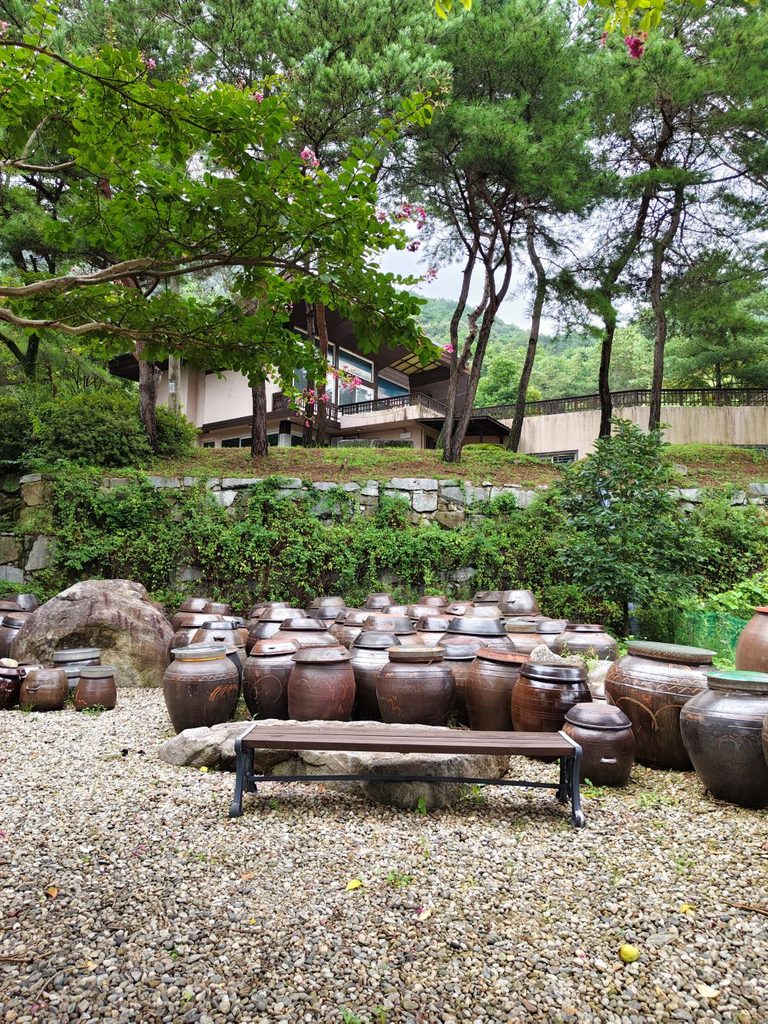
Onggi jars arranged in the garden.
Annie Dillard writes in The Writing Life, “How we spend our days is, of course, how we spend our lives.” I have always understood that sentence intellectually. It feels different when you are handed a day with very little prescribed inside it. What do you do with time that is not already spoken for?
For me, the answer is to think, walk, talk, listen to the forest, think about stories, and eventually write.
The landscape here feels significant for another reason. Toji is not simply a convenient place in which writers happen to be housed. It is closely associated with Park Kyongni, whose great novel Toji, meaning “land,” turned Korea’s history and upheavals into an enormous meditation on people, place, dispossession, and survival. Even the name seems to ask something of you.
I have been thinking about land since arriving here. There is a particular way of traveling that treats a place as a resource. You arrive, look, photograph, write about it, collect interesting people and details, and leave with a story. The place becomes material, the people become characters, the landscape becomes atmosphere. Writers are particularly good at this kind of extraction because we can make it look like attention.
I don’t want to write that way. If a place gives you something, I think you have to ask what you are giving back. Not in some grand or sentimental sense. A writer cannot repay a forest for being beautiful, or a city for allowing her to walk through it. But there is an ethical dimension to paying attention. You can arrive somewhere intending to take from it, or arrive willing to let it alter you.
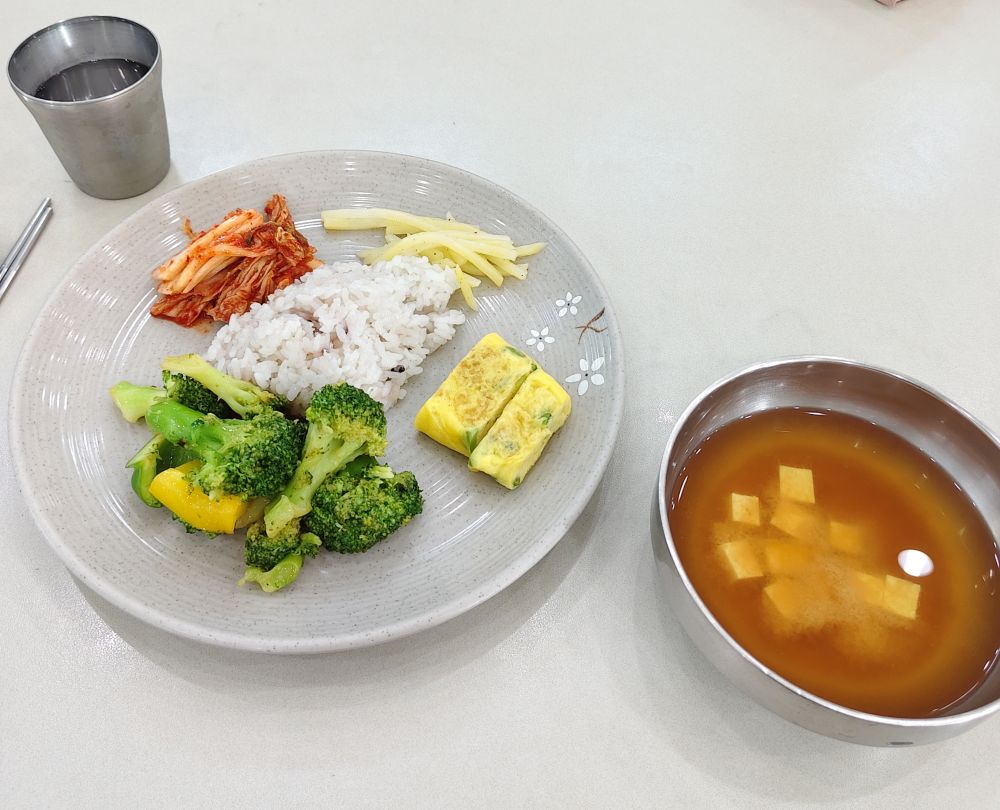
Freshly prepared meals for the Toji residents.
I don’t want Korea to exist in my work merely as a backdrop against which I can place myself. Nor do I want to collect it as one more credential, one more country visited, one more interesting chapter in an itinerant life. I want to pay attention long enough for the place to become more complicated than my first impression of it. That means noticing what does not fit my narrative, listening to people rather than simply turning them into material, and allowing another culture to resist being explained too quickly.
Writing itself may be a form of relationship. You take something in, you are changed by it, and then you try to make something worthy of what you have received.
That feels particularly important at Toji. Park Kyongni spent decades making a vast imaginative world from land, history, and human lives. The foundation that bears her name now gives writers a place from which to make their own work. There is something almost circular about that: One writer’s labor has become another’s shelter.
The responsibility of being here is not simply to produce something while I have the opportunity. It is to remember that I am a temporary inhabitant. The room and desk are mine for a while; even the path through the trees is mine only in the sense that I am passing through it. The land was here before me. It will remain after I leave.
There is also a mythology around residencies in which a writer arrives in a beautiful landscape and immediately becomes the most disciplined version of herself. She wakes at dawn, walks through the forest, returns to the desk, and produces several pages of luminous prose before breakfast. I am suspicious of this mythology. Writing is rarely so obedient.
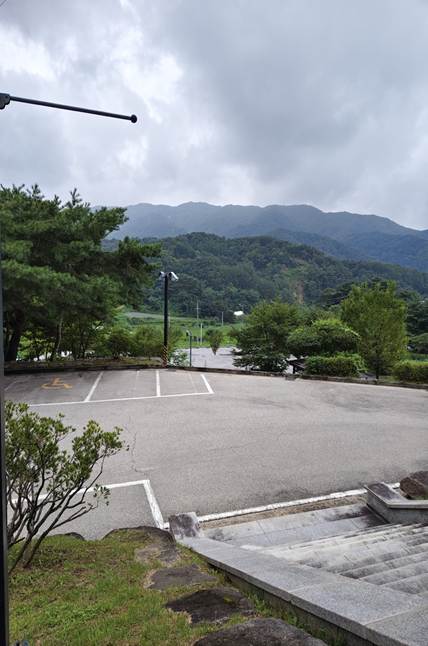
The mountains overlooking the Toji Cultural Center.
Sometimes the work begins long before the document is opened. A plot forms while you are walking; a character arrives while someone is talking about their own work; a sentence occurs over lunch. An idea can spend three hours apparently doing nothing and then suddenly become useful. The point of having a room of one’s own may not be that one must spend every hour inside it. It may be that, for once, the hours belong to you.
Woolf ’s room was never merely about interior decoration or solitude. It was about having the material conditions to think, work, and make something without the constant demands of other people determining the shape of your day.
A century later, I find myself in a room in Wonju with a key in my hand. Earlier this year, I came to Korea as a student. Now I have returned as a writer. There is something pleasing about that symmetry. The country has not changed itself for me; I have simply arrived with a different question.
A room does not give you a book. A desk does not give you a sentence. A forest does not necessarily give you inspiration. But they can give you something rarer: time in which to find out what is already waiting inside your head.
For now, I have a key, a desk, and the forest. There are other writers drinking coffee and talking about their work, fixed meals and unfamiliar hours, plots beginning to take shape, cicadas, frogs, toads, and the occasional suspicion of a snake. There are onggi quietly holding their contents, allowing time to work on something. And there is land beneath all of it, carrying histories that existed long before I arrived.
Perhaps the task is not to extract a story from this place and carry it away. Perhaps it is to let the place leave something in me first. Then whatever I make from it should be worthy of having been given the time.
⁂ This work was written as an overseas artist in residence at the Toji Cultural Center with the support of the Toji Cultural Foundation and the Wonju Metropolitan Government of the Republic of Korea.
The Author
Reeti Roy is a writer, educator, and founder of Aglet Ink, and a Toji Cultural Foundation overseas artist in residence. She holds degrees from Jadavpur University and the London School of Economics and works across writing, research, and education. Her journalism and essays explore culture, identity, work, and the intersections between people and place.
(Photographs by the author)
Cover Photo: The forest path leading to the dining area.