


From Gwangju to London: Fermenting a Future from Food Waste
By Vibhanshu Maurya ||
To most people, a pile of discarded cauliflower leaves looks like waste. But Rebecca Ghim saw the beginning of a recipe. Thousands of kilometers from Gwangju, where she grew up surrounded by kimchi, she began asking whether the fermentation knowledge she once took for granted could help solve a very modern problem: what to do with perfectly edible food that nobody wants to buy. That question eventually led to The Ferm, the London-based company she now runs with her German co-founder, Maylin Stanic.
Growing up in Gwangju, Rebecca never thought of kimchi as anything unusual. “Every meal had kimchi, and there was never just one kind,” she recalls. Kimjang, the tradition of preparing large quantities of kimchi together, meant family and community – and, as Rebecca remembers with affection, grandmothers gathering and arguing over the right ratios and flavors. At the time, it was simply part of everyday life. It was only after leaving Korea that she began to notice how much knowledge was contained in what she had taken for granted: preservation, seasonality, fermentation, sharing, and adapting recipes to what was locally available.
“Sometimes you need distance from your own culture to understand what you’ve inherited,” Rebecca says. Years later, while studying Design for Social Innovation and Sustainable Futures at the University of the Arts London (UAL), those childhood experiences began to connect with a very different concern: food waste. She became interested in food waste, particularly edible parts of vegetables that disappear from the food system simply because there is little demand for them. At the same time, she began looking differently at the food traditions she had grown up with.
Fermentation had long been a way of preserving abundance and working with what was available seasonally.
That was when the idea behind The Ferm began to take shape: Could fermentation turn overlooked vegetables into something people genuinely wanted to eat? For Rebecca, however, sustainability alone was not enough. “It had to be genuinely delicious first,” she says. “The sustainability story should make you love it more, but it shouldn’t be the reason you tolerate a product.”
Finding Value in What Gets Left Behind
At first, The Ferm was more experiment than business. Rebeca tried different vegetables, recipes, and fermentation methods, figuring out what worked – and what did not. Cauliflower leaves became especially important.
In Britain, cauliflower is often sold without much of its outer foliage, although the leaves themselves are edible. Rebecca began experimenting with fermenting them as kimchi. She quickly discovered that the leaves were not simply a substitute for napa cabbage. They had their own texture and character. The experiment eventually became one of The Ferm’s core products: Spicy Cauliflower Leaf Kimchi. Broccoli stalks followed, becoming Broccoli Stalk Jangaji, a Korean-style preserved vegetable product. The experience also established an important OK principle for the company: Not every overlooked vegetable needs to become kimchi. Instead, the ingredient comes first. Rebecca and Maylin ask which fermentation or preservation method suits it best.
Maylin came to The Ferm by a very different route. A former competitive athlete from Germany, she had long been interested in nutrition and hoped to build a food business around gut health, plant-based food, and zero waste. When she first encountered The Ferm, the idea immediately appealed to her. “The idea of taking byproducts and transforming them through fermentation into delicious, nutritious food felt absolutely genius to me,” she says. Fermentation was also familiar from her own childhood. For Maylin, sauerkraut carried memories of home and family in much the same way that kimchi did for Rebecca.
After meeting, the two developed what Maylin describes as a “sister-like bond.” Their professional strengths also complemented each other. Rebecca brought her knowledge of fermentation and Korean food traditions, while Maylin’s background in business and consulting helped turn those ideas into a company capable of growing.
What they soon realized was that their food cultures had more in common than they might appear to. Kimchi and sauerkraut may taste very different, but both grew from the same basic instinct: Preserve what is plentiful now so it can be eaten later.
Their differences can be equally useful. One founder might ask whether a new product still respects the tradition behind it; the other might ask whether somebody unfamiliar with that tradition would simply enjoy eating it. “The Ferm sits somewhere in that conversation,” they say.
From Waste to Something People Want
Turning discarded cauliflower leaves into packaged kimchi may sound simple. Doing it consistently is not. The Ferm works with suppliers to collect leaves that might otherwise leave the human food chain. Once they arrive at the production facility, they are treated like any other ingredient – washed, prepared, salted, seasoned, and fermented. The change is striking: something with almost no commercial demand becomes a product someone deliberately chooses from a shop self. “That transformation of value is at the heart of The Ferm,” Rebecca and Maylin explain.
But unconventional ingredients bring unconventional challenges. Cauliflower leaves differ from napa cabbage in water content, fiber, structure, and fermentation behavior. Broccoli stalks behave differently again. The founders have had to work out everything from seasoning distribution and fermentation speed to texture, shelf life, and packing. As they put it, “You can ferment it” and “you can manufacture it consistently at commercial scale” are two very different things.
The supply chain can be even more complicated. “The irony is that waste is abundant, but creating a reliable supply chain from it is surprisingly difficult,” they say. Suppliers have traditionally had little reason to record exactly how many kilograms of cauliflower leaves will be available on a particular day. The Ferm therefore has to turn materials that were never intended to become products into a predictable food supply chain with collection systems, forecasting, food-safety standards, and traceability.
As The Ferm grows, Rebecca and Maylin are wary of solving the problem by simply switching to ingredients that are easier to source. For them, growth should mean creating market for more overlooked food, not less.
But Is It Still Kimchi?
The Ferm’s approach also raises a cultural question. If kimchi is made in Britain from British cauliflower leaves, is it still kimchi? For Rebecca, authenticity does not mean repeating one recipe forever. Kimchi itself has always varied between households, regions, seasons, and available ingredients. Seen that way, using British cauliflower leaves is not necessarily a break with tradition. It can also be understood as another version of an old habit: working with what is available. What matters, she says, is understanding where that tradition comes from.
“We also don’t want to claim that anything fermented with chilli is automatically kimchi,” Rebecca says. “There needs to be knowledge and respect behind the adaptation.” For her, innovation becomes more meaningful when the tradition being changed is understood rather than stripped of its cultural context.
At the same time, kimchi’s place in Britain is changing. When The Ferm began, Rebecca and Maylin often had to explain what kimchi was. Today, they increasingly meet customers who already eat it regularly – and not only as a Korean side dish. They see people adding it to sandwiches, toasties, eggs, salads, noodles, and dishes from entirely different cuisines.
The reaction they like best is simple: Someone tries the cauliflower leaf kimchi because the food-waste story catches their attention, then comes back because they genuinely like the taste. That is exactly the shift The Ferm wants – from buying something because it seems sustainable to buying it because it is genuinely delicious food.
Seeing Gwangju from Afar
Building a fermentation company in London has also changed the way Rebecca sees Gwangju. As a child, the variety of kimchi around her and the importance of fermentation in local life seemed ordinary. From London, she began noticing the people and work behind traditions that once seemed ordinary: the farmers growing the vegetables, the producers making gochu-garu and salt, the regional differences in fermentation, and the people keeping that knowledge alive.
Rebecca plans to visit Gwangju later this year. This time, she will return not only as someone who grew up here, but also as someone who has spent years building a fermentation company thousands of kilometers away. She hopes to meet people working with kimchi and fermentation, learn from them, and share some of their stories with The Ferm’s audience in Britain. “I think I’ll probably notice many things that I didn’t know to pay attention to when I lived there,” she says.
For Rebecca and Maylin, the bigger question is no longer simply how to sell more kimchi. It is how fermentation might change the way the food system decides what has value and what becomes waste. “If we can make somebody look at a cauliflower leaf or broccoli stalk differently after eating one of our products, that’s a small change,” they say. “If we can help create a food system in which those ingredients have value in the first place, that’s the much larger change we’re working towards.”
For more information: www.theferm.net
The Author
Vibhanshu Maurya, originally from India, is pursuing his PhD at Chonnam National University. He is a writer for the Gwangju News, where he writes about science, people, culture, and the international community in Gwangju.
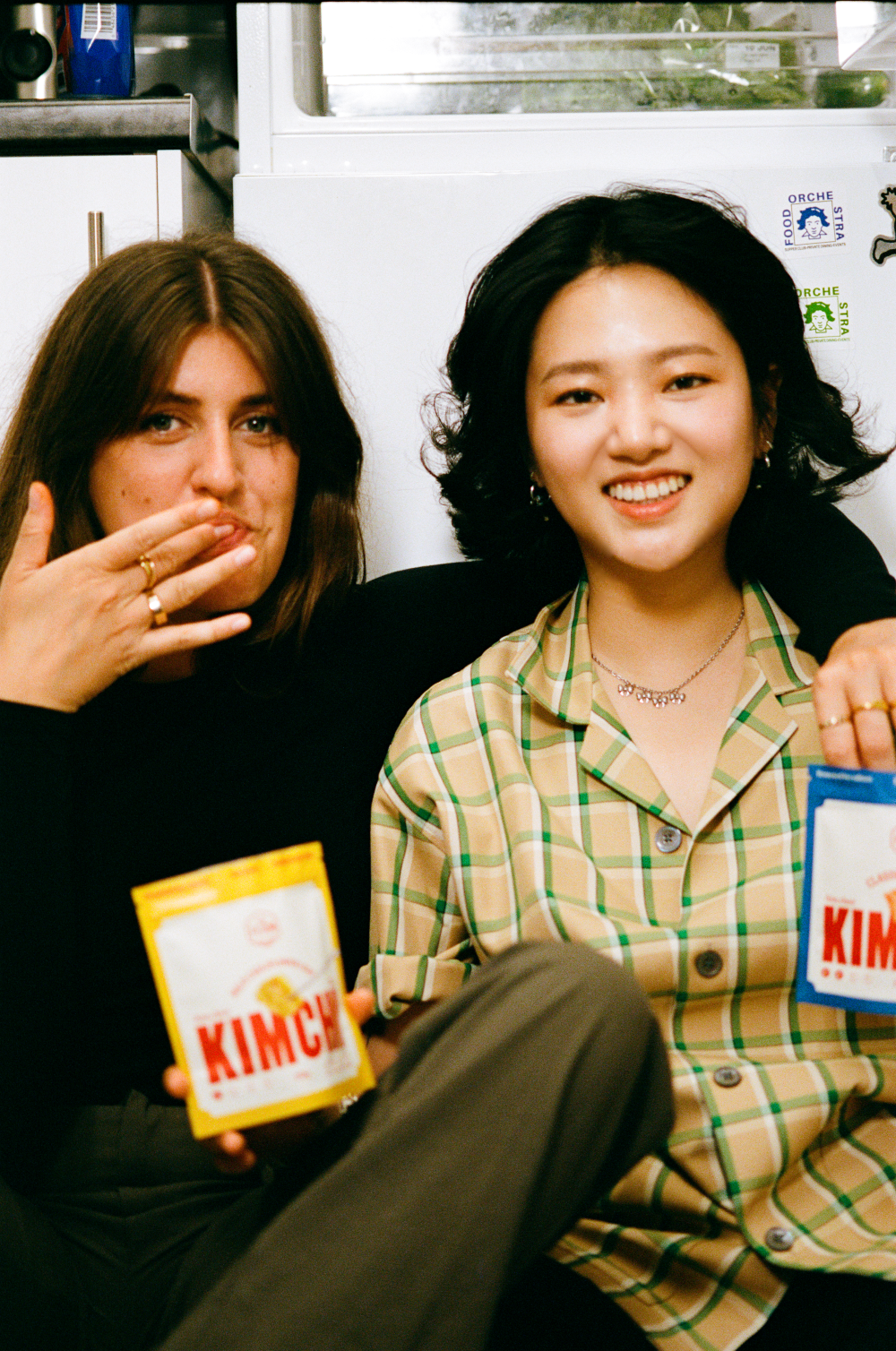
Cover Photo: The Ferm co-founders, Rebecca and Maylin, with their fermented products in London. (The Ferm)