


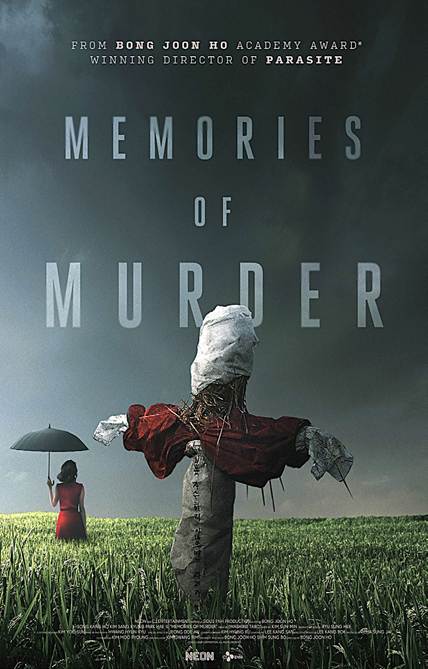
Memories of Murder: The Search for an Ordinary Face
By Farrukh Anique ||
On the night of September 15, 1986, a woman’s body was found in a field in Hwaseong, a quiet rural area south of Seoul. She had been bound, raped, and strangled. The local police assumed it was an isolated incident. They were wrong. Over the next five years, nine more women would be killed in the same area, in the same way, on rainy nights, by a man no one could find. It became the largest criminal investigation in South Korean history: over two million police days, more than 21,000 suspects questioned, 40,000 fingerprints collected. And still, nothing. The case went cold. The killer vanished into ordinary life. And South Korea was left to live with an open wound it could not name.
It is this wound that Bong Joon-ho’s Memories of Murder, released in 2003, pressed its finger into. The film did not solve the case. It did something harder: It asked what such a failure costs, and who pays.
The film is set in 1986, in the early months of the killings. But to understand what Bong is doing, one must first understand the Korea of that year. The country was ruled by Chun Doo-hwan, the same military dictator whose crackdown in Gwangju had left hundreds dead six years earlier. Under his regime civil defense drills were conducted regularly, and the state’s grip on daily life was total. As the storyline goes, on the night of one such drill, when every door in the village had been shut and every light turned out, the detectives heard the song on the radio and suspected that killer would strike again that night. When a local police chief requested additional men to patrol the killing grounds after dark, he was told none were available. They had all been dispatched to suppress a demonstration in Suwon.¹
This is the Korea in which the film breathes. A state that turned its full strength against its own people demanding freedom, and could spare nothing for the women being murdered in its fields. Bong does not deliver this as a lecture. He lets it surface through the fabric of everyday scenes: a blackout falls, the screen goes dark, and somewhere in that darkness a woman screams. No finger is pointed. The audience is left to feel the weight of what the state chose and what it did not.
Into this landscape come two detectives. Park Doo-man, played by Song Kang-ho, of Parasite and A Taxi Driver, is a local cop, poorly trained, loud, physical, a man who believes he can see guilt in another man’s face. He kicks suspects. He fabricates evidence. He trusts his gut with the confidence of someone who has never once been made to answer for being wrong. His partner, Cho, is worse: a man whose first instinct at any dead end is to use his boots. From Seoul arrives Seo Tae-yoon, a composed and methodical detective who believes in documents, forensics, procedure. He is everything Park is not. He speaks quietly. He reads case files. He does not hit people.
“The fllm did not solve the case. It did something harder: It asked what such a failure costs, and who pays.”
At first, the film seems to know whose side it is on. Seo’s rationality appears to be the answer to Park’s chaos. But Bong is not interested in that easy parable. As the investigation drags on, months becoming years, bodies accumulating, every lead collapsing, something begins to shift. Seo grows obsessive. His composure cracks. By the end, it is Seo who is beating a suspect, Seo who is begging the evidence to say what he needs it to say, and Park, the brute, the fraud, who looks at the suspect’s face and says, quietly, “He isn’t the one.” The men have traded places. Neither method has worked. The killer has swallowed them both.
This is the film’s deepest cut: not that the murderer escaped, but that the hunt itself became a kind of violence, consuming the men who carried it out and leaving them hollowed. The case did not merely go unsolved. It unmade the people who tried to solve it.
And yet, despite all of this, Bong fills the film with laughter. There is slapstick in the interrogation rooms, absurdity in the police station, dark comedy in the sheer incompetence of men who trample their own crime scenes and lose evidence to rain and passing tractors. He moves between farce and dread so seamlessly that there are moments when you are laughing and then realize, with a chill, that you have been laughing at something terrible.
One detail stayed with me. The detectives discover a pattern: The killings occur on rainy nights, and each time, a particular song has been requested on the radio before the murder. Someone, somewhere, is requesting the station to play the song, and then stepping out into the rain to kill. Think on this. A love song, requested on a public broadcast, becoming the prelude to a woman’s death. The ritual of it. The intimacy of it. The horror is not in the violence alone. It is in the ordinary human gestures that frame it: a phone call, a song, a rainy evening, the things that for anyone else would make up a quiet night at home.
Song Kang-ho carries this film on his back, and it is perhaps the finest work he has ever done. Park Doo-man is not written as a likeable man. He is arrogant, corrupt, and often cruel. Yet Song plays him in such a way that the viewer cannot look away. When Park interrogates a suspect, you see a man performing certainty he does not possess. When he watches another body being pulled from a ditch, the smallest flicker crosses his face, not grief exactly, but something closer to bewilderment, as if the world has betrayed a promise he cannot quite name. And when, years later, he returns to the drainage pipe where the first body was found, now an aging man who sells juicers for a living, the swagger is gone entirely. What remains is only the memory of failure and a question that will never let him rest.
It is this final scene that seals the film. Park kneels by the pipe and peers inside. A little girl approaches and tells him that another man had been there not long ago, looking inside in just the same way. Park asks her what the man looked like. She thinks for a moment. “Ordinary,” she says. And then Song Kang-ho does something extraordinary. He turns and looks directly into the camera. Not at a character. Not at the landscape. At us. At whoever is sitting on the other side of the screen. Bong has said he did this because he believed the killer, still free, still unnamed, would come to see the film about his own crimes. He wanted that man to be met, at the very end, with a pair of eyes that would not look away. He was probably right.
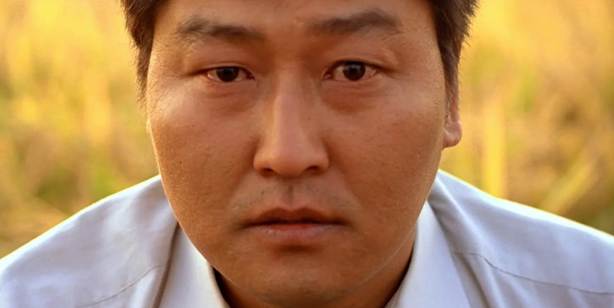
Detective Park Doo-man (Song Kang-ho) looks into the camera in the final scene of Memories of Murder. The Hwaseong murders remained unsolved for thirty-three years. (IMDb)
In 2019, sixteen years after that scene was filmed, the killer was finally identified thanks to advanced DNA restoration techniques. He had been in prison since 1994, not for the Hwaseong murders but for the rape and murder of his own sister-in-law. He confessed. And then came the detail that the justice system could not absorb: the statute of limitations on the Hwaseong murders had expired in 2006. He could not be charged. He remains in prison today only for the 1994 killing. And it turned out that the little girl was right: He was ordinary. He had lived among people, held a job, married, blended in completely. And it is precisely this that makes Park’s stare, all these years later, so difficult to bear. He is not looking at a monster. He is looking at a face no one would remember, the kind of face you pass on the street and forget before you reach the next corner. The kind of face that could belong to anyone.
That is the cruelty of this film, and its truth. The thing we most want a killer to be, alien, recognizable, marked, is the thing he is not. And the systems we build to catch him, the methods we trust, the institutions we believe in, are as fallible and as blind as the men who run them. By the end, what has gone missing is not only ten women and one killer. It is the certainty that the world can be read, that guilt has a face, that if you only look hard enough, you will find it.
You will not. That is what Park’s eyes say. And they have been saying it, to every audience, for over twenty years.
Memories of Murder (살인의 추억)
- Director: Bong Joon-ho
- Year: 2003
- Genre: Crime, Thriller, Drama
- Cast: Song Kang-ho, Kim Sang-kyung, Kim Roi-ha
- Where to watch in Korea: Netflix, Watcha, TVING, Wavve
Reference
¹ Elves, B. (2020). The not knowing. Bright Wall/Dark Room. https://www.brightwalldarkroom.com/2020/08/ 28/memories-of-murder-2003/
The Author
Farrukh Anique, originally from Pakistan, is a PhD student at Chonnam National University. He’s got a real love for the performing arts, culture, literature, and languages. In his spare time, he dives into Korean culture and history, and stories that spark his curiosity. Oh, and he absolutely loves strawberries. Email: farrukh.ask@gmail.com
Cover Photo: Official poster for Memories of Murder. (IMDb)