


From Pansori to Squid Game: Korean Storytelling Going Global
By Murdock O’Mooney ||
Korean storytelling is currently red hot. Squid Game, for example, is the most watched TV show in Netflix history, with Season 1 earning 265.2 million views alone, or 2.2 billion hours of watch time. When Season 3 dropped, Squid Game was number 1 in all 93 countries that post a top 10 list. It was a clear demonstration of the show’s global dominance.
When I returned to my teaching job at an American high school last summer, all anyone could talk about was the 2025 Netflix and Sony Pictures film K-Pop Demon Hunters, which broke global records becoming the most watched Netflix original movie in the platform’s history. The film’s breakout track “Golden” also made history by winning both an Oscar and a Grammy, with four tracks being featured simultaneously on the Billboard top 10.
Psy critiqued young wealthy Koreans and took over the world with “Gangnam Style.” The video just surpassed 6 billion views on YouTube, and at its peak was number 1 in 30 countries including France, Germany, the UK, and Australia. But of course, the number-one most watched video in YouTube history is the Korean song “Baby Shark,” with over 17 billion views. It is only 90 seconds long.
BTS has also sold out stadiums all over the world and had seven number 1 Billboard albums – a feat only seen by elite performers such as The Beatles, Led Zeppelin, The Rolling Stones, and Bruce Springsteen. Female K-pop band Blackpink also became the first artist in YouTube history to achieve 100 million subscribers according to the Korea Creative Content Agency (KOCCA).
Beyond this, the global value of the “K-content” industry exceeds US$110 billion, with K-pop and TV dramas driving the vast majority of international brand awareness.
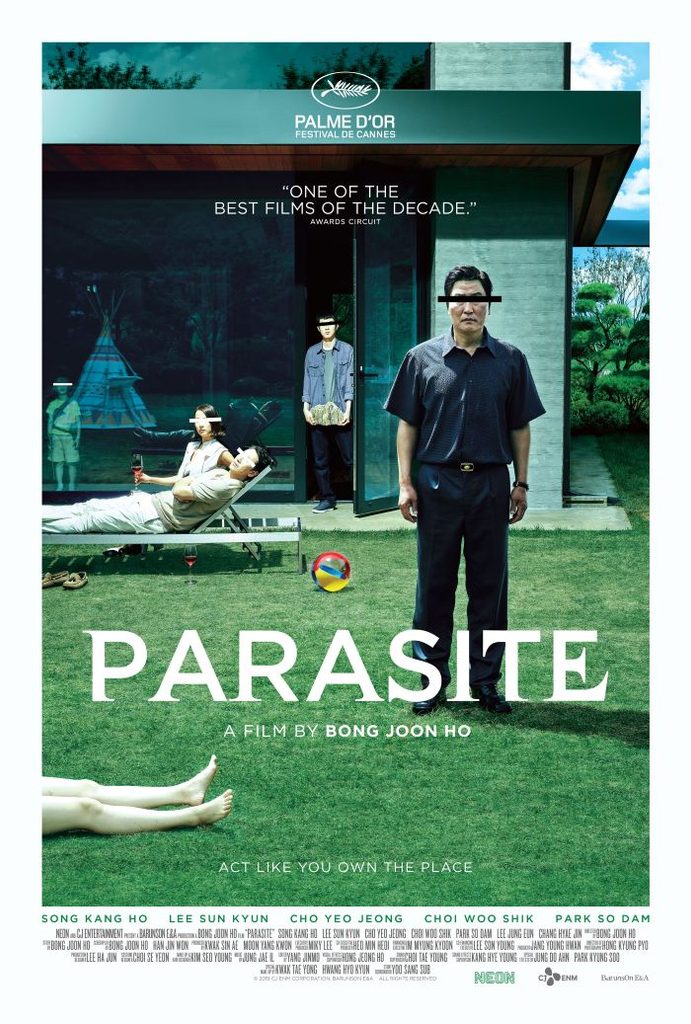
Motion pictures as storytelling. (IMDb)
Movies are no different with director Bong Joon-ho’s film Parasite’s Oscar sweep at the 2020 Academy Awards. The film won four categories, including best director and best picture, making it the first non-English-language film to take home these honors in 92 years! Parasite also unanimously won the Palme d’Or, the top prize at the Cannes Film Festival, and helped redefine how the Academy Awards views international cinema.
This trend applies to literature as well, with author Han Kang (yes, that’s her real name) winning the 2024 Nobel Prize, a first for a Korean author, and a first for an Asian woman. The Swedish Academy explained their choice as being “for her intense poetic prose that confronts historical traumas and exposes the fragility of human life.” Han is actually from Gwangju and her ties to the city are central to her work. Her breakthrough 2014 novel Human Acts is directly based on the May 18 (1980) Democratic Uprising. The novel examines themes of grief, human vulnerability, and the collective memory of the victims and survivors of the massacre. Her other notable novels include, The Vegetarian, which won the International Booker Prize, and We Do Not Part.
All this is impressive, and we could spend many pages recounting all the globally recognized Korean storytellers, but what is it about Korean stories that have captivated audiences around the world? Are they exceptionally interesting or impactful? Or are they just exceptionally well composed and executed? If we trace the origins of Korean storytelling, we can see that today’s global soothsayers are tapping into a 1000-year-old storytelling tradition that dates back to the Three Kingdoms Period, which began around 57 BCE.
According to an article published by Seoul National University, Korean storytelling traditionally fell into two categories. The first are national foundation myths, such as Dangun, which is a story of divine creation featuring bears, tigers, and the origin of mankind. The second are shamanic myths that were sung and performed during rituals to explain gods, spirits, and the underworld (think the global Joseon Dynasty zombie hit Kingdom). These ancient stories were recorded in texts such as Samguk Yusa (Memorabilia of the Three Kingdoms), which was written in 1281 CE.
A bit later during the Silla (57 BCE – 668 CE) and Goguryeo (37 BCE – 668 CE) periods, poetic dramas known as hyangga (향가) were recorded using Chinese characters that were adapted to Korean phonetics (hyangchal, 향찰). Later, in the Joseon Dynasty (1392–1897), songs known as sijo (시조) became the dominant poetic form – three-line lyrical expressions of love, grief, loyalty, and nature. Many K-pop songs operate like sijo, combining complex metaphorical lyrics with stunning visual backdrops and intricate dance arrangements.

K-pop as storytelling. (Victor Rodvang via Unsplash)
With the advent of Hangeul (한글), the Korean alphabet, in 1446, written forms of storytelling began to exist in Korea with novels being printed using wood block presses, but they were strictly for the upper class, or yangban (양반). These books began getting mass produced in the late 1700s, making them more easily accessible for their Korean audience. They were written in easy-to-read Hangeul, not classical Chinese. And while buying these vernacular stories was expensive, you could always rent a book at a sechaek-jeom (세책점), or rental shop. So, in this way, we can also attribute the democratization of the written Korean story to the late Joseon Dynasty.
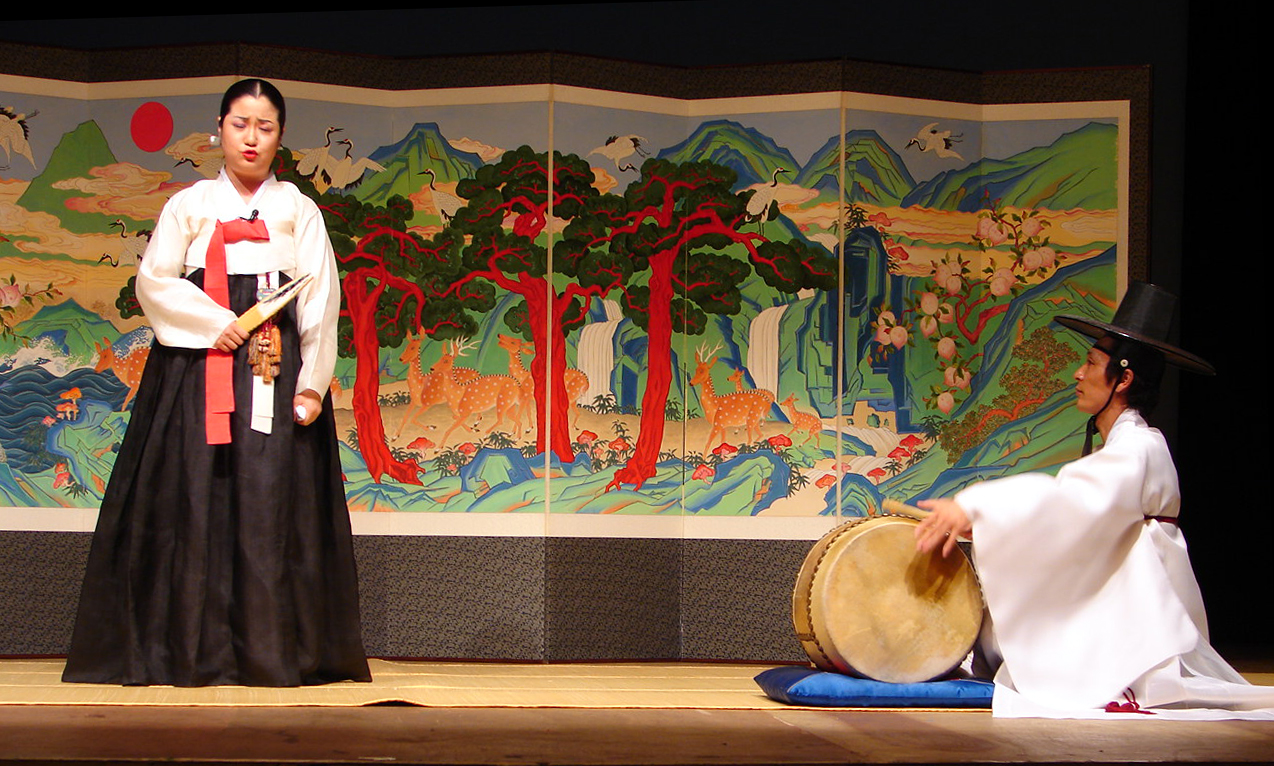
A more contemporary and musical Korean storytelling form that also emerged in the 17th–18th century and can still be observed in Korea today is pansori. Pansori features a single storyteller known as a sori-kkun (소리꾼) and a drum player, or gosu (고수). Together they perform epic, hour-long stories through song, spoken narrative, and dramatic physical gestures. Performers wear traditional Korean hanbok, with the singer having a paper fan that they use masterfully to exaggerate elements of the tale.
Pansori is still very relevant today in Korea and can be observed at festivals and cultural performances year-round. The audience will often participate through chuimsae (추임새), or shouts of encouragement for the singer during pauses in songs. In this way, it can also be argued that pansori helped establish the idea of real-time feedback from the audience in Korean storytelling. Today, this feedback might manifest in live chat comments on livestreams, podcasts, and even mukbang (먹방) food-eating videos.
Major themes from these ancient forms of Korean storytelling include class inequality, corrupt leaders, rigid hierarchies, social injustice, shamanism, the shadow world, and familial loyalty. My wife and I recently watched the 2024 Korean film Exhuma, which features a group of mudang (무당), or traditional Korean shamans. They have adventures, are sexy and cool, and ultimately have a showdown with the ghost of an eight-foot-tall samurai general named Daimyo Oni.
Daimyo Oni guards an ancient Japanese burial ground on the top of a Korean mountain, turns into a fireball at will, slaughters pigs for fun, and gets into arguments with ancient tree spirits who tell him to leave. It was an amazing film that
combined many elements of the aforementioned story forms, but as it’s a horror film, it’s not for the faint of heart.
Other common themes of ancient Korean stories also feature Robin Hood-style adventure plots, such as the magic-wielding outlaw protagonist in The Tale of Hong Gildong, written in the 16th century. There are ancient tales of romance as well, such as The Tale of Chunhyang, which tells the story of how love and loyalty overcome boundaries of social class. So, while modern Korean stories are exceptionally creative and definitely in a class of their own, it’s safe to say that their DNA comes from traditional Korean stories, songs, and myths.
It will be interesting to see what stories are produced in Korea in the coming years, and if they deviate from these traditional themes. I’ll definitely be paying attention, and as British writer Sir Philip Pullman stated, “After shelter, companionship and nourishment, stories are the thing we need most in the world.”
Sources
- Korean Literature 1. (n.d.). Seoul National University. https://sangoak.snu.ac.kr/wp-content/uploads/ sites/46/2024/04/08_eng.pdf
- Kwon, K. (n.d.). “Korean pansori.” Compact anthology of world literature, Part four: The 17th and 18th
- centuries. OpenALG. https://alg.manifoldapp.org/read/ compact-anthology-part-4/section/6c2ea150-5a1e-47cf-ac75-bb168112738f
- Open Resources. (n.d.). Digital Library of Korean Literature, Literature Translation Institute of Korea. https://library. ltikorea.or.kr/discover/collection
- Top 10 Most Popular Non-English Shows on Netflix of All Time. (n.d.). Netflix Tudum. https://netflix.com
- List of Most-Viewed YouTube Videos. (2020, February 26). Wikipedia. https://en.wikipedia.org/wiki/List_of_most-viewed_YouTube_videos
The Author
Murdock O’Mooney is an educator, writer, and lover of good stories. He’s told a tale or two in his time, but hopefully not a tall one. Korean stories, of course, are some of his favorite.
¹ CC-BY-SA 3.0, https://commons. wikimedia.org/w/indexphp?curid=4781533
Cover Photo: Pansori as storytelling. (Steve46814¹)