

What Exists in Between? – Malta Asks at the Gwangju Biennale
By Vibhanshu Maurya ||
A growing global community of settled international residents continues to guide their fellow foreigners through everyday life in Gwangju.
When I visited Horanggasy in Yangnim-dong in early August, Malta’s first-ever pavilion at the Gwangju Biennale was itself somewhere in between.
Inside the Glass Polygon, around 1.5 tons of natural-fiber rope waited to become walls and a tree-like structure. Downstairs, rooms were being prepared for sound and virtual-reality works. Across the courtyard, Maltese artist Norbert Francis Attard was spraying and assembling parts of his installations. Nothing was quite finished yet.
The exhibition is called “Bejn / In-Between.” Bejn is the Maltese word for “between,” but the project is not simply about what lies between Malta and Korea. Across sculpture, poetry, installation, sound, and immersive media, the artists are interested in what can exist between almost anything: sound and silence, inside and outside, tension and release, understanding and not understanding, one place and another, one meaning and the next.
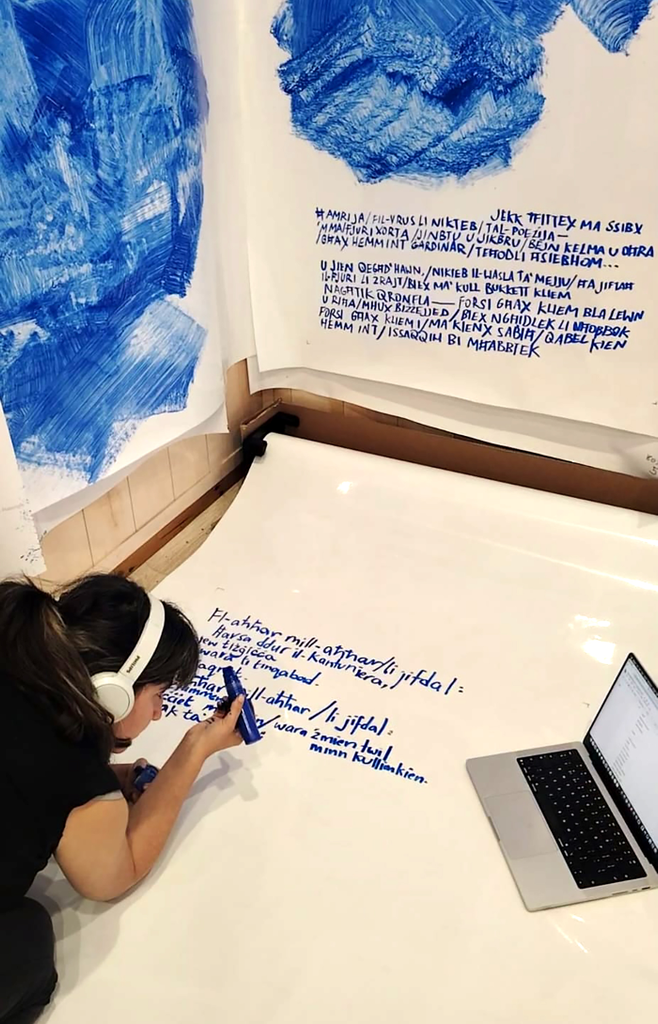
Sam Alekksandra writing 80 Korean and Maltese poems in the atelier of the Malta Pavilion. (Julien Vinet)
Malta and Korea provide some of the materials and cultural references through which the idea of the in-between is explored. For example, rope carries different cultural and historical values in each country. In the exhibition, Maltese festa traditions meet Korean ideas of color and ritual. At the pavilion, Korean and Maltese poetry occupy the same walls without always being translated. Sounds recorded in Gwangju and Malta sometimes remain recognizably separate and sometimes dissolve into one another. What matters is not simply joining two cultures together but seeing what happens in the space created between them.
Malta’s historic first participation in the Gwangju Biennale brings together Norbert Francis Attard, the poetry and visual-art collective Ponks (Sam Alekksandra and Julien Vinet), and sound artist
and composer Michael Quinton. Working as the Bejn Kollettiva, they have developed site-specific works in Gwangju under curator Moon Hyun Jeoung.
Before visiting Horanggasy (호랑가시), I met Sam, Julien, Norbert, and Moon at the nearby Leeleenam Studio. Ponks had first visited Gwangju in October last year to study the site before returning this summer for a longer stay in Gwangju to develop the works.
“We’re all making site-specific work,” Sam explained, art designed specifically for the place where it will be shown. The artists arrived with ideas, but those ideas were never supposed to remain untouched. They would have to respond to the architecture, materials, collaborators, and experiences they encountered here. Norbert interrupted one early description of the project as being about the space between Malta and Korea. “Not only Malta and Korea,” he said. “That’s just one layer.”
Julien offered sound as an example. A footstep makes a noise, but between one sound and another there is an interval. That apparent silence is not truly empty: The previous sound fades, the next has not yet arrived, and something remains suspended between the two. That suspension – rather than a neat resolution – runs through much of the pavilion.
Moon offered a Korean word that approaches the idea from another direction: sa-i (사이). As she explained, it can mean the space between things or people, but it can also describe the relationship between them. For her, the project does not need obvious similarities between Malta and Korea. What matters more is what happens when different meanings are placed side by side.
A Temple of Rope and Poetry
Ponks makes that idea physical in Rope Temple.
Rope is an ordinary material, but it carries different meaning in Malta and Korea. In Malta, an island nation shaped by the Mediterranean, it is closely connected with boats, fishing, maritime life, and religious traditions. In Korea, Ponks became particularly interested in geumjul (금줄), the traditional sacred rope used to mark or protect a space. The material is therefore familiar to both cultures without meaning exactly the same thing in either.
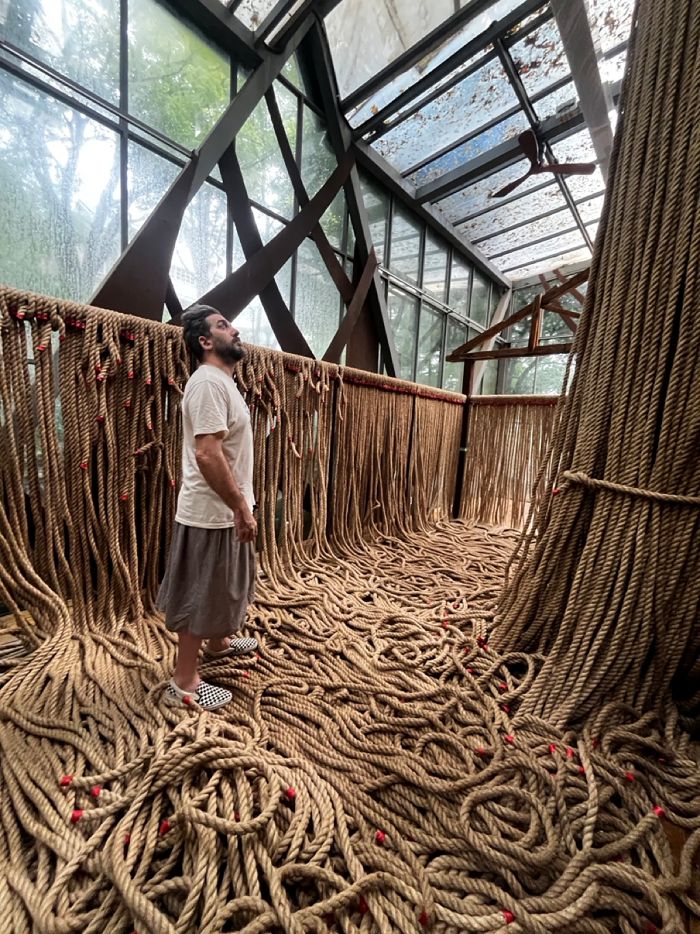
Julien Vinet in the making of Rope Temple for the Malta Pavilion at Gwangju Biennale 2026. (Sam Alekksandra)
Inside the Horanggasy venue, those ropes will form dense walls around a room within a room. A tree-like structure will rise through the center, incorporating the building’s existing spiral staircase. Visitors will move through the ropes rather than simply stand outside and observe them.
When I toured the site, much of this still existed as coils, steel supports, measurements, and plans. That unfinished state revealed how deeply the work depends on the building itself. “The space,” Julien replied immediately when I asked about what Gwangju had contributed most that they could not have created from Malta.
Horanggasy is not a typical neutral, white-walled gallery. Its glass walls, timber structure, staircase, surrounding forest, and parts of the original building have all become part of the work. As Norbert explained, a similar artwork might be reconstructed elsewhere, but its meaning would change.
Poetry adds another layer to Rope Temple. Dozens of Korean and Maltese poems will appear across the surrounding glass, while the wider project brings together around 140 poems. Some ropes are also intended to activate recorded poetry when touched. Not all of the poetry will be translated.
During an earlier trip to Gwangju, Sam met a Korean poet who read his work aloud to her. She could not understand the Korean words, but the experience affected her deeply. “It was like he shot an arrow in my heart,” she recalled. For Sam, that moment demonstrated that language has spaces within it too. Meaning can exist somewhere between the literal definition of words and the tone, rhythm, gesture, emotion, and effort involved in sharing them. “You don’t necessarily need to understand something to connect to it,” she said. Gwangju also changed her understanding of poetry itself. She was struck by how visibly poetry remains connected to public and personal life here, including protest and the preservation of memory around May 18.
Within Rope Temple, poetry therefore occupies another in-between condition: readable but sometimes untranslated, visible yet not entirely accessible, capable of being heard even when it cannot be fully understood.
Holding Tension
Norbert Francis Attard approaches the same idea through architecture, material, and tension.
Attard, one of Malta’s pioneering contemporary artists, represented Malta at the Venice Biennale in 1999 and has spent decades working across architecture, installation, sculpture, and site-specific art.
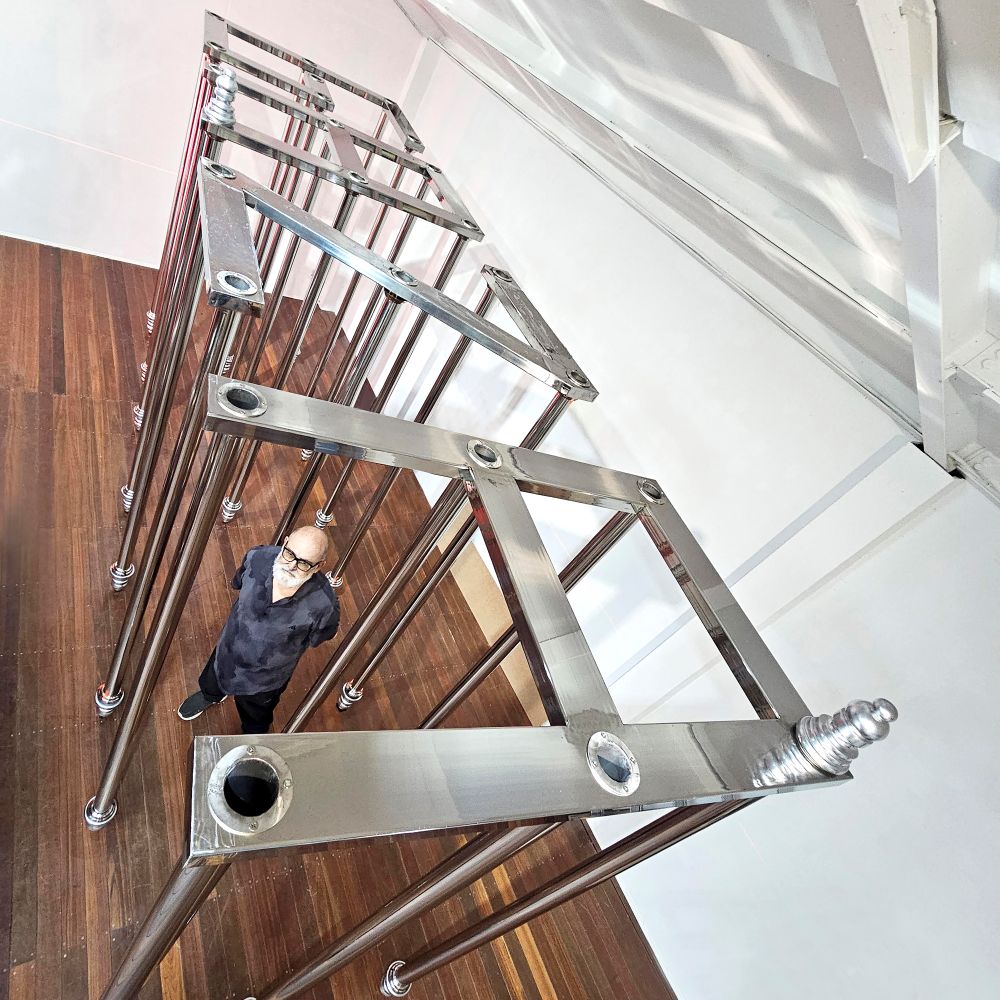
For Peristyle, he had initially imagined particular elements in gold. Working with a local metal manufacturer made that solution either too difficult or too expensive, leading him to polished steel instead. Then something changed. He began noticing polished steel throughout Gwangju – in architectural details, structures, and objects around the city. A material chosen partly for practical reasons suddenly gave the work another connection to the place where it was being built. “I felt more satisfied,” he explained, because the material seemed to add another layer to the work.
Peristyle draws from the Maltese festa, a colorful and intensely communal religious celebration held in towns and villages across Malta. Attard incorporates forms inspired by the bandalori, decorative banners carried on distinctive poles during these celebrations. But a festa contains striking contrasts. In the streets there are bands, shouting, color, and fireworks; inside the church there may be quiet and prayer. Some major Maltese feasts also commemorate past sieges and wars.
Attard pushes those oppositions further by placing a visual language of celebration beside references to present-day devastation, including Gaza. The reference is deliberately not immediately legible. A visitor has to move, look again, and spend time deciphering what is there. The viewer sees the work first and only gradually recognizes what it says.
Architecturally, a peristyle is itself an in-between space: a passage defined by columns that mediates between an inner and outer area. Visitors will physically move through Attard’s structure, becoming part of that relationship rather than viewing it from a distance.
In another installation, he uses stretched elastic bands alongside forms recalling the Maltese festa and colors connected with obangsaek (오방색), Korea’s traditional five-color system. The elastic is important because it remains under tension. The aim is not to remove the tension. Keeping it visible and unresolved is part of the work. That may be one of the most useful ways to approach the exhibition as a whole. Bejn is not always a peaceful middle ground. The in-between can also be unstable, uncomfortable, or unresolved.
The Sound Between Sounds
For Michael Quinton, the in-between is something we hear.
Quinton spent just over two weeks recording across Gwangju before returning to Malta to compose his sound installation, Koinonia (κοινωνία). The Greek word koinonia means “fellowship, participation, sharing, or communion.”
“Perfect silence does not exist, except in a vacuum,” he explained. Even in what we call silence, something remains: background noise, resonance, vibration, the decay of a previous sound, anticipation of another.
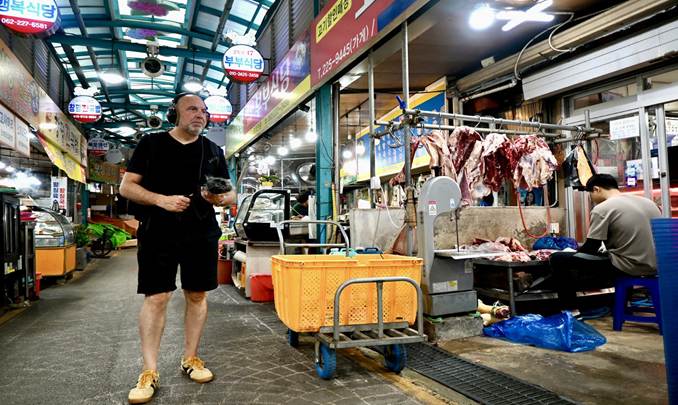
Michael Quinton in a Gwangju market doing sound research for his Malta Pavilion installation at Gwangju Biennale 2026. (Julien Vinet)
Quinton was especially struck by Gwangju’s relative quietness. Compared with Malta – a small, densely populated country where sounds often feel closer and louder – he found Gwangju surprisingly calm for a city. Birdsong caught his attention because many of the calls sounded unfamiliar. He also became fascinated by public announcements and vehicles using loudspeakers around the city. Because he did not understand the Korean words, he listened instead to their pace, tone, rhythm, and even the sound quality of the loudspeakers.
In Koinonia, recordings from Malta and Korea sometimes remain clearly distinguishable. At other times, they merge until their origins become difficult to identify. Language often makes the differences most obvious. Environmental sounds are harder to place, allowing Malta and Gwangju to blend more easily into one soundscape.
The composition has five movements that Quinton compares to breathing: inhalation, the pause in between, and exhalation. He has deliberately searched his recordings for gaps, background sounds, offbeats, decay, footsteps, machinery, and irregular rhythms – things that might usually be considered the spaces between the important sounds – and moved them into the foreground.
The room will not be acoustically treated to remove its natural echo. Instead, that echo will become part of the work. Eight speakers placed around the long, narrow room will allow sounds to move from one side of the space to another. Even the audience becomes part of the work. Bodies absorb and alter sound, meaning the same composition can be experienced differently depending on where someone stands, sits, or lies down. For Gwangju residents, his hope is that they leave the installation hearing their own city slightly differently.
Leaving the Meaning Open
Other parts of the pavilion continue the same exploration.
In the basement, three rooms explore what Ponks calls the “roots” of poetry: sound, words, and the relationship between a poet and a place. One room will allow visitors to move through long arrangements of poetry almost as if browsing clothes on a rail – searching through many pieces until one creates a connection. Another uses 360-degree VR video to take visitors to locations in Malta and Korea through the eyes of artists
and performers. Rather than presenting Malta through a conventional tourism catalogue of coastlines, monuments, and picturesque streets, visitors encounter places through someone else’s interpretation of them.
Again, the interesting space is not simply Malta on one side and Korea on the other. It is the experience produced in between. That is also why Moon does not want to tell visitors what they should think when they visit the pavilion. She hopes they will discover their own “in-between” – perhaps a relationship, a tension, a similarity, or a difference. The artists themselves do not yet know exactly what audiences will make of it.
When I left Horanggasy, much of the exhibition was still unresolved. Rope had not yet become a temple. The sound room was not yet dark. Poetry had not yet covered the glass. But perhaps that was the most appropriate moment to encounter Bejn. A poem can be felt without being completely understood. Silence can contain sound. An artwork imagined in Malta can become something different while being built in Gwangju. A material can belong to two traditions without meaning the same thing in either.
And, as Moon’s explanation of sa-i (사이) suggests, what exists between two things does not have to be empty space. Sometimes, it is the relationship itself.
BEJN / IN-BETWEEN is commissioned by Arts Council Malta, supported by the Ministry for the Arts, Culture and National Heritage, Visit Malta and the Cultural Diplomacy Fund managed by the Ministry for Foreign and European Affairs.
The Author
Vibhanshu Maurya, originally from India, is pursuing his PhD at Chonnam National University. He is a writer for the Gwangju News, where he writes about science, people, culture, and the international community in Gwangju.
Cover Photo: Norbert Attard’s Peristyle (work in progress) for the Malta Pavilion at Gwangju Biennale 2026. (Julien Vinet)