







Movie Review: A Revival of Fiction for Life – The Secret Life of Walter Mitty
By Jacqueline L. Becerra ||
At the hour of a setting sun, the fluorescent subway lights beam over bent postures looking at phones and over drifting sleepers. Even in transient periods of time, everyone is occupied in their own headspace, staring off into a digital or physical realm – or worst-case scenario – unintentionally staring at one another. Our day-to-day lives are full of fragments of empty time and space, like long commute rides, waiting times, and mindless tasks. One may find themselves solely reflecting in their thoughts but with modern technology: with busy fingers and music echoing in earbuds.
I admit that I’ve forgotten the last time I zoned out with no singular thought in mind. My brain’s always at work: running through the day’s tasks, my schedule – and if I get the luxury – a half-decent written plot of a daydream. These scenes were created for the purpose of escaping reality, to fill in the time, and as The Secret Life of Walter Mitty (2013) shows, they can disrupt it too. From its movie poster and the overly clichéd description uncovered in a Google search, I merely expected the movie’s message to be to get out there and live life to its fullest. And while this was met, I was entranced by how the movie presented this affirmation of life through its engrossing what-if scenes.
This imaginative movie is screenwritten by Steve Conrad and directed by Ben Stiller, who is also the leading actor. Here, both producers re-envision the original short story published in 1939 by James Thurber. In this movie, the main plot follows Walter Mitty, a negative asset manager at Life magazine who has recently developed a secret crush on Cheryl Melhoff, a new co-worker in his department. However, the possibility of fulfilling his love story becomes jeopardized as the entire company makes a digital shift to “Life Online.” This transition comes with a downsizing of the entire company, with which all surrounding characters feel an uneasiness about their job security. Thus, for the last print issue of the magazine, each character is faced with the pressure to do well. Our main character is not left out, being responsible for Negative 25, the final print cover, he encounters one problem: It is nowhere to be found! In a race against time, Mitty sets out to find Negative 25, which is referred to as “the quintessence of life,” tracking its photographer, Sean O’Connell, and embarking on a journey to fulfill his work.
Living in a Loop
Walter Mitty is plainly introduced, meticulously tracking his ordinary expenses in a bankbook: mom’s retirement, home deposit, eHarmony signup, piano storage, etc. His unassuming character is affirmed by his position at Life, where, in processing photo negatives, he works apart from everyone in a hidden lower level of Life’s building. Amongst stored files and film-developing tools, he continues on with his work as he has done for the past sixteen years. There is no plaque honoring him as star employee of the month or for any notable achievements. With days predictable and routine, it is no surprise that Mitty is encased with his own visions of ecstatic and flashy grandeur, and epic fight scenes, romantic confessions, and heroic rescues.

A CGI fight scene. (IMDb)
Nevertheless, when it comes to reality, he is at once still, unresponsive, and nonreactive. In fact, almost every character comments on his zoning out: He acquires certain nicknames like “Dream Machine,” and to get his attention, he hears things like “Ground control to Major Tom,” a line from David Bowie’s song Space Oddity. This is all to say our protagonist is awfully unaware of his surroundings. His plain demeanor continues through the dating scene, where his incomplete eHarmony profile reflects a drab uneventful life. To this, he bluntly admits that he hasn’t
done anything or been anywhere “noteworthy or mentionable” as a technical issue forces him to talk to an eHarmony agent, who also points out his fragmentary profile and lack of engagement. As such, it’s mostly at the beginning of the movie where we see a plethora of these creative daring acts that we as viewers know Mitty cannot perform. However, in a twist of character, Mitty does act them out, also gaining an immense following on his dating profile as these accomplishments are added to his profile one after another.
Pits of Imagination
Mitty’s daydreams seamlessly generate themselves on the screen with great frequency and scale. For this reason, viewers can find themselves second-guessing whether the scenes are real or not. That is, until they’re broken by comedic transitions, highly computer-generated effects (CGI), or exaggerated acting. These sensational visions emit a bold creative function for the screen; high-energy action scenes that strike the viewers’ visual perception, but they also obscure the actuality. Consequently, viewers are shown an unsettling reality: that as a result of the extreme zoning out, we miss out on a lot of the present. Mitty is pulled into his world of fantasy and does not hear what is being said to him or realize what is going on around him.
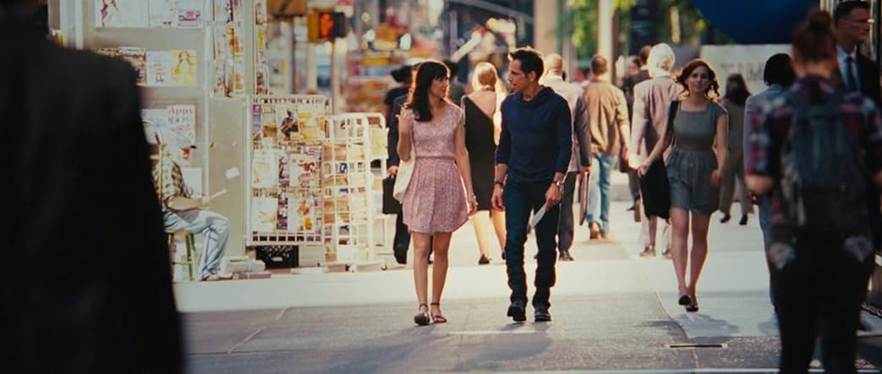
A slice of life. (IMDb)
This acts as a wake-up call to regulate daydreaming and zoning out, noting that Mitty’s answers were right in front of his face. For example, towards the end, he finds out that his mother had previously met Sean O’Connell and knew his whereabouts, and this was not hidden, as she directly told Mitty at a grocery store. Except that he clearly did not hear this and went forth on a sudden treacherous journey. It wouldn’t be far-fetched to claim that it’s because of his creative inattentiveness that his story takes place. In this way, his grand delusions have subconsciously prepared him for this trek. He was just waiting for the push that would allow him to set out.
In the search for Sean O’Connell and Negative 25, Mitty seems to completely phase out his visions as he undertakes his sporadic and wild adventure. And what once appeared to be fantastical is realized: taking a same-day flight to Greenland, jumping out of a plane, and climbing the Himalayas. In addition, viewers are no longer pulled into the screen with CGI-plastered images but with environmental landscapes. Wide camera shots of Mitty against the untouched backdrop of nature reframe our main character to only be a small figure. He is no longer in his head but one belonging in a vast world.
Final Takeaway
We might never get to embark on the same journey that Walter Mitty did, but the ending has an endearing sentiment. He did not set out on another huge mission or journey, but simply walked out with Cheryl onto the street. The movie’s biggest takeaway: to be fully present. Often, we get caught up day by day, thinking the only way to truly live is to travel somewhere halfway around the globe or to do something completely crazy and irrational. And maybe that is one portion of it, but life is a fluctuating force, both grand and minimal in its scale. These small moments will all add up to something, and that’s also worth living for. In other words, the takeaway is to live out our fantastical dreams and keep on creating those visions of what someday might be reality – if we pursue them in the future.
Amongst the many comedic yet cliché life-motivating movies, I recommend The Secret Life of Walter Mitty (2013), if you haven’t watched it already. This movie makes no promises of encouraging your next move but strikingly calls on the potentiality of imagination. So, take a minute to settle into boredom and fragments of empty time. Who knows what the wandering imagination can possibly shape? We just need to give it a chance.
The Author
Jacqueline Becerra is a past Critical Language Scholarship recipient at Chonnam National University and reminisces back on those memories of humid summer nights. Through her writing at Gwangju News, she wishes to convey the same fondness the city gave to her.
Cover Photo: Official movie poster. (IMDb)