


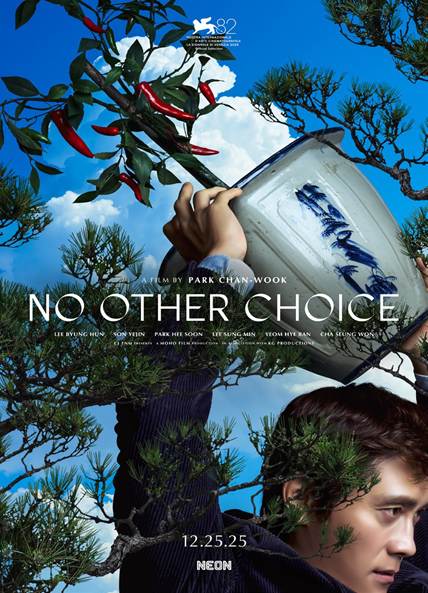
Movie Review: No Other Choice – The Lengths We Go for What We Love
By Farrukh Anique ||
Recently, nearly thirty-thousand employees of the American multinational tech company Oracle woke up at six in the morning to find an email waiting on their phones: “After careful consideration of Oracle’s current business needs, we have made the decision to eliminate your role as part of a broader organizational change. As a result, today is your last working day. We are grateful for your dedication, hard work, and the impact you have made during your time with us.”
Just imagine it: breadwinners of thirty-thousand households sent back home with a single click. To be dismissed on two hours’ notice, not because you shirked your duties but because you did them too well. Yes, that was the bitter irony; these employees had diligently trained their own replacements. The AI models that made them redundant had been trained by their very hands.
And Oracle is hardly the only company sending people home in droves. In the past twelve months alone, AI-driven restructuring has cost twenty-five thousand Intel employees their jobs, sixteen thousand at Amazon, and nine thousand at Microsoft. These are not isolated incidents. They are part of a pattern, one that the future is likely to repeat on a much larger scale. This breakthrough in information technology is not merely a surge of innovation; it is a storm gathering force, and this is only its opening gust.
In 1997, the American novelist Donald Westlake published The Ax, the story of Burke Devore, a man caught in the grip of a mass layoff. Nearly two decades ago, the celebrated Korean filmmaker Park Chan-wook, creator of masterpieces such as Oldboy and The Handmaiden, read the novel. He has said that for fifteen years, he tried to make it into a film in America, but for one reason or another, the project never materialized. In the end, he resolved to make it in Korea instead. The story was recast in a Korean setting, and one of Korea’s finest actors, Lee Byung-hun, was chosen for the central role.
The story follows a man named Man-su, once a manager at a paper factory. Swept aside by the shrinking need for human labor in the face of accelerating technological change, he finds himself unemployed. Man-su is a husband who, even after many years of marriage, still loves his wife with a reckless intensity of a teenage boy in love. He is a father who adores not only his own daughter but also his stepson deeply enough to cross any line for his sake. But above all, he is a worker in the truest sense of the word, a man profoundly, almost helplessly, in love with his work. When that work is taken from him, it feels as though something essential has been torn out of his being. As if he is no longer himself. As if he has become a stranger in his own skin. Park Chan-wook says that what struck him most about this story was that the man did not turn the full force of his hatred toward the company that repaid years of loyalty by abruptly casting him aside. Instead, he poured all of his energy into finding work again.
The paper industry had seeped into Man-su’s bones. He wanted no other work, and perhaps even if he had tried, he would have failed elsewhere. He sat for interview after interview, only to find that someone better always stood ahead of him, someone more experienced, more polished, more skilled. There were many men like him: capable managers, freshly wounded at the hand of progress, all wandering in search of work. Man-su’s greatest enemies were these other Man-sus, men just like him, sitting at home and sending applications to every paper company they could find, men who, somewhere, somehow, were always slightly better than he was.
One day, his wife, Mi-ri, says jokingly, “You want this job so badly, just imagine, if that other candidate somehow failed to show up, wouldn’t the position simply fall into your lap?” They both laugh. And then, suddenly, Man-su stops laughing. Something stirs. Something detonates in his mind. “If he failed to show up… for some reason.” For what reason? A natural one? Or could that reason be manufactured? How far is an ordinary, harmless man willing to go, a man who only wants his daughter to learn the cello from the best music teacher in the city? That is the question this story sets out to answer.
This film once again lays bare the intricacy of Park Chan-wook’s craft. The violence is not shown in such a way that the audience is coaxed into sympathizing with the criminal. Instead, we are shown a helpless, cornered, increasingly desperate man, someone who does not so much wield crime as carry it like an ugliness he can never put down. At no point does he seem to relish what he is doing. Again and again, he stumbles, falters, nearly collapses under the weight of it.
Park has said that when one looks closely at life, no emotion appears in a pure form. Every moment seems born of the mingling of sorrow and joy. You may suddenly smile while standing at a funeral or feel an unexpected sense of sadness while watching a conveniently funny comedian. That is why grief and happiness are not two separate entities; they are twin faces of the same coin. Perhaps it is this very chain of thoughts that allows him to blend horror, comedy, crime, and drama into such a seamless cocktail that the boundaries between them begin to blur. Against the restless urgency of the foreground story, he quietly paints, in the background, the cruelty and uncertainty of the corporate world: how a loyal employee of many years can suddenly, because of cold and heartless technology, come to seem like a redundant spare part.
Park says that the moment Lee Byung-hun was cast, he knew something special was about to take shape. Lee keeps the audience spellbound. When he sits in an interview room, he seems like the most compelling manager the paper industry could ever produce. When he stands up to a bully to protect his son, he appears as a clumsy yet courageous father. When he embraces his wife, he melts her heart in an instant. And when he steps into a life of crime, he is not sleek or heroic like an action-film star; he is a novice – awkward, error-prone, frightened. He falls, gets up, steadies himself, and runs.
There is one deeply affecting scene I watched again and again. Man-su is standing in a shoe store. Another former manager from the paper industry works there temporarily as a shoe salesman. His inexperience is obvious to Man-su and to the audience alike. One customer, put off by his clumsiness, leaves without buying anything. Man-su says to him, “Do you ever miss those days when you’d sit with a colleague after work in the evening and share a drink?” The salesman looks startled. “After more than a year of unemployment, I can spot men like myself from a distance.” Man-su continues. Then the salesman opens up: “I used to work in the paper industry. We made special paper. Paper for banknotes. Paper for lottery tickets. There may not have been anyone better than us at making that kind of paper. And making good paper, it isn’t just a job. It’s an art, and we were unmatched in that art. But when I talk about it now, people laugh.”
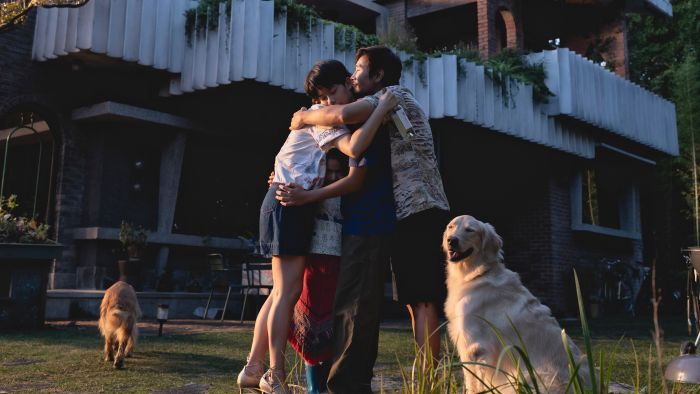
Man-su and his family in an embrace, a moment of calm before the storm. (CJ Entertainment)
Man-su replies, “Why do they laugh? There’s nothing laughable about it. What feeling could be more pleasant than running your hand over a sheet of high-quality paper?” The salesman freezes. He stops what he is doing and looks at Man-su. No ordinary person could have spoken that line. The Korean word used here for “pleasant” is pogeun-hada (포근하다), a word rich with shades of meaning. One cannot help but admire the writer for choosing it. It is the word used for the gentle warmth of spring after a winter of cold harsh enough to crack the bones. It is used for the soft, perfectly cozy feeling of wearing a new sweater that fits just right. It is used for the safety, peace, and happiness a baby feels when drawn into a mother’s loving arms. Can such a word be used for paper?
These two unemployed men were not merely speaking about their profession. They were two young lovers mourning the loss of the beloved whose touch and warmth once brought them solace, only to be taken from them suddenly, and for no reason at all. Watch this scene. In Lee Byung-hun’s eyes, feel the pain he is trying not to allow to spill over, and fall in love with the command he has over his craft.
With this film, Park Chan-wook and Lee Byung-hun shape a work of rare precision, where satire, slapstick, and drama flow into one another without losing sight of the truth it wants to speak. Beneath its wit and craft lies a deeply unsettling recognition: The cold age of AI is not some distant future; it is already at our doorstep, and it will reach into human lives in ways most of us are still too unprepared to imagine. The cruelty of such a moment may look almost absurd on screen, but in life it will probably not feel like comedy. Just horror.
The Author
Farrukh Anique is a PhD student immersed in mechanical engineering at Chonnam National University. Originally from Pakistan, he’s not all about gears and equations though. He’s got a real love for the performing arts, culture, literature, and languages. He is an amateur theater actor, a short-story writer, and he speaks five languages. In his spare time, he dives into Korean culture and history.
¹Rotten Tomatoes. https://www.rottentomatoes.com/m/no_other_choice
Cover Photo: Official poster for No Other Choice. (Rotten Tomatoes®¹)