

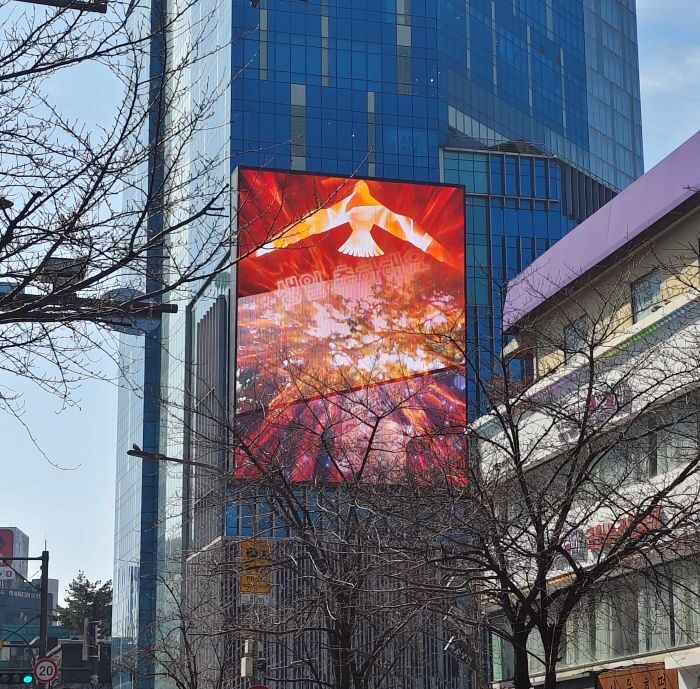
The Calcuttan in Korea: Neon Rhythms and the Quiet Hue
By Reeti Roy ||
Sinchon: A Symphony of Youth and Steam
If Bukchon is a held breath, Sinchon is a shout. Stepping out of the subway station, I was met by a wall of sound – not the frantic honking of Park Street, but a choreographed chaos of melody. Sinchon is the city’s restless heart, a place where the air vibrates with the ambition of students and the relentless flicker of neon. It is a district that refuses to sleep, its arteries filled with the heat of charcoal grills and the high-definition dreams of a generation.
Near the U-Plex mall, the landscape shifts from street level to a sprawling, glossy gallery of devotion. Towering birthday posters from fans – massive, backlit shrines to pop idols – turn the concrete into a landscape of collective longing. Agust D stared back from these tributes, his gaze sharp and defiant, a king in a concrete empire. A classmate’s recent quip came to mind: “Yoongi, marry me!” This phrase has become a global shorthand for a very specific kind of modern devotion, one that bridges the gap between the digital screen and the Sinchon pavement.
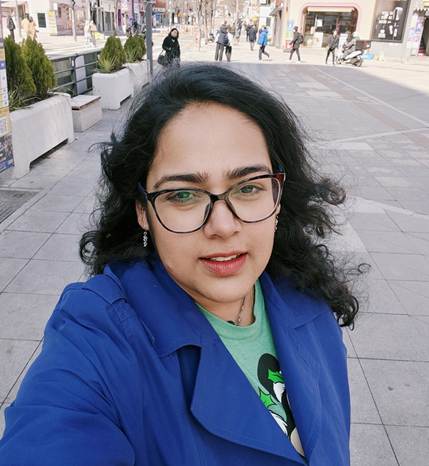
Reeti walking about in Sinchon.
Below these titans of pop culture, the real kings of the street – the buskers – had claimed their territory. A young man with a guitar sang a ballad so raw it felt like he was handing his heart to the passersby. In Calcutta, we gather around tea stalls to debate politics with a fervor that can last until the small hours. Here, the youth gather around microphones to debate the soul through melody.
The Digital Confessional: The Coin Norae-bang
When the sensory overload of the street becomes too much, there is a specific kind of sanctuary unique to this city: the coin norae-bang. Unlike the sprawling, multi-room complexes designed for corporate teams, these are compact, neon-lit karaoke booths – digital confessionals where you pay by the song rather than the hour. For a few hundred won, you are granted a soundproof universe. In Sinchon, deciding what to sing is a high-stakes emotional audit. Do you lean into the current zeitgeist with Enhyphen’s Knife or Jin’s Don’t Say You Love Me, K-pop sensations dominating the March 2026 charts? Or do you reach for the “norae-bang staples” – songs that every Korean student seems to know by heart, like Day6’s You Were Beautiful or the timeless energy of BigBang’s Sunset Glow? There is a therapeutic power in this choice. Whether it’s shouting through a rock anthem to release the pressure of a looming exam or whispering through a ballad, the norae-bang is where the “polite violence of collectivism” I often observe in the streets is traded for a raw, uninhibited individuality.
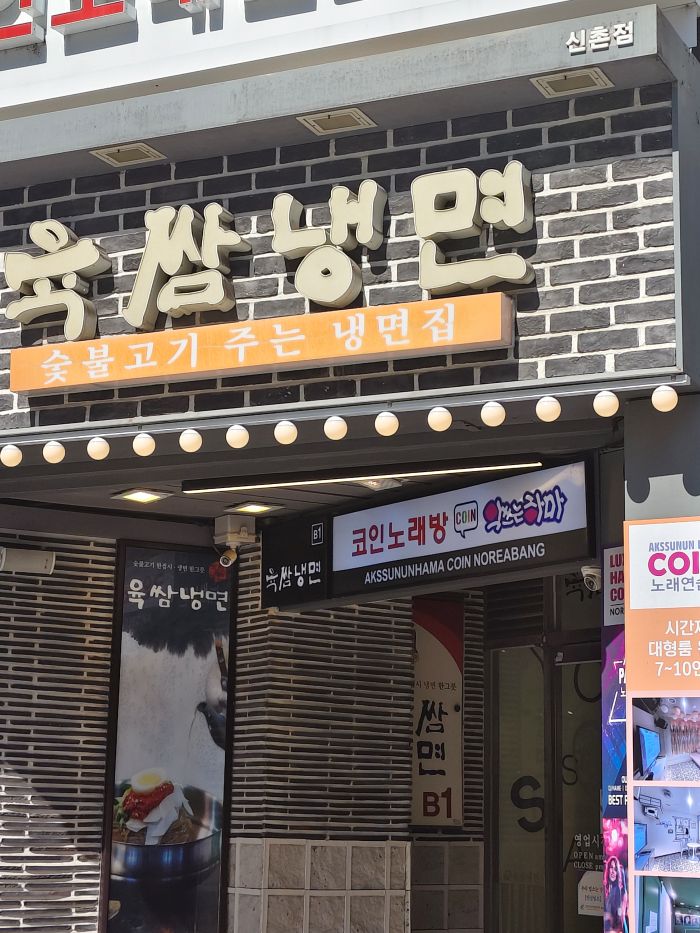
The coin norae-bang – pay-by-the-song karaoke.
A Bridge to Gwangju: Why Sinchon Calls
For a city like Gwangju, which thrives on art that asks questions and has a history of radical expression, Sinchon offers a fascinating parallel. While Gwangju is the spiritual home of resistance and the avant-garde, Sinchon is where that energy meets the hyper-modern pulse of the next generation. People of Gwangju should visit Sinchon, not just for the shopping but to witness a different kind of “careful alchemy.”
Here, the activism of the past has evolved into a revolutionary kind of presence. If Gwangju prizes art for its questions, Sinchon prizes the street for its performance. To walk from the quiet, historically charged streets of Yangnim-dong into the electric roar of Sinchon is to see how Korea’s spirit of jeong – that warm, lingering connection – survives even in the middle of neon and noise.
The Yonsei Threshold: A Global Microcosm
I am here in the heart of this neon pulse for a reason both pragmatic and deeply personal. I have enrolled in an intensive Korean language program at the Yonsei University Korean Language Institute (KLI). It is a strategic expansion of my mission as a creative entrepreneur and cultural commentator.
My classroom is a miniature United Nations. I sit alongside students from China, Mongolia, Germany, Vietnam, France, India, Japan, and the USA. We are a diverse, international group who seem laid back but diligent – my kind of people, those who take their work seriously but not themselves. Despite our vastly different origins, we are united by the struggle of the tongue.
My first day at the KLI was marked by a serendipity that felt almost scripted. As we sat in our classroom, the sky outside began to soften. Then, it started to snow. In the K-dramas, I watched back in Calcutta, the first snow is a sign that those who see it together will stay together forever. My homeroom teacher smiled and told us it was a “good sign.” I looked around at my classmates and wondered if this meant we were destined to be friends for a lifetime.
The Geometry of Sound: Monophthongs and Diphthongs
The work itself is a rigorous dismantling of how I speak. We are currently deep into the mechanics of vowels – specifically the distinction between monophthongs and diphthongs. In the Bengali of my childhood, vowels are fluid, often bleeding into one another. In Korean, the distinction is a matter of architectural precision.
A monophthong is a single, pure vowel sound where the tongue and lips remain stationary – think of the “ah” (ㅏ) or “ee” (ㅣ) that stays constant. They are the steady pillars of the language. But then come the diphthongs – vowel sounds that glide. They begin as one sound and move toward another within the same syllable, like “ya” (ㅑ) or “wa” (ㅘ), requiring a deliberate shift in the mouth’s geometry.
Learning to navigate these glides feels like learning a new way to move through the city itself. If a monophthong is a straight, wide boulevard, a diphthong is one of Sinchon’s hidden alleys – a curve that reveals a new perspective just as you think you’ve reached the end. Each shift in the tongue is a refusal to let meaning fade into a blur; it is a radical act of care.
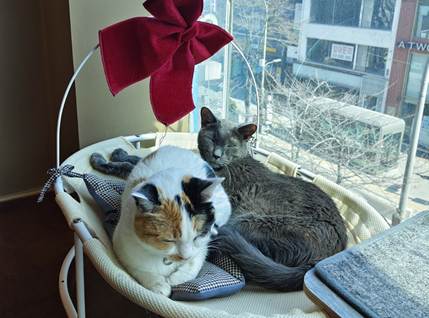
Reeti with cats at the cat café.
The Cat Café: Whispers and Paws
Seeking a different kind of company, I climbed the stairs to a cat café. Inside, the world muted. A cat stretched across a wooden shelf, indifferent to the neon flickering outside. There is a specific kind of silence in a room full of cats – a shared, soft-padded meditation. In this quiet, I found myself thinking of my own tuxedo cat,
Finesse, back home in Calcutta – a creature who understands the poetry of silence better than anyone. Finesse, with her sharp black-and-white mask and watchful eyes, is a foundational anchor in my life. Seeing these cats in Seoul, observing the urban rush with the same calm indifference, makes the thousands of miles between Calcutta and Sinchon feel negligible.
The Shadow of the Hospital
But as I looked through the large glass window, my heart snagged on the view across the street. Beyond the playfulness of the café, I saw them: people in white gowns, some pushing IV poles, walking toward the sprawling hospital complexes of Yonsei. Earlier, I had walked past the engineering buildings to find university merchandise. But seeing the patients made the academic pursuit of healing feel suddenly, achingly visceral.
A heavy pensiveness settled over me. In the midst of the posters, the sizzling mandu, and the sleeping cats, there was the hospital – the great equalizer. I thought of the medical hubs in Calcutta, the same anxious faces, the same desperate hope held in the hands of loved ones. In that moment, the distance between the two cities vanished. The fragility of the body is a language we all speak fluently, regardless of our mastery of diphthongs.
Even in this high-tech corridor, the pulse of life is inseparable from the reality of its end. The joy of the busker, the diligence of the student, and the pain of the patient exist on the same street, separated only by a pane of glass and the falling snow.
The Author
Reeti Roy is a cultural commentator and the founder of Aglet Ink. A graduate of Jadavpur University and the London School of Economics, she is currently based between Korea and India, investigating Indo-Korean social architectures through an anthropological lens.
Photographs by the author.
Cover Photo: Agust D / Min Yoongi on a billboard.