

When Traffic Isn’t Your Fault: Rethinking Commutes in Gwangju Using AI
By Saqib Sharif ||
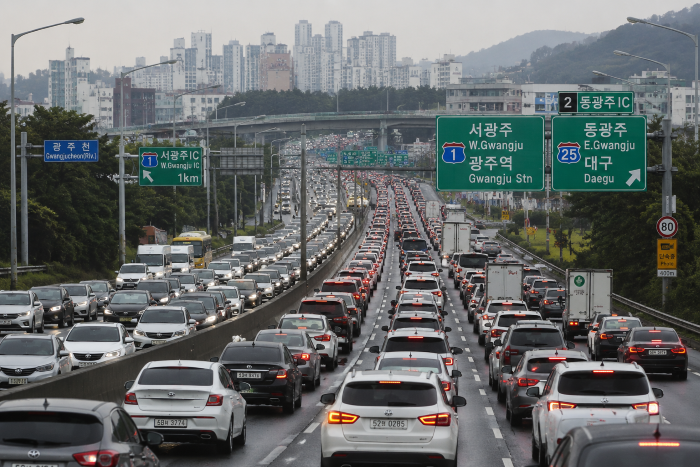
In Gwangju, the day often begins with movement. People leave their homes with a plan, a schedule, and a quiet expectation that they will arrive on time. A short commute of 15 kilometers can feel routine, taking 30 to 40 minutes on a normal day. But the city does not always follow a plan. A single accident on a highway can stretch that same journey far beyond expectation. Cars slow, then stop, and time begins to slip away.
What follows is familiar. A worker arrives late, not because of poor planning, but because of conditions beyond their control. Yet in many workplaces, lateness is still treated as a personal failure. Explanations are required. Doubt often follows. Sometimes there are penalties. Over time, this creates tension between employees and employers, built not on intention but on uncertainty.
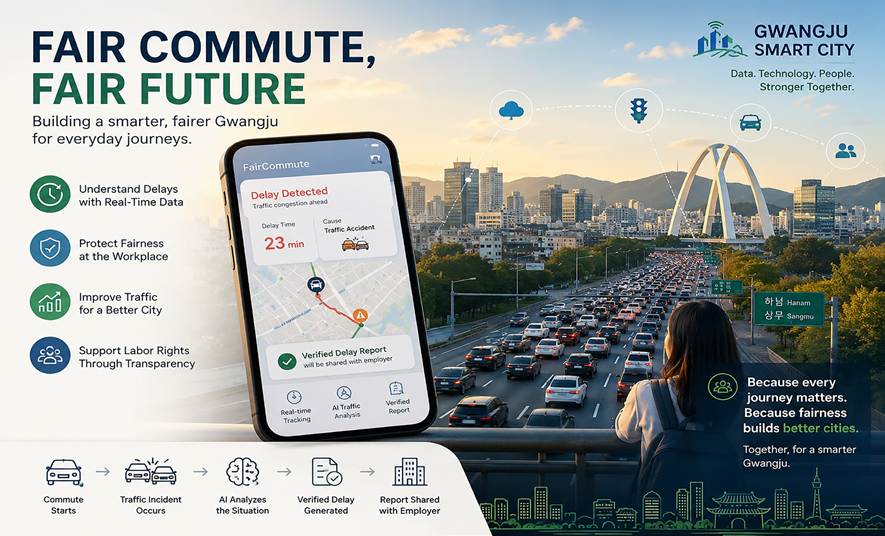
A smarter Gwangju in motion. FairCommute uses real-time traffic data and AI to turn unavoidable delays into verified insights, reducing stress for commuters and building fairness between employees, employers, and the city. (GN with OpenAI ChatGPT)
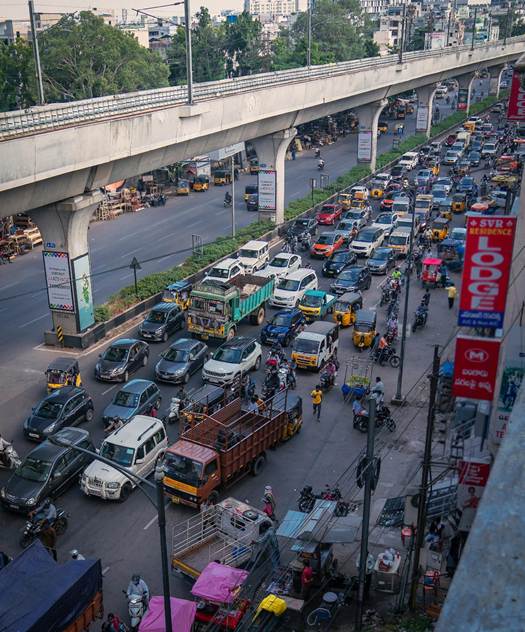
This daily experience is not unique to Gwangju. Across South Korea, long and unpredictable commutes have become part of modern life. A recent report highlighted that many workers spend extended hours traveling each day, with some facing commutes long enough to affect their well-being and social life. In fact, studies cited in the Korea Herald suggest that long commute times may contribute to isolation and reduced quality of life, as people spend more time on the road and less time with family or in personal activities. This insight adds an important dimension to the problem. Traffic congestion is not only about delay. It is about lost time, mental stress, and the quiet erosion of daily life.
(Its Kiran via Pexels)
Gwangju, however, is not standing still. Through initiatives like the Gwangju Smart City Project, the city is investing in intelligent infrastructure, connected systems, and data-driven services. Traffic signals are becoming smarter. Urban systems are becoming more responsive. The goal is not only efficiency but a better quality of life for citizens.
Yet one critical gap remains. While roads and systems are becoming intelligent, the human experience of commuting is still judged by outdated standards. A delay caused by congestion is treated the same as a delay caused by personal choice. The system sees the outcome but not the cause.
This is where the idea of FairCommute begins. The concept does not try to eliminate traffic, which is often unavoidable. Instead, it tries to understand it, measure it, and communicate it fairly.
“Traffic congestion is not only about delay. It is about lost time, mental stress, and the quiet erosion of daily life.”
Imagine a system that works quietly during your commute. It understands your usual route and travel time. It compares your movement with real-time traffic conditions across the city. When something unusual happens, such as an accident or sudden congestion, it recognizes the disruption. It analyzes the situation using patterns, historical data, and live traffic feeds. From this, it produces something simple but powerful: a verified explanation. Not a guess. Not a personal claim. A data-backed statement of what happened, how long the delay lasted, and why it occurred.
This information can be shared with employers in a limited and privacy-respecting way. It does not expose personal routes or unnecessary details. It only answers what matters. The result is a shift in workplace dynamics. Instead of questioning the employee, the conversation is grounded in shared, objective data.
For a city like Gwangju, this idea fits naturally into its smart city vision. Data is already being used to improve infrastructure. Extending that data to support fairness in daily life is a logical next step. When commute patterns are analyzed at scale, they can reveal where congestion happens most often, which routes are consistently unreliable, and where improvements are needed. This helps not only individual workers but also city planners and policymakers.
A pilot program in Gwangju could bring this idea into reality. A few hundred commuters, a handful of companies, and a few months of real-world data would be enough to test its impact. The goal would not only be technical accuracy but human outcomes. Do employees feel less pressure? Do employers respond differently when they have clear information? Does trust improve?
If successful, the implications go far beyond Gwangju. Cities around the world are facing the same challenges of congestion, long commutes, and rigid workplace expectations. A model developed here could be adapted elsewhere, connecting urban data with everyday human experience.
In the end, this is not just about technology. It is about how a city understands its people. A smart city is not only one that moves efficiently, but one that recognizes the realities of daily life. Traffic congestion is a shared condition, not an individual failure.
“A smart city is not only one that moves efficiently, but one that recognizes the realities of daily life.”
There is also a deeper social impact. Long commutes, as noted in national reports, are already affecting how people live, reducing personal time, and increasing stress. When that stress is combined with workplace penalties, the burden becomes heavier. A system like FairCommute does not remove traffic, but it removes unnecessary conflict. It replaces assumption with evidence and tension with transparency.
Gwangju is already building smarter roads and systems. Now it’s time to make them truly smart by understanding the people who rely on them every day.
Sources
Song, S. (2025, November 18). S. Korea logs world’s longest commute, which studies say may fuel loneliness. The Korea Herald. https://www.koreaherald.com/article/10618434
Lim, J. (2026, May 5). Korea’s work-hour cuts hinge on labor reform: Study. The Korea Herald. https://www. koreaherald.com/article/10731343
The Author
Saqib Sharif is a robotics engineer with a PhD in mechanical engineering, specializing in the design of smart healthcare devices and microrobots. With a strong background in medical technology and innovation, he is passionate about creating solutions that enhance smart healthcare. Dr. Sharif has been living in Gwangju for the past ten years. Currently, he serves as a senior researcher at Shinsung Tech Pvt. Ltd., Gwangju.
Cover Photo by GN with OpenAI ChatGPT.