






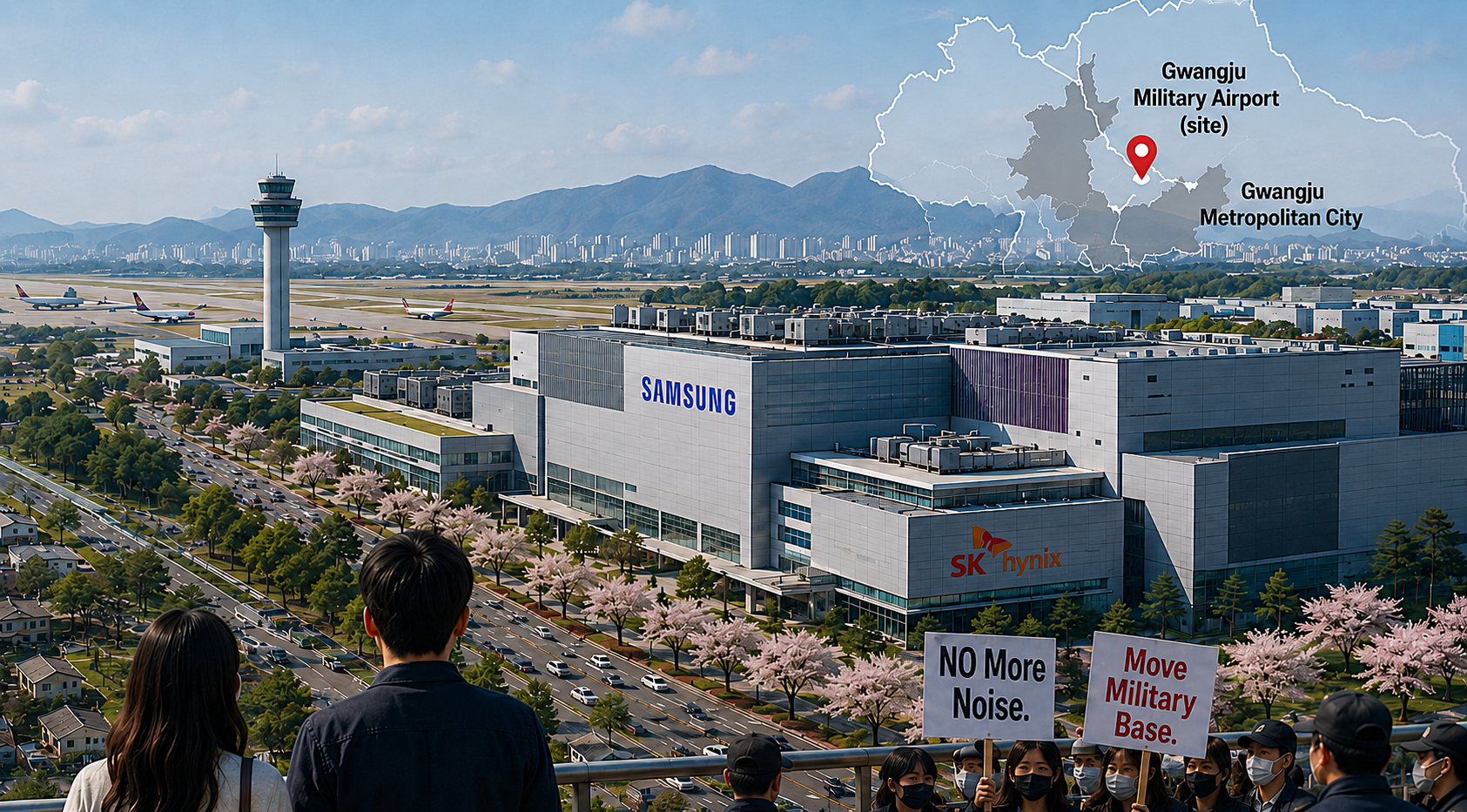
Gwangju’s Semiconductor Gamble: What Will 800 Trillion Won Mean for Ordinary Citizens?
by Saqib Sharif ||
Yes, you read that right. The figure is 800 trillion won (US$580 billion). I cross-checked it with multiple reliable sources. To put that enormous figure into perspective, only a handful of countries have an annual GDP larger than US$580 billion. Very few indeed.
For decades, Gwangju has had a familiar problem. It has universities, research institutes, talented young people, and a developing industrial base, yet many of its brightest young people eventually leave for Seoul, the surrounding metropolitan area or other industrial cities. That could now change dramatically.
Gwangju is preparing for one of the biggest industrial projects in its history. The government plans to build a massive semiconductor cluster in the southwestern region. Samsung Electronics and SK Hynix are expected to invest about 800 trillion won across the wider project. The government wants the new cluster to begin mass production by 2030. For Gwangju, this could change the city’s economy for generations.
But there is an important question behind the huge investment figure: Can Gwangju actually build something that big in the proposed time? The government has set an extremely ambitious schedule. Land, water, electricity, workers, housing, and transportation all have to be prepared almost at the same time. Industry officials have warned that the schedule assumes that almost everything will proceed without major delays.
The selected site is the Gwangju Military Airport in Gwangsan District. The plan is to relocate the military airport and transform the large site for semiconductor manufacturing. The airport has been a major urban issue for Gwangju for many years. Its relocation could finally free a huge area of land for industrial and urban development. It would also reduce the aircraft noise that has affected surrounding communities.
The problem is that moving the airport is not simple. The relocation has been discussed for more than a decade. Muan County has emerged as the preliminary relocation site, but several administrative and political steps remain. A local referendum is expected around October, while consultations with the U.S. military are also required.¹
The U.S. connection is particularly important. The Gwangju Military Airport is a Korea–U.S. Air Force collocated operating base. American military interests are therefore involved in the relocation process. U.S. officials have said they have important military interests at Gwangju, although there has been no official statement saying that the United States is opposing the semiconductor project.²
The issue became more controversial recently. On August 4, eight South Korean university students attempted to enter Osan Air Base in Pyeongtaek while protesting against what their organization described as U.S. interference in the semiconductor project. Six entered the base and two were stopped at the entrance. Three of the activists were later arrested after South Korean courts issued arrest warrants.³
The student protest shows how complicated the project has become. What started as an industrial development plan is now connected to questions about military bases, local land, national industrial policy, and the South Korea–U.S. alliance. The students’ claim that the U.S. military is obstructing the semiconductor project should be treated as an allegation, not an established fact. Still, the incident shows that the airport relocation has become much more than a local planning issue.
Even if airport relocation proceeds smoothly, another major challenge remains. A semi-conductor fab needs enormous amounts of water. The planned Gwangju cluster is expected to require about 650,000 tons of water every day by 2030. This is a huge demand for a region that must also protect water supplies for households, agriculture, and existing industries.⁴
The government is considering several solutions. One possibility is to increase the supply from Dongbok Dam in Hwasun County. The government has also considered nationalizing the dam, which is currently owned by Gwangju City, to speed up plans to raise its height. But this could create another conflict with residents in Hwasun.¹
“The same project can create prosperity and pressure at the same time.”
Water is only half of the problem. Semiconductor factories also require enormous quantities of electricity. The government believes that renewable energy and nuclear power can provide the necessary supply. New transmission infrastructure will also be required. The government is accelerating plans for an underground transmission network connecting the existing power system to the proposed cluster.⁵
This infrastructure will cost a great deal of money. Underground transmission lines can cost many times more than conventional overhead lines. They can reduce opposition from residents because there are no large transmission towers, but the higher construction cost will ultimately be part of the economic price of creating the semiconductor cluster.
There is another question that receives less attention: Where will the workers live?
The project will require highly skilled engineers, technicians, and researchers. It will also create demand for construction workers, equipment specialists, maintenance workers, logistics company employees, and many other occupations. The government expects tens of thousands of specialized jobs and a much larger employment effect across the wider economy. But attracting skilled workers to Gwangju will require more than factory jobs.
The city will need housing. It will need schools and childcare facilities. It will need better public transportation. Hospitals and other public services will also face greater demand. If thousands of new workers arrive without enough housing, rents and apartment prices could rise quickly.
This is where ordinary residents may feel the semiconductor project most directly. Property prices in areas around the proposed site have already attracted attention. Expectations of future development can increase land values before construction even begins. For existing homeowners, this can create significant wealth. For young families and renters, however, it can make Gwangju less affordable.
This creates a difficult contradiction. One of the main goals of the semiconductor project is to give young people more reasons to stay in the region. But if housing prices rise too quickly, young people may find it harder to establish their lives in Gwangju. A higher salary does not necessarily mean a better quality of life if housing, childcare, and other costs rise at the same time.
Local businesses will also experience both opportunities and risks. Thousands of workers and contractors will create new customers for restaurants, cafés, hotels, taxis, and shops. Construction and logistics companies could see strong growth. Local engineering and technology companies could also become suppliers to the semiconductor industry.
The bigger opportunity is for Gwangju’s small and medium-sized companies. If local businesses can become part of the Samsung and SK Hynix supply chains, the economic effect could spread throughout the city. If most contracts instead go to companies already established around Yongin and other semiconductor centers, Gwangju could receive much less of the long-term benefit.
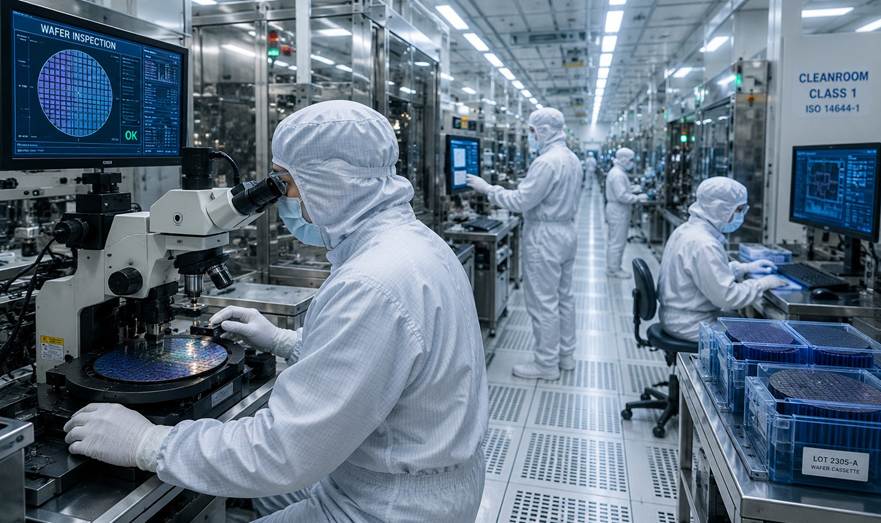
Inside a clean room, transforming silicon wafers into microchips. (GN with ChatGPT)
This is one reason the location itself matters. Yongin already has a mature semiconductor ecosystem. It has suppliers, experienced workers, infrastructure, and established industrial networks. Samsung and SK Hynix initially had strong reasons to expand there. Building a completely new cluster in Gwangju means creating an ecosystem almost from the beginning.
The government knows this. It is trying to compress a process that took seven to nine years for the Yongin National Semiconductor Cluster into only two or three years in the southwest. That is an extraordinary acceleration. The government argues that strong administrative support can make it possible. Industry officials are less confident.
Their concern is not that the project is impossible. Their concern is that too many things have to go right at exactly the same time. The airport must move. Water infrastructure must be ready. Electricity must be available. Land must be prepared. Workers must be found. Housing must be built. Samsung and SK Hynix must also maintain their investment plans. A major delay in any one of these areas could affect the entire schedule.¹
There is also a financial risk for taxpayers. The government may build water and electricity infrastructure ahead of the factories. If the semiconductor market later weakens and companies delay or reduce their investments, some of that infrastructure could initially be underused. Industry officials have warned that this could leave the government carrying depreciation and maintenance costs.¹
The pressure to move quickly also increases construction costs. Samsung’s P5 memory fab in Pyeongtaek provides an example. The value of one structural construction contract reportedly increased from around 550 billion won to about 1.9 trillion won. The reason is partly the accelerated construction schedule. Speed, in other words, has a price.¹
For Gwangju’s finances, the project could still be transformative. More factories mean more economic activity. More workers mean more consumption. More companies could mean greater local tax revenue. A larger population could strengthen the city’s commercial base.
“Money alone does not guarantee a better city.”
But Gwangju will also have to spend more. Roads will need to be expanded. Public transportation will need to improve. Water and electricity systems will require major investment. Schools, hospitals, and emergency services will have to prepare for a larger population. The city must therefore look at both sides of the financial equation.
The environmental impact also deserves careful attention. Semiconductor manufacturing is a high-tech industry, but it is not a low-resource industry. Large quantities of water and electricity are required. Industrial chemicals are used in manufacturing. Wastewater must be carefully treated. The city will need strong environmental monitoring as the project develops.
The water issue could become particularly sensitive. Gwangju and surrounding communities already depend on limited water resources. A large industrial consumer will compete with households and other users during dry periods. The government therefore needs to explain clearly how water security for residents will be protected.
The same applies to electricity. Gwangju residents should know where the additional electricity will come from. They should know where new transmission lines will be built. They should also know how the environmental impact of new power infrastructure will be managed. Industrial development should not mean that local communities carry all the environmental costs while companies receive most of the economic benefits.
For ordinary residents, however, the most important changes may be much simpler. A young university graduate could find a semiconductor job without moving to Seoul. A local restaurant could gain hundreds of new customers. A small engineering company could win a major contract. A family could see the value of their home increase.

(akitada31 via Pixabay)
But the opposite could also happen. A young couple could find an apartment too expensive. A small shop could face higher rent. Roads could become more crowded. Water and electricity demand could increase. Residents could face years of construction before seeing any direct benefit.
This is why the semiconductor project should not be judged only by its investment figure. The 800 trillion won headline sounds impressive. But money alone does not guarantee a better city. The real measure will be whether ordinary people experience better jobs, higher incomes, and improved public services without an unacceptable increase in living costs.
Gwangju also needs to make sure that local universities benefit. Chonnam National University, GIST, Chosun University, and other institutions could become important sources of semiconductor talent. New programs could be created for semiconductor engineering, materials, electronics, AI, and manufacturing. Students should have clear pathways from university into local companies.
The project could also change the character of Gwangju’s workforce. The city may attract engineers and researchers from other parts of Korea. Foreign professionals could also arrive. This could bring new restaurants, international schools, cultural activities, and businesses. Gwangju could become a more international industrial city.
But growth needs planning. A sudden population increase without enough housing and infrastructure could put pressure on existing communities. The city should plan for families, not only workers. People who move to Gwangju for semiconductor jobs will need places to live, schools for their children, and healthcare for their families.
The airport relocation could also create a second opportunity. Once the military airport is gone, the surrounding land could become valuable urban space. Gwangju could connect industrial development with housing, parks, commercial areas, and public transportation. If planned carefully, the former airport area could become more than a factory zone.
This is perhaps the biggest opportunity for Gwangju. The city does not have to choose between industry and quality of life. It can attempt to build both. But this requires planning from the beginning. Housing, transport, schools, parks, and environmental protection should be designed alongside the factories.
The 2030 deadline makes all of this much harder. The government wants mass production within President Lee Jae Myung’s five-year term. That creates a strong political incentive to move quickly. But a semiconductor cluster is a project that will exist for decades. Rushing decisions today could create problems that Gwangju residents will live with long after the current government has left office.
“Can Gwangju actually build everything in time?”
The city therefore needs to think beyond 2030. The first fabrication plants are only the beginning. The real question is what Gwangju will look like in 2040. Will there be a strong semiconductor ecosystem? Will local companies be supplying global manufacturers? Will young people still leave for Seoul? Will housing remain affordable? Will Gwangju have enough water and electricity?
These questions matter more to residents than the size of the investment announcement.
Gwangju has been given an extraordinary opportunity. The semiconductor cluster could become the city’s biggest economic project in modern history. It could create jobs, attract investment, and give young people a reason to stay. It could also transform a military airport site that has constrained the city for decades.
But the project is also a race against time. The government is trying to compress considerable years of planning into a few short years. Land, airport relocation, water, electricity, workers, and housing must all come together. The scale of the opportunity is enormous, but so are the risks.
For the people of Gwangju, the semiconductor project should therefore be viewed with both excitement and caution. Residents should welcome new jobs and investment. At the same time, they should ask difficult questions about public spending, housing, water, electricity, the environment, and local employment.
The chips will eventually be produced inside clean rooms. The real impact, however, will happen outside them. It will be felt in apartment prices, school classrooms, restaurants, roads, and family budgets. It will be felt by students deciding whether to leave Gwangju or build their careers here.
The success of the project will not ultimately be measured by whether Gwangju becomes home to four semiconductor fabrication plants. It will be measured by whether ordinary residents can say that their lives have become better because those fabs came here. This is the real semiconductor test for Gwangju.
Sources
¹ Tight timeline puts southwestern chip cluster plan at risk. The Korea Times. https://www.koreatimes.co.kr/business/ companies/20260713/tight-timeline-puts-southwestern-chip-cluster-plan-at-risk
² Osan gate-crashers were student activists protesting US role. Stars and Stripes. https://www.stripes.com/branches/ air_force/2026-08-05/student-activist-gate-crashers-osan-korea-22461943.html
³ Three student activists arrested over alleged infiltration into U.S. air base. Yonhap News. https://en.yna.co.kr/ view/AEN20260806003651315
⁴ South Korea to launch $3.5 billion chip fund. Reuters. https://www.reuters.com/world/asia-pacific/south-koreas-lee-wants-military-airbase-relocated-by-mid-2028-chip-cluster-2026-08-10/
⁵ Korea fast-tracks power grid for southwest chip cluster. Seoul Economic Daily. https://en.sedaily.com/ finance/2026/07/16/korea-fast-tracks-power-grid-for-southwest-chip-cluster
The Author
Saqib Sharif is a robotics engineer with a PhD in mechanical engineering, specializing in the design of smart healthcare devices and microrobots. With a strong background in medical technology and innovation, he is passionate about creating solutions that enhance smart healthcare. Dr. Sharif has been living in Gwangju for the past ten years. Currently, he serves as a senior researcher at Shinsung Tech Pvt. Ltd., Gwangju.
Cover Photo: Concept city model of Gwangju’s chip industry. (GN with ChatGPT)