


Inside the GIRC: Gwangju Life Volunteer Guidance Corps – Gwangju’s International Residents Supporting Their Own
By Kim Minsu ||
A growing global community of settled international residents continues to guide their fellow foreigners through everyday life in Gwangju.
Since Jeonnam-Gwangju Special Metro-politan City launched on July 1st, the merged region of Gwangju and Jeollanam-do is now home to roughly 110,000 registered foreign residents across the city and province. In Jeollanam-do, the largest groups are E-9 (non-professional employment) and E-8 (seasonal worker) visa holders, while in Gwangju, D-2 (student) visa holders lead, followed by F-4 (overseas Korean heritage) and E-9 visa holders. Nationally, the number of foreign residents grew by 5 percent over the past year, while in Jeollanam-do the increase was more than double that rate, at 10.5 percent.
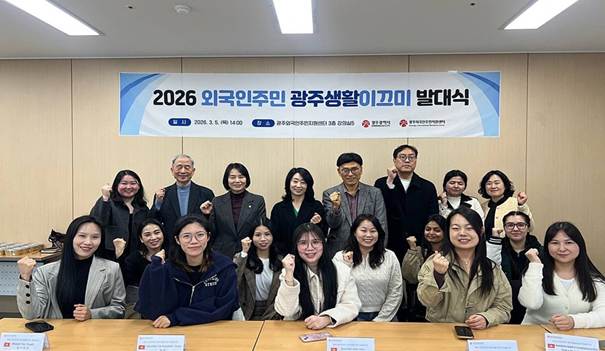
The Gwangju International Residents Center (GIRC) launched its Gwangju Life Volunteer Guidance Corps in 2024, and this year marks the program’s second cohort of volunteers. Twelve volunteers from ten countries make up this year’s core team, and in just five months – March through July – they have supported well over a hundred cases.
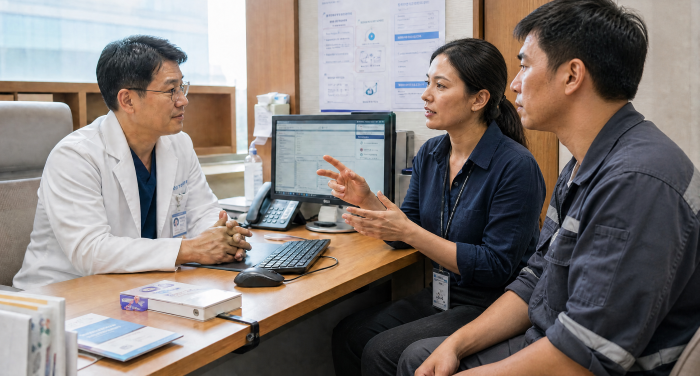
Ikkeumi volunteers stand ready to assist new residents with medical and legal matters, official documents, language, and more. (GIRC with Nano Banana 2)
How the Corps Is Structured
The Volunteer Guidance Corps is built around a core group of regular volunteers, each recruited for their language ability and at least two years of experience living in Gwangju. When a request comes in for a language or nationality not represented among the regular volunteers, a GIRC coordinator draws on a wider network of occasional volunteers who can step in as needed. This flexible structure has let the program respond to residents from a wide and growing range of nationalities – including Myanmar, Mongolia, Uzbekistan, Kyrgyzstan, Kazakhstan, Cambodia, China, Nepal, Thailand, India, and Indonesia – without limiting support to only the languages the core team happens to speak. English-language interpretation is also available for residents who are more comfortable communicating that way.

Medical interpreting has consistently made up the bulk of the work, accounting for over half, and in some months more than 80 percent, of all cases. But the range of situations volunteers have stepped into tells a fuller story of what it takes to settle into life in a new country such as Korea.
“The same familiar face re-turning again and again – something a one-time interpreter could never offer.”
Cases That Made a Difference
In one case, a Vietnamese worker was injured on the job, and his employer initially tried to blame him for the accident. GIRC connected him with a lawyer, and a volunteer interpreted throughout the consultations and the industrial-accident review process, making sure his statement of what happened was clearly understood by both the lawyer and the company. With the facts properly on record, the claim was recognized as a legitimate workplace injury, and the worker received an initial compensation payment.
In another case, a worker from Thailand filed for unfair dismissal relief with the Jeonnam Regional Labor Relations Commission after his employer falsely reported that the worker had abandoned his job without notice – a claim that, left unchallenged, could have cost the worker his visa status entirely. A volunteer interpreted between the worker and the commission throughout the process, helping him lay out exactly what had happened. The fact-finding process ultimately exposed the employer’s report as false, so the worker avoided being registered as having unlawfully left his job and was able to complete the procedures needed to maintain his status of stay, including extending his stay and continuing his job search.
In a third case, a foreign worker was involved in a collision with a car while riding an electric bicycle home and needed hospital treatment. A volunteer interpreted throughout the visit – from registration and explaining the accident and his symptoms, through the examinations and treatment, and finally through the doctor’s follow-up instructions – helping the injured worker receive care without difficulty.
Volunteers (ikkeumi/이끄미 in Korean; literally, “one who guides”) have also helped families through sensitive paperwork: One volunteer accompanied a mother as she formally registered a child born outside marriage, walking her through a process that could have otherwise felt confusing and intimidating to navigate alone. Another supported a family applying for a public registration system meant to protect children of undocumented parents, ensuring the child could still access basic services regardless of the parents’ immigration status. A young resident who fell victim to an online shopping scam had a volunteer beside her at the police station, helping her file a report and understand what would happen next.
“Twelve volunteers from ten countries … have supported well over a hundred cases.”
Perhaps most telling are the cases where volunteers have stayed with a resident over many weeks: accompanying a worker through months of physical therapy following a hand injury or supporting a family through the full process of registering a newborn’s citizenship and securing a passport. This kind of continuity – the same familiar face returning again and again – allows volunteers to build real trust with the people they serve, something a one-time interpreter could never offer.
Who Is Being Helped
Vietnamese residents, the majority group among international residents in Gwangju have made up the largest share of service users nearly every month, often accounting for half or more of all cases. Volunteers have also assisted residents not yet fluent in Korean, as well as unregistered residents and refugee applicants – groups who might otherwise struggle to access services at all, and for whom a trusted interpreter of the same culture and nationality can make the difference between successfully navigating a system and being shut out of it.
How to Request Support
Any international resident living in the Gwangju area can request a Gwangju Life Volunteer free of charge. Requests can be submitted online through GIRC’s website (girc.or.kr, under Notices) or a dedicated application link, by phone at 1644-3828, or in person at the center. Staff in charge of this program then match the applicant with a volunteer who speaks their language, drawing on an occasional volunteer if no regular volunteer covers that language. The service runs through December and covers everything from hospital visits and immigration procedures to banking, police matters, and legal consultations.
A Model Built on Peer Trust
At its heart, the Gwangju life guidance program reflects a simple but powerful idea: Residents who have already learned to navigate Korean bureaucracy, hospitals, and workplaces – and who communicate comfortably in Korean – are uniquely positioned to guide fellow foreign residents of the same country and culture who are just beginning that same journey. As the program continues through year’s end, the GIRC hopes to continue expanding both the range of services offered and the number of communities it reaches – proof that some of the most effective support for Gwangju’s international community comes not from institutions alone but from international residents helping other international residents.
Gwangju Life Volunteer Guidance Corps (광주외국인주민지원센터)
- Location: Pungyeong-ro 145-beon-gil 82 (Heukseok-dong), Gwangsan-gu, Gwangju
- Phone: 1644-3828
- Website: https://girc.or.kr/
The Author
Kim Minsu is the managing director of the Gwangju International Center (GIC), where she has worked since 2005. She oversees the overall management of both the GIC and the GIRC, with more of her time these days spent in support of the GIRC.
Cover Photo: Launch event of this year’s cohort of the Gwangju Life Volunteer Guidance Corps. (GIRC)