



Building Inclusive and Sustainable Cities: Reflections from Gwangju and the Next Generation of Global Leaders
By Asher Craig ||
There are few greater privileges than engaging with young leaders who are determined to shape a better future. My recent visit to Gwangju, South Korea, to speak at the UNESCO APCIC¹ Global Youth Leaders Camp was one of those occasions that leaves you both inspired and optimistic.
Bringing together young people from across Southeast Asia, the U.S., Canada, and Europe, the camp created a unique space to exchange ideas, challenge assumptions, and explore how cities can become more inclusive, resilient, and sustainable. It was an honor to share Bristol’s journey and in doing so, learn from the experiences and ambitions of participants representing every corner of the globe.
From Community Activist to City Leader
My own leadership journey did not begin in city hall. It began in communities – listening, organizing, and working alongside people who often felt excluded from decisions that shaped their lives. Those experiences led me into local government, where I served as deputy mayor of Bristol between 2016 and 2024. During that time, I was responsible for portfolios including children and young people, public health, equalities, communities, and neighborhoods. Throughout my career, one principle has remained constant: Lasting change happens when power is shared with communities rather than exercised over them.
Today, as chief executive of The Pathway Fund, I continue that mission by working to unlock investment and opportunity for Black and racially minoritized communities across England, recognizing that economic justice is fundamental to building stronger, more inclusive societies.
“ … a unique space to … explore how cities can become more inclusive, resilient, and sustainable.”
The Message I Shared
My presentation at the camp, “Building Inclusive and Sustainable Cities – Bristol’s Journey,” was not simply about one city. It was about the principles that can transform any city, regardless of its size, geography, or level of development. I shared Bristol’s experience of placing justice at the heart of city leadership. Whether tackling racial inequality, responding to the climate emergency, improving public health, or creating more affordable housing, our approach was rooted in a simple belief: People must always come before systems.
One of the examples that generated significant interest was Bristol’s One City approach² – a model of collaborative leadership that brings together local government, businesses, universities, the NHS, voluntary organizations, and communities around a shared long-term vision extending beyond political cycles. The lesson is clear: No single organization can solve complex urban challenges alone.
We also reflected on Bristol’s work to confront difficult histories, advance racial justice, declare a climate emergency, and strengthen mental health and well-being through Thrive Bristol,³ expand democratic participation through Citizens’ Assemblies, improve health equity through initiatives such as Fast-Track Cities Bristol⁴ and delivering Bristol City Leap⁵ – a £1 billion partnership between Bristol City Council and Ameresco UK, which will accelerate green energy investment in Bristol and help towards decarbonizing the whole city.
These achievements were never the result of individual leadership alone. They were made possible through partnerships, shared ownership, and a willingness to challenge established ways of working.
What Cities Should Prioritize
The conversations in Gwangju reinforced that cities everywhere face remarkably similar challenges, even when the contexts differ. If we are serious about creating inclusive and sustainable cities, I believe there are several priorities that deserve our collective attention.
First, inclusion cannot be treated as an optional policy objective. Equity must be designed into every decision – from transport and housing to education, healthcare, and economic development. Second, climate action and social justice must go hand in hand. A green transition that leaves vulnerable communities behind is neither just nor sustainable. Third, cities must embrace long-term thinking. Political cycles are short, but the challenges of inequality, climate changeanddemographicchangerequiresustained collaboration over decades. Finally, participation matters. Communities are not simply recipients of services; they are experts in their own lived experience. The most effective solutions emerge when residents become partners in shaping the future of their cities.
A Message to Young Leaders
The young people I met in Gwangju gave me enormous confidence for the future. My message to them was simple: Never underestimate your ability to influence change.
Leadership is not defined by age, title, or position. It begins with curiosity, courage, and the willingness to act. Every major movement for justice has been driven by people who believed change was possible before others did. Cities need young people who ask difficult questions, challenge inequality, build bridges across difference and bring fresh ideas to longstanding problems.
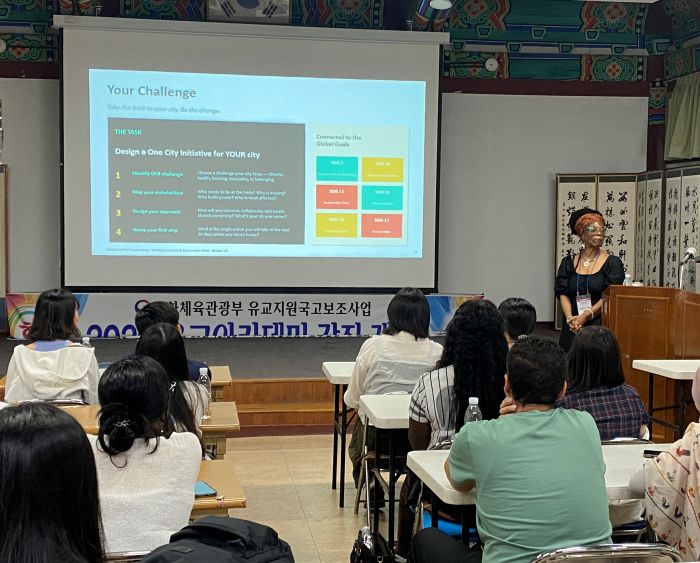
I encouraged participants to return home with one practical commitment: Identify one challenge facing your city, bring together the people who need to be part of the solution, and take one meaningful step within the next 30 days. Transformation rarely begins with grand gestures; it begins with consistent action.
“What struck me most was the willingness of young people … to engage openly with one another.”
Experiencing Gwangju
Beyond the conference itself, my time in Gwangju was deeply memorable. Gwangju is a city that understands both the importance of memory and the power of hope. Its history, particularly its struggle for democracy and human rights, gives the city a profound sense of purpose that continues to shape its identity today.
Throughout my visit I experienced exceptional hospitality from Gwangju International Center, the organizers; UNESCO; volunteers; and participants. The warmth, generosity, and openness of everyone I met reflected the very values that the camp sought to promote. What struck me most was the willingness of young people from so many different countries to engage openly with one another despite their diverse cultures, experiences, and perspectives. Their commitment to dialogue, collaboration, and shared learning reminded me that our greatest global challenges can only be addressed through international cooperation.
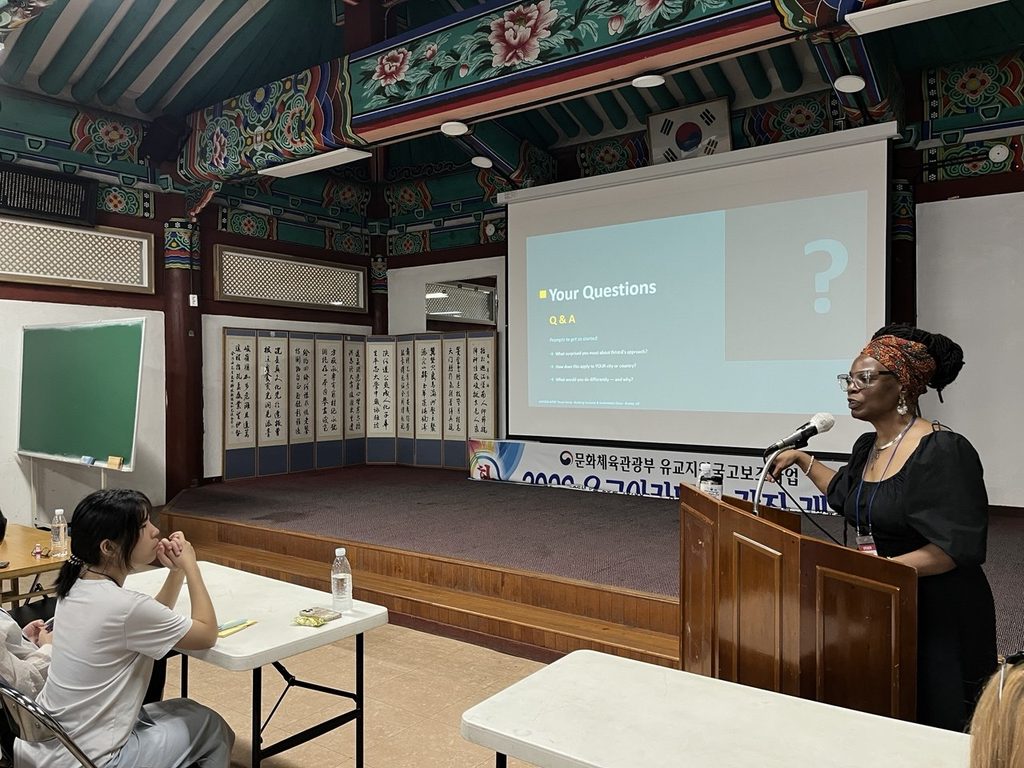
(Gwangju International Center)
I left Gwangju with new friendships, renewed optimism, and a stronger belief that cities will continue to be at the forefront of solving many of the defining challenges of our time.
The future of our cities will not be determined solely by governments or institutions. It will be shaped by people – especially young people – who are prepared to lead with courage, compassion, and a commitment to justice. As I reminded participants by closing with the words of Alice Walker, “The most common way people give up their power is by thinking they don’t have any.”
The next generation of city leaders is already here. Our responsibility is to create the conditions in which they can thrive.
¹ APCIC = Asia-Pacific Coalition of Inclusive Cities
² Bristol’s One City Approach: https://www.bristolonecity.com/about-the-one-city-plan/
³ Thrive Bristol: https://www.thrivebristol.org.uk/
⁴ Fast-Track Cities Bristol: https://fasttrackcitiesbristol.org/
⁵ Bristol City Leap: https://www.bristolcityleap.co.uk/
The Author
Asher Craig is an experienced leader in government, finance, and civil society, focused on driving systemic change for Black and global majority communities. She is the CEO of the Pathway Fund and chair of the Bristol Legacy Foundation. She served as deputy mayor of Bristol from 2016 to 2024.
Cover Photo: Asher Craig giving a presentation on building inclusive and sustainable cities at the 2026 UNESCO Global Youth Leaders Camp. (Gwangju International Center)