

The Power of Protest and Persistence
By Lisa Casaus ||
There are those who say that protest “doesn’t change anything,” but you can thank protest for the eight-hour workday and voting rights. For some, it has won the right to sit in any bus seat or drink from any water fountain, or even to enter a building in a wheelchair. Many of these achievements took years or even decades to accomplish.
My first experience of protest was as a spectator in a foreign land. As a teacher of English in Korean public schools on an E2 visa, I was not legally allowed to protest. And, growing up as a middle-class white kid, I had never “needed” to protest. I had only a vague idea of protest as being something that “overly emotional” people did. Many such privileged people are just as unaware of how important the use of free speech is or how close authoritarian threats to democracy truly are on any given day.
On that day in the fall of 2016 when I experienced this first protest, the main street in downtown Gwangju, a street regularly blocked off for festivals and other events, was filled with people holding candles. They sang, some sat on the cold ground, others on mats and rugs they had brought from home. They were demanding the impeachment of then-president Park Geun Hye for corruption. It was one night of many that formed the Candlelight Revolution (촛불혁명). There had been protests as early at 2015 calling for her resignation, but from October 2016 to March 2017, protesters took to the streets en masse, and succeeded.
In December 2024, after then-president Yoon Suk Yeul declared martial law in response to civil unrest, mass protests demanded and resulted in his impeachment and removal. I had returned to the U.S. by that time. Our own presidential election in November of that year had led many Americans, including myself, into a gloom of depression leading up to the inauguration in January 2025. But strains of hope popped up in corners online: Look at what South Korea has just accomplished!
However, even with my limited experience, I knew that results from protest could take years. In January of 2023, a little over nine months after Yoon’s election, I learned from a former co-worker, that she was going up to Seoul (a four-hour bus ride), almost weekly to protest for impeachment. I had seen the big banners on street corners, I remembered other teachers who had boycotted Japanese brands when international tensions were high, but in my sheltered bubble, this was only the second time I had come across a “real-life protester.”
Yoon was impeached 11 days after the event that brought millions of Koreans to the streets, but it took months to remove him from office and sentence him. Rival protests for and against his reinstatement were reported by international news outlets. According to BBC News, as of February 2026, 27 percent of Korean voters still supported Yoon.
Current U.S. polls show only a 34 percent approval rating nationwide of the current U.S. president, even after his unsanctioned attacks on Iran, which have thrown the world economy into turmoil. On top of this is example upon example of explicit corruption.
The American resistance movement has been growing since the presidential inauguration. In January 2025, I joined my first protest as an actual protester, flying 1,600 miles to be in Washington, D.C. There, I met people who had taken buses from New York and Pennsylvania, even an American ESL teacher who had flown in from Germany to attend. It was the Saturday before the inauguration ceremony and the Women’s March had put out a mass call.
While the size of the crowd was nowhere near the size of the 2017 Women’s March, which drew nearly half-a-million protesters to Washington, it was substantial. Several more trips to the nation’s capital in the following months showed me people from all over the country who were willing to come hundreds, if not thousands, of miles to declare that the man in the White House was not fit to be our president.
It was not until a large-scale protest in April 2025 that brought 200,000 people to D.C. and hundreds of local events nationally that legacy media began to report on the protests. The No Kings Movement, with its coalitions of veteran and new grassroots groups, was born out of this momentum.
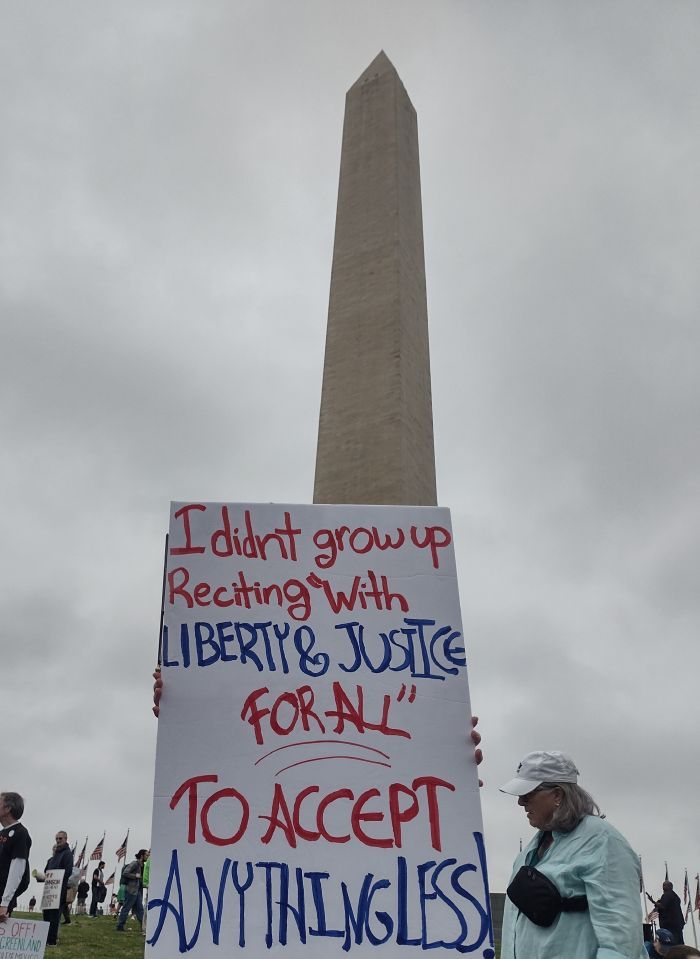
No Kings protest sign in Washington D.C.
No Kings Day 1.0 was organized to protest Trump’s proposed birthday celebration, a military-style parade complete with tanks that would cost over $40 million taxpayer dollars. Trump’s birthday coincides with Flag Day (June 14). This date in 2025 was also the 250th anniversary of the U.S. military. The parade suffered underwhelming turnout and reviews, while the United States experienced its largest day of coordinated action in the nation’s history, bringing out a reported 5,000,000 people across 50 states. (Trump’s response from the White House in the following months was to continue to send National Guard troops as “law enforcement,” despite the wishes of state governors.)
No Kings Day 2.0 took place in October 2025, this time given wide-scale media attention ahead of the event. An estimated 7,000,000 people turned out to over 2,300 listed events in 50 states, with some events also held internationally. Legacy media coverage grew as well to report the numbers. (The response from the White House was an AI-generated video of the president in a fighter jet, dumping feces on protesters’ heads!)
No Kings Day 3.0, in March 2026, took place just weeks after Trump started a war of choice with Iran. The number of attendees grew larger still, to over 8,000,000 in over 3,000 national and international events. Many protest signs included anti-war themes, as well as messages demanding an end to flagrant corruption, release of the Epstein files, justice for survivors, and calls to abolish ICE (the U.S. Immigration and Customs Enforcement agency).
The flagship event on March 28th was held in Minneapolis, Minnesota, the city that saw January 2026 deaths of Renee Nicole Good and Alex Pretti who were shot by Immigration and Customs Enforcement personnel and Department of Homeland Security personnel, respectively. Over 200,000 people attended the Minneapolis event.
Why do the numbers matter? The No Kings movement is based on the principles of non-violent direct action and the 3.5 percent rule proposed by political scientist, Erica Chennoweth, PhD, co-author of Why Civil Resistance Works, and author of the essay The Future of Nonviolent Resistance. The research posits that nonviolent, sustained resistance and coalition building is more effective at gaining support than violent resistance, and that if 3.5% of the population can be actively engaged in diverse forms of sustained resistance, they will likely succeed in removing an authoritarian government. For the United States, a nation of over 330 million people, that number is 11.5 million people.
This is not a magic number that, if reached, means all is instantly won, but it is a point of hope for many. It is a goal for which to strive for internationally because authoritarianism is on the rise around the world. Positive change has required constant action by individuals and communities, those who value freedom and humanity over greed, to uphold the claims of democracy and to hold their government accountable. Civil rights; labor rights; voting rights; women’s, children’s, LGBTQ+, and disability rights have been hard won, fought for by the people who believed that change would come if they refused to give in to tyranny.
The Carnegie Endowment for Internation Peace reports on its global protest tracker that “in the last 12 months, more than 68 countries have seen significant protests,” and that, as of April 2026, there are currently 30 active protests. Just this past May 1, events all over the world rallied on International Workers Day, also celebrated as Labor Day in over 80 countries.
In South Korea, you may have finally enjoyed May 1 as a public holiday after the 2025 legislation, which proposed changing the name and status of the former “Worker’s Day” to include civil servants and teachers starting in 2026. One of the largest challenges was the change in name. An article in the Korea Herald lays out the long history and the controversy surrounding language in the legislation and the negotiations that are still being held. This is only one example of bureaucracy’s slow-turning wheels, but it is also an example of the power of protest and persistence.
Sources
Carnegie Endowment for International Peace. (n.d.). Global protest tracker. https://carnegieendowment.org/ features/global-protest-tracker
Chenoweth, E. (2017, February 1). It may only take 3.5% of the population to topple a dictator – with civil resistance. The Guardian. https://www.theguardian.com/commentisfree/2017/feb/01/worried-american-democracy-study-activist-techniques
Lee, S. (2026, April 30). Korea’s Labor Day gets a name change, but who counts as a worker? The Korea Herald. https://www.koreaherald.com/article/10729351
The Author
Lisa Casaus taught in Gwangju public schools from 2016–2023. As an artist, she is processing current events through her work and developing ways to use art as activism and education.
Photographs by the author.
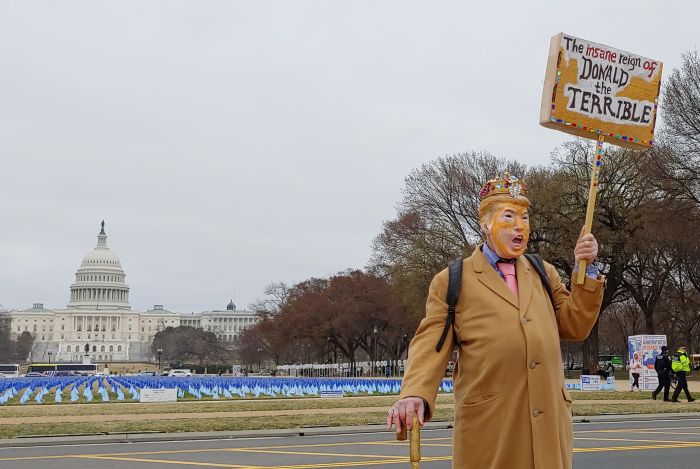
Cover Photo: Protestor in Washington D.C.