

Ponderings & Contemplations: Place Names with Intriguing Revelations
By Park Nahm-Sheik ||
Place names often come with meanings not always apparent on the surface. Take, for example, a village known as Bae-bau (배바우), located on the outskirts of the town of Hwasun, just south of Gwangju. Etymologically, it refers to a dock used to anchor sea-going sailing boats. It just so happened that Bae-bau once harbored a fairly busy traffic of vessels that once crisscrossed the seas surrounding the Korean Peninsula, especially along the southwestern shores.
Approximately ten kilometers due south of Bae-bau was Gaet-maeul (갯마을; literally, a seaside village), which we often misread as Gae-maeul (개마을; a canine village or village of/for dogs). Also known as Mosan-ri (모산리), Gae(t)-maeul was just a few kilometers from where I was born and raised in the early 1940s. This home village of mine went by the name of Hancheon-ri (한천리), which literally means a village with a cold well. This water source had a reputation of providing the coolest potable water around town.
By the way, the village right next to Hancheon-ri was Cheonggye-dong (청계동). The name of this village comes from the clear brook that flows in front of it. Another village, Geumjeon-ri (금전리) is to the south of Hancheon-ri. Geumjeon-ri apparently had hosted a gold mine until a couple of centuries ago. It was perhaps not coincidental that the three syllables in Geum–jeon–ri refer, respectively, to gold, field, and village.
Additionally, on a gentle hilly slope on the perimeter of Hancheon-ri was a stretch of arable land, known informally as Daek-maeul (댁마을; the village of lords), overgrown with lush bushes well into my teens. The name Daek-maeul suggests that our ancestors had served as underlings to the owners of the land they were inhabiting (in a servant–master relationship of one sort or another). Clearly visible to this day and age are the remnants of their rundown houses dating back to that remote past. And we are told that the Daek-maeul residents were of Cheongdo Kim clan lineage, in which case they must have hailed from the town of Cheongdo in the province of Gyeongsangbuk-do, which is outside of Jeollanam-do.

(GN with Microsoft Copilot)
Parenthetically, Neorit-jae (너릿재) is by far the best-known mountain pass in this province, Jeollanam-do. As is fairly well known, Neorit-jae is a compound moniker made up of two nouns, that is, neol (널, coffin) and jae (재, mountain pass). It allegedly has to do with the fact that Neorit-jae has traditionally been a popular route for coffin-bearers heading for burial sites on either side of the pass. It may be noted in this connection that the original bi-syllabic neol-jae (널제) has given way to the trisyllabic Neo-rit-jae. Interestingly, what is front and center in the word formation process involved here may not be the number of syllables per se. Although it comprises just two syllables, neol-jae may not be as easy to articulate as is its trisyllabic cousin Neorit-jae. For all practical purposes, the trisyllabic Neorit-jae may actually be more economical phonologically than its bi-syllabic relative.
On the subject of high terrain, Mudeung-san (무등산) is among Gwangju–Jeonnam’s tallest mountains at close to 1,187 meters above sea level, second only to Jiri-san in Gurye, sandwiched on the multi-provincial borders between the Jeolla and Gyeongsang Provinces. The name Mudeung-san itself says as much: Unrivaled and unequaled is what it proclaims loud and clear to the whole province of Jeonnam and the entire city of Gwangju as well. Mujinju (무진주), which happens to be how our ancestors once referred to Gwangju, apparently lays unmistakable claim to the commanding presence of the city in the entire region. By the way, Mudeung-san used to be called Mu-ak/Mujin-ak (무악/무진악) during the Baekje and Silla Periods and as Seoseok-san during the following Koryeo Period.
My hometown of Hwasun nestles in the calm and quiet embrace of this august and auspicious mountain peak. Mudeung-san deserves to stand and be counted among the most dignified of Korea’s national parks, bearing eloquent witness to the grandeur of Gwangju–Jeonnam on display for all to appreciate. And my nostalgia for Hwasun (with specific reference to Hancheon-myeon, Hancheon-ri) appears to be something I just can’t seem to shake off.
According to folklore, the place name Hwasun (화순) means “harmonious, peaceful, and compliant.” Hwasun certainly is a lovely sounding place name. I am in love with this wondrous town, almost head over heels. I may be under a lasting spell emanating from the beauty of this truly one-of-a-kind town. I may very well be in love with it, unrequited as the love may be.
Before closing, let me say that Mudeung-san isn’t the sole peak that does us folks from Gwangju–Jeonnam proud. We can take just as much pride in such other sky-commanding mountain tops of Hwasun as those proudly displayed by Baeka-san, Mohu-san, Cheoneun-san, Manyeon-san, and Yongam-san, which also seem to deserve our attention as well as affection.
The Author
Park Nahm-Sheik is a native of Gwangju. After graduating from Chonnam National University, he went on to receive a master’s degree at the University of Hawaii and a PhD (applied linguistics) at Georgetown University, both in the U.S. Upon completing an illustrious career at Seoul National University, Prof. Park served as president of the International Graduate School of English.
[1] https://creativecommons.org/licenses/by-sa/4.0
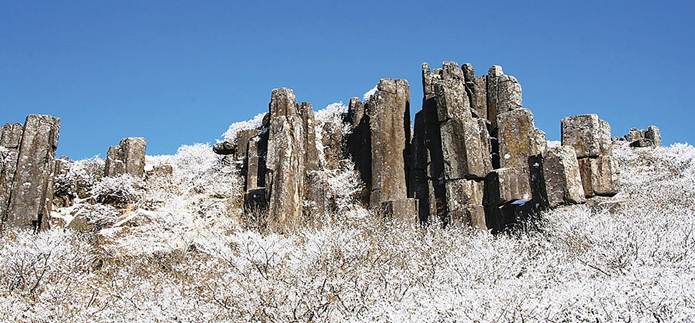
Cover Photo: Mudeung-san columnar joints. (Seong Ilhan, [1])