
Strengthening Solidarity with the World’s Oppressed: A Call for Gwangju to Lead
By Choi Yong-ju ||
The tragedy of Gwangju in May 1980 stemmed from isolation. While citizens suffered under the violence of martial law troops, most Koreans remained unaware – the government had imposed a strict blackout on the press. Cut off from the outside world, Gwangju’s resistance was distorted and labeled as a riot instigated by communists and disgruntled elements. The result was not only physical suppression but a deeper crisis of oblivion, one that hardened into distortion, denigration, and stigmatization.
Yet Gwangju was not alone internationally. During research at UCLA’s East Asian Library, I found compelling evidence: While the Korean government suppressed the story at home, it was being reported swiftly and accurately across the United States, Japan, and Europe.
The international response was swift and substantial. Human rights organizations gathered outside Korean embassies, distributed appeals near the White House, and organized prayer meetings and fundraisers in solidarity. Beginning May 20, 1980 – when a Chicago human rights group first circulated English-language accounts of the uprising – solidarity actions spread across New York, Los Angeles, Japan, and Germany. On May 28, a memorial at Riverside Church in Manhattan drew prominent activists and politicians. By year’s end, international delegations had visited Seoul and Gwangju, documented the atrocities, and submitted reports to Amnesty International, the United Nations, and the U.S. government.
“Gwangju’s civil society and local government must develop programs that respond to these realities with the seriousness they demand.”
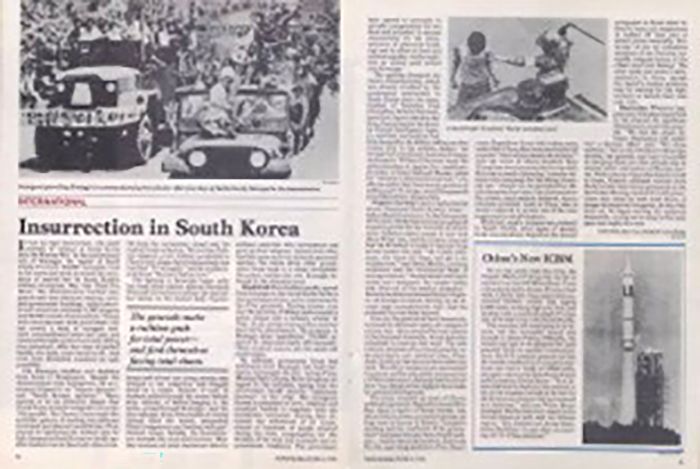
Newsweek, June 2, 1980. (Courtesy of the Seoul Metropolitan Archives)
Forty-six years later, Gwangju must consider what it owes in return. Repayment cannot take the form of commemoration alone – it requires concrete, sustained action in solidarity with those who suffer today under state violence and repression.
The scale of need is considerable. In Gaza, Iran, and Lebanon, civilians are bearing the costs of armed conflict. In Myanmar, Nepal, Sri Lanka, and Hong Kong, people are being detained or disappeared for exercising democratic rights. Across parts of South Asia, Latin America, and Africa, ethnic minorities, migrants, and women face systematic persecution. Gwangju’s civil society and local government must develop programs that respond to these realities with the seriousness they demand.
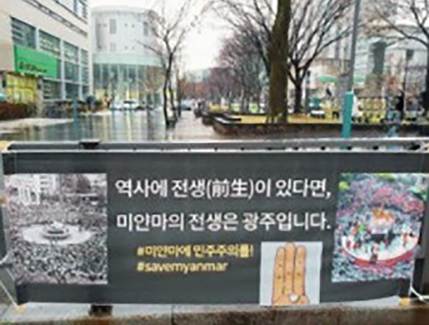
Gwangju–Myanmar Solidarity banner displayed in Gwangju, March 2021. (Courtesy of Gwangju–Myanmar Solidarity)
Gwangju has established a foundation. The World Human Rights Cities Forum has become a recognized platform for international solidarity. The Gwangju Prize for Human Rights Award contributes meaningfully to democratic development abroad. May 18 organizations have issued statements of solidarity with movements in Myanmar, Nepal, Hong Kong, and elsewhere.
However, annual events and public statements are insufficient. What is required now is institutional commitment: an international solidarity fund, a permanent support body, and sustained partnerships with human rights organizations worldwide. These structures are not ends in themselves. They are the means by which the remarkable communal spirit of the Gwangju Uprising is carried forward as living practice rather than historical memory.
The Author
Choi Yong-ju studied sociology and previously served as chief investigator for the Truth and Reconciliation Commission for the May 18 Democratization Movement. He is currently researching overseas archival records related to May 18 and has translated works by Jon Elster and Martin Mittelmeier into Korean.
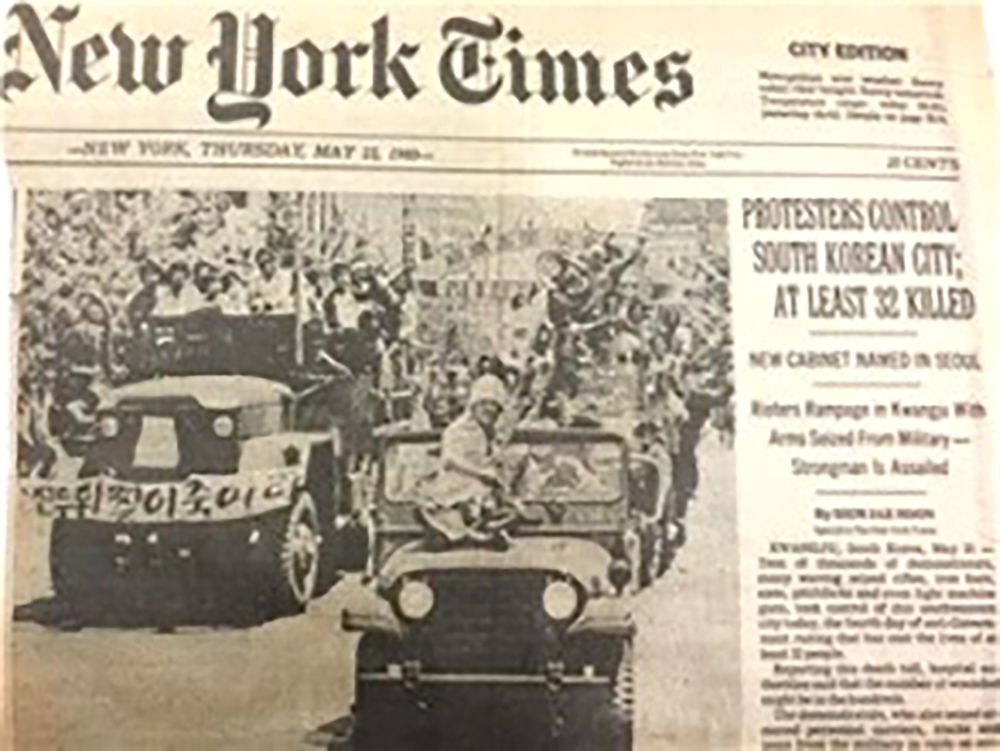
Cover Photo: The New York Times, May 22, 1980. (Courtesy of the May 18 Foundation)