




The Impact of AI on Human Rights
By Muhammad Umar Tahir ||
It was Sunday, and I was sitting in a waiting area of a nearby community center when I noticed something interesting happening right next to me. An old man was trying to unlock his phone using face recognition, but it was not working. He tried again and again, slightly adjusting his face, moving the phone closer, and even changing the angle, but the system did not recognize him. After a few attempts, he laughed and said, “Maybe the phone does not like me today… haah!” It was an interesting moment, almost funny, and something many of us may have also experienced. But as I watched that small event, a deeper thought came to mind: What happens when machines begin to decide who we are, and whether we are accepted or rejected?
For a long time, we have believed that human rights are protected by laws, systems, and institutions created by people. These include important rights like privacy, equality, freedom of expression, and access to opportunities. These rights are considered basic, and they help create a fair and balanced society. But now, something new is becoming part of this system. Artificial intelligence is slowly entering areas that were once completely managed by humans. At first, it feels like a helpful tool, but over time, it starts to play a bigger role in decision-making processes that directly affect people’s lives.
In our daily lives, AI already feels normal and useful. It helps us search for information, write messages, and organize our tasks more efficiently. It recommends what we should watch, what we should buy, and even how we should respond to messages. These systems make life easier and save time, which is why we trust them more and more. But behind this convenience, AI is quietly becoming more powerful. It is moving beyond simple assistance and entering areas where decisions are not just helpful but important. This is where things start to become more serious.
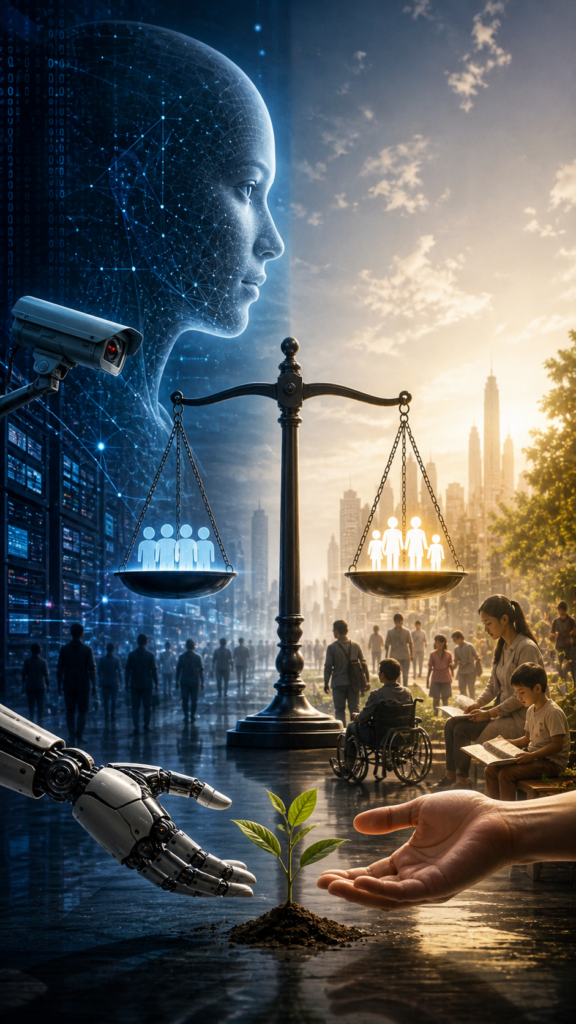
(GN with OpenAI ChatGPT)
Concerns About Human Rights
Today, AI systems are being used in situations that directly impact human lives in meaningful ways. For example, they can help decide who gets selected for a job, who qualifies for financial support, or how risks are evaluated in different situations. In some environments, AI can also monitor activities, recognize faces, and track movements over time. These systems are fast, efficient, and capable of handling large amounts of information. However, they are not always perfect, and this is where concerns about human rights begin to appear.
One of the most important concerns is fairness. AI systems learn from data, and that data comes from real-world situations. If the data contains bias or imbalance, the system may also reflect those patterns. This means that decisions made by AI might not always treat everyone equally. For example, a system designed to select candidates for a job might unintentionally favor certain profiles over others based on past data. The system is not intentionally unfair, but it learns from patterns that already exist. This raises an important question. If a machine makes an unfair decision, who is responsible, and how can it be corrected?
Another important concern is privacy. AI systems depend on large amounts of data to function effectively. This data can include personal details, behavior patterns, preferences, and even location information. While this helps systems improve their performance, it also creates risks for individuals. Many people do not fully understand how their data is collected, stored, or used. In some cases, information is shared across systems without clear awareness. Once data becomes part of a system, it becomes difficult to fully control or remove it. This creates a situation where convenience and privacy must be carefully balanced.
There is also the question of control and transparency. As AI systems become more advanced, they are able to make decisions very quickly, sometimes faster than humans can understand. In many cases, people rely on these systems without knowing how they actually work. The decision is visible, but the reasoning behind it is not always clear. This creates a challenge because trust depends on understanding. If people cannot understand how decisions are made, it becomes difficult to fully trust the system. Transparency becomes important, not only for experts but for everyday users as well.
Support for Human Rights
But this is only one side of the story, and it is important to look at the other side as well. Artificial intelligence also has the potential to support and strengthen human rights in many positive ways. For example, AI can help identify unfair practices by analyzing large amounts of data and finding patterns that humans might miss. It can highlight issues that need attention and support efforts to create more balanced systems. In this way, AI can be used as a tool for fairness, rather than a source of bias.
In healthcare, AI can make a significant difference by improving access to medical services. It can assist doctors by analyzing complex data, helping detect diseases earlier, and suggesting more effective treatments. In areas where medical resources are limited, AI can help provide support and improve decision-making. This does not replace human expertise, but it enhances it. In many cases, better and faster decisions can lead to better outcomes for patients, which directly supports the right to health and well-being.
In education, AI can help create more inclusive learning environments. It can adjust content based on the needs of individual students, making education more accessible for people with different abilities and backgrounds. It can also support communication by breaking language barriers, allowing people from different regions to connect more easily. These improvements help promote equal opportunities and make systems more inclusive for everyone.
A Complex Relationship
This is what makes the relationship between AI and human rights so complex. The same technology that can create challenges can also provide solutions. It can increase efficiency, but it can also pose risks. It can improve access, but it can also raise concerns about control. The outcome depends not on the technology itself, but on how it is designed, implemented, and managed.
At the same time, we must also understand another important reality. Technology is not just a tool anymore. It is becoming a source of power. Those who develop and control advanced AI systems may gain significant advantages, not only in specific areas but across multiple systems. This includes access to resources, influence over decisions, and control over important processes. This shift is not always visible, but it is gradually shaping how power is distributed.
This is where artificial intelligence connects to something even larger. It is not only changing technology or improving systems. It is slowly influencing how the world is organized. In the past, power was mainly connected to human strength, physical resources, and direct control. Today, intelligence systems are becoming a major factor in shaping influence. The systems that are more advanced, more connected, and more intelligent can affect how decisions are made and how systems operate.
This means that the impact of AI is not limited to one area. It can influence many parts of life at the same time. From personal decisions to larger systems, from everyday convenience to important processes, everything becomes connected through intelligent technologies. This is why the role of AI in shaping the future is becoming so important. It is not just about technology – it is about direction.
The direction depends on human choices. At the same time, one thing is becoming clear. In the future, those who understand and use AI effectively will move forward faster. Those who ignore it may find it difficult to keep up. This applies not only to individuals but also to larger systems and societies. The gap between those who adapt and those who do not may continue to grow.
This is not something to fear, but it is something to understand. Awareness is important. Responsible use is important. Careful design is important. These are the factors that will decide whether AI supports human rights or creates challenges for them.
Looking back at that small moment in the waiting area, it no longer feels like just a simple situation with a phone. It feels like a small reflection of a much bigger change. A change where machines are not just tools, but decision-makers. A change where systems are becoming more intelligent, more connected, and more involved in human life.
The impact of AI on human rights is not something that will happen in the future. It is already happening, slowly and quietly. The real question is not whether AI will influence human rights, because it already does.
The real question is . . .
How will we guide this technology so that it protects human rights instead of putting them at risk?
The Author
Muhammad Umar Tahir is an electrical engineer pursuing his PhD in the Artificial Intelligence Convergence Department at Gwangju Institute of Science and Technology (GIST). He is interested in applying AI to healthcare devices, particularly in advancing medical imaging technologies and brain stimulation. Outside research, he enjoys exploring new places, meeting people, and exchanging ideas on how innovation can improve the quality of life.
Cover Photo by Numan Ali via Unsplash.