


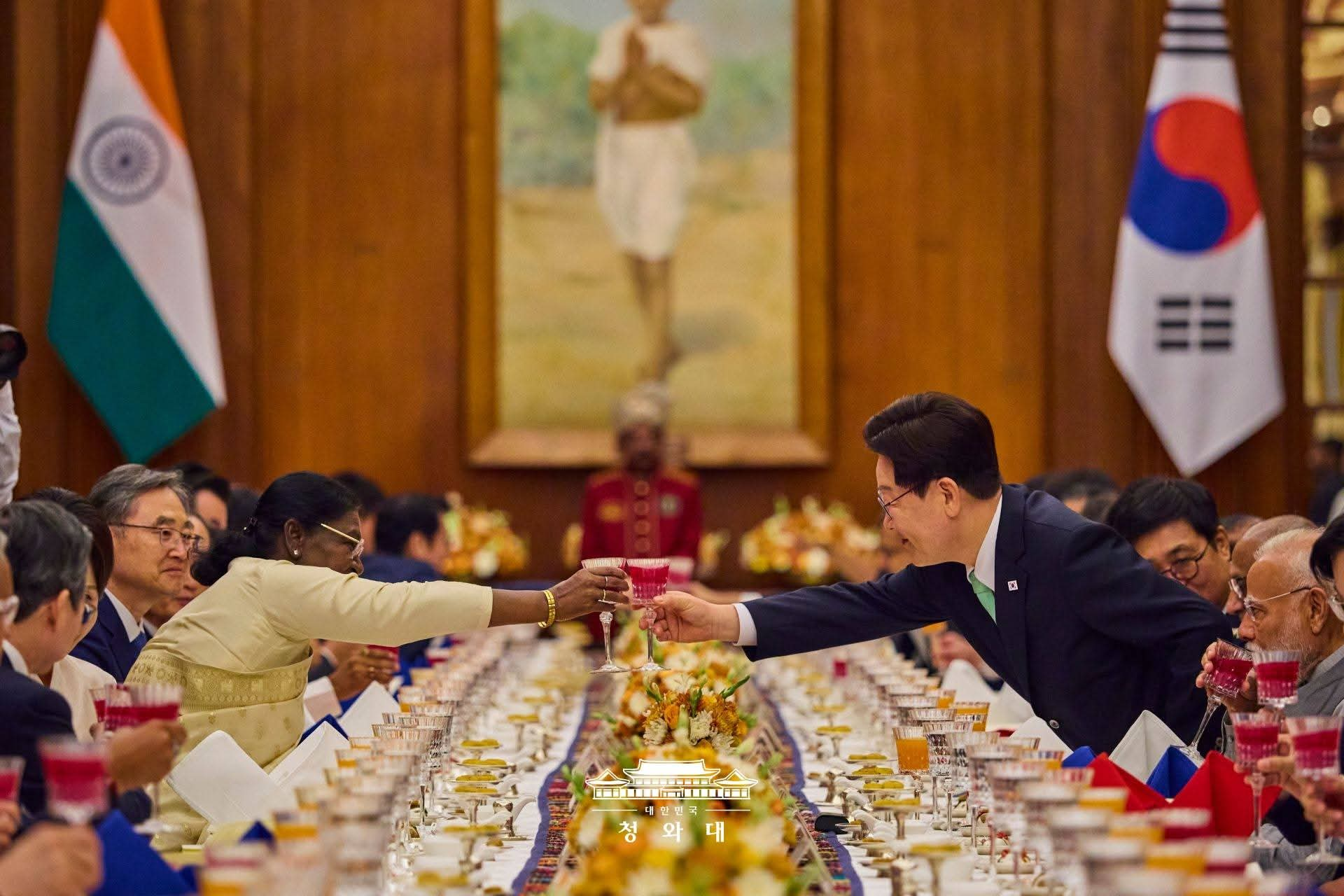
The India–Korea Mirror: Beyond the Ledger
By Reeti Roy ||
For decades, conversations between India and South Korea have been dominated by economics. We celebrate rising trade figures, semiconductor investments, defense partnerships, and free trade agreements. Yet the most valuable exchange between the two countries may not be technological or commercial. It may be cultural.
As someone who has spent considerable time living and working in both countries, I have often found that India and Korea mirror one another in unexpected ways. Both are ancient civilizations negotiating modernity. Both possess extraordinary cultural confidence. Both carry invisible anxieties about their place in the world. The similarities are striking, but so are the differences. Each country excels where the other struggles, and it is precisely in those differences that the greatest opportunities for learning lie.
The Diplomatic Moment
The timing of this conversation is significant. President Lee Jae Myung’s state visit to India in April 2026 marked a new chapter in bilateral relations. The Joint Strategic Vision (2026–
2030), an ambitious target of US$50 billion in bilateral trade and expanded cooperation in semiconductors, digital infrastructure, shipbuilding, and economic security reflects the growing confidence both governments place in one another. Yet the deeper significance of the visit lay beyond economics. It acknowledged that the relationship between India and Korea has matured and that its next phase will depend not only on governments and corporations but also on universities, artists, entrepreneurs, researchers, and ordinary citizens.
Diplomatic agreements can establish frameworks, but people build relationships. If India and Korea are to become genuine long-term partners, they must learn from one another with the same seriousness that they pursue in trade and investment.
Lessons for India: The Architecture of Success
The first lesson India could learn from Korea is the power of collective responsibility. In Korea, public spaces are treated as shared spaces. Streets are remarkably clean, public transport functions with extraordinary efficiency and queues are respected. These are not simply outcomes of effective governance but reflections of everyday social behavior. There is an understanding that one’s actions affect strangers.
Living in Korea, I often found myself reflecting on how efficiency is not merely an administrative achievement but a form of social trust. Systems work because people expect them to work and behave accordingly. Returning to India reminded me how often we celebrate our ability to navigate disorder rather than asking why disorder should be accepted in the first place.
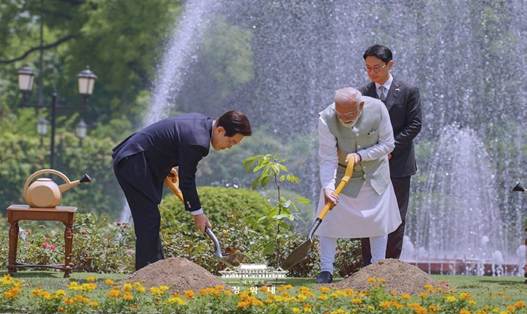
President Lee and Prime Minister Modi planting an ashoka tree sapling representing Indian–Korean friendship.
India is exceptionally resourceful. We adapt to complexity with astonishing creativity. Yet resilience should not become an excuse for weak institutions. Civic responsibility is not an imported ideal. It is the foundation upon which trust, infrastructure, and public life are built.
Korea also demonstrates the value of sustained investment in education, research, and long-term planning. Its remarkable transformation from the devastation of war into one of the world’s leading technological and cultural powers was not accidental. It was the result of decades of strategic thinking and institutional commitment.
India has no shortage of talent. What we sometimes lack is consistency. We produce brilliant individuals despite the system rather than because of it. Imagine what India could become if excellence became predictable rather than exceptional.
Perhaps Korea’s most visible success is its ability to tell its own story. Korean cinema, music, literature, and cuisine have become global cultural exports through sustained investment in creative industries and cultural diplomacy. India possesses one of the richest cultural traditions in the world, yet our global storytelling remains fragmented. Soft power cannot depend solely on Bollywood or yoga. It must also include regional literature, contemporary art, indigenous knowledge, and the remarkable diversity of Indian culture.
Lessons for Korea: The Vitality of Inclusion
Admiration, however, should never become romanticization. Korea, too, has much to gain from looking towards India. India’s greatest strength may be its comfort with complexity. We have not perfected pluralism and our social divisions remain real. Yet few countries have accumulated as much historical experience negotiating linguistic, religious, and cultural diversity within a single democratic framework.
As Korea confronts demographic decline and increasing migration, diversity is no longer a distant question but an emerging reality. Future prosperity will depend not only on technological innovation but also on social inclusion. India’s experience demonstrates that diversity, while often challenging, can also become a source of creativity and resilience.
Korea could also benefit from embracing a broader definition of success. Achievement is frequently measured through educational attainment, professional status, and relentless productivity. The results are impressive but often come at considerable personal cost.
Returning home from Korea reminded me that India’s strengths are often less visible. Families remain deeply interconnected. Communities continue to function as informal support systems.
Festivals, neighborhood networks, and everyday social interactions create forms of resilience that cannot be measured through economic statistics alone.
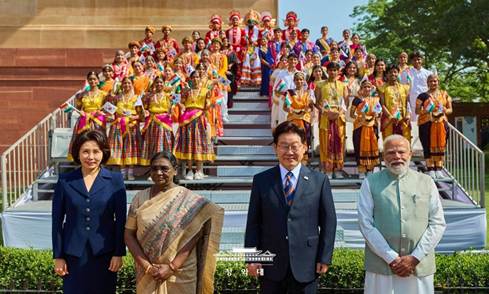
The President and First Lady of South Korea with Indian Prime Minister Narendra Modi and Indian President Droupadi Murmu (second from left).
There is another lesson India quietly offers: the ability to improvise. Entrepreneurs, artists, and social innovators regularly create solutions despite limited resources. Frugal innovation has become one of India’s defining characteristics. Korea’s institutions are extraordinarily efficient, but they can also be rigid. Greater tolerance for experimentation and unconventional career paths may encourage even greater creativity in an increasingly uncertain world.
The Synthesis: Learning Without Imitation
The future of India–Korea relations will not be determined solely by rising trade figures or ambitious investment targets. Those are essential foundations, but they are not enough. Enduring partnerships are built when societies become genuinely curious about one another.
India does not need to become Korea, nor does Korea need to become India. The value of this relationship lies precisely in the qualities each possesses that the other increasingly needs. Korea’s strengths in long-term planning, public trust, and institutional discipline complement India’s capacity for pluralism, adaptability, and creative problem solving. Rather than viewing these differences as contrasts, we should see them as opportunities for mutual learning.
There are already signs of what this exchange could become. India has demonstrated how affordable, resource conscious innovation can address complex social challenges at scale. Korea, meanwhile, has shown how sustained investment in education, research, technology, and cultural industries can transform a nation’s global standing within a single generation. As both countries confront shared challenges, from demographic change and climate resilience to artificial intelligence and the future of work, they have much to gain from exchanging ideas as readily as they exchange goods.
The India–Korea relationship is often described through the language of economics. Trade matters. Investment matters. Strategic cooperation matters. Yet the most enduring relationships are rarely built by governments alone. They are strengthened through classrooms, galleries, research collaborations, entrepreneurial exchanges, shared meals, and the quiet conversations that allow people to understand one another beyond headlines and stereotypes.
Having lived in both countries, I have come to believe that the real value of the India–Korea partnership lies not in how much we resemble one another but in how much we can learn from our differences. The mirror between India and Korea does not simply reflect who we are today. It offers a glimpse of who we might become if we are willing to look beyond ourselves.
As the bilateral relationship enters a new chapter, perhaps our greatest investment will not be measured in billions of dollars but in the willingness of our societies to listen, learn, and imagine a shared future together.
The Author
Reeti Roy is a cultural commentator and the founder of Aglet Ink. A graduate of Jadavpur University and the London School of Economics, she is currently based between Korea and India, investigating Indo-Korean social architectures through an anthropological lens.
Photographs by the Blue House, Korean Government.
Cover Photo: President Lee Jae Myung shaking hands with Indian President Droupadi Murmu.