
Gwangju City News – April 2026
Historic Milestone: Jeonnam and Gwangju Merge
Exactly 40 years after Gwangju was elevated to directly governed city status and separated from South Jeolla Province (aka Jeonnam) in 1986, Gwangju Metropolitan City and Jeonnam are merging into one. On March 1, the National Assembly passed the Special Act for the Establishment of the Jeonnam-Gwangju Integrated Special City at a plenary session – the first case of a metropolitan administrative merger in Korean history. The official name is Jeonnam-Gwangju Integrated Special City, with the short name Gwangju Special City. A massive special metropolitan city of 3.2 million residents will be born, with the main offices distributed across three locations: Gwangju, Muan, and Suncheon. On June 3, during local elections, the inaugural integrated special city mayor and integrated superintendent of education will be chosen in a single vote, with the city officially launching on July 1.
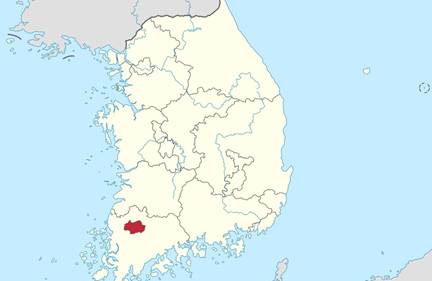
Gwangju City (red) surrounded by Jeonnam Province. (NordNordWest, CC BY-SA 3.0 de)
The Jeonnam-Gwangju Integrated Special City is set to transform South Korea’s industrial landscape through semiconductors and AI. To reverse the reality of 8,000 young people leaving Gwangju and 4,000 leaving Jeonnam annually, industries capable of creating jobs for the young needed to be attracted.
Gwangju 2026 Budget Increases
Gwangju Metropolitan City successfully secured 3.9497 trillion won in the 2026 national budget. This is an increase of 563.9 billion won (16.6%) compared to the previous year, more than double the overall government growth rate of 8.1%. Included are major SOC investments: 61.7 billion won for AI Mobility Pilot City development (a key element of the Future Vehicle Specialized City strategy), 167.2 billion won for electrification of the Gyeongjeon Line (Gwangju-Songjeong to Suncheon), and 66.8 billion won for the Gwangju–Gangjin Expressway.
Gwangju City Expands Welfare and Care Policies
In 2026, Gwangju City’s flagship welfare program, Gwangju Dauum (True to Gwangju) Integrated Care, will significantly expand its eligible beneficiaries from those with median income up to 90% to 160%. The plan is to complete a universal welfare model in Gwangju ahead of its national rollout. The addition of pharmacist home-visit medication services is expected to fill gaps in the home medical care service network. Of Gwangju City’s 2027 main budget of 7.6823 trillion won, the welfare and care sector includes
7.43 billion won for community integrated care support, 12.29 billion won for Gwangju-style lifelong housing construction, and 2 billion won for birth family congratulatory Sangsaeng Cards.
Subway Line 2 Surface Streets Largely Reopened
At the end of last year, the 16.3 km of surface roads along Phase 1 of Gwangju Subway Line 2 (scheduled to open in late 2027) were largely opened after six years of restricted access. Of the City Hall–Gwangju Station segment (17 km total), and some remaining sections (687 m), including the Geumho District entrance and Baegun Plaza, are scheduled for phased opening through June. Nearby commercial districts are expected to regain vitality during the spring peak season. Aligned with April’s spring outing season, traditional markets and cultural streets along the route are anticipated to emerge as new spring destinations.
In conjunction with this reopening, Gwangju City has launched a comprehensive campaign to stimulate local consumption and support measures for small business owners along nearby streets affected by the subway construction during the prolonged construction phase. The city has invested a total of 11.9 billion won into these recovery efforts.
Gwangju AI Ecosystem: Results Produced, Bigger Leaps Ahead
Gwangju Metropolitan City has completed Phase 1 of the Gwangju AI Hub City Project, pursued over the past five years, and will invest approximately 600 billion won from 2026 over the next five years to build an AI Transformation (AX) Demonstration Valley. The goal is to integrate AI into regional strategic industries such as mobility and energy, expanding AI services that citizens can experience in their daily lives.
Gwangju is also pursuing the establishment of a National Neural Processing Unit (NPU) Computing Center, designation as an AI regulation-free demonstration city, and attraction of a National AI Research Institute. This project – which aims to build an AI Innovation Space, concentrate 1,000 AI convergence companies, and create over 6,000 jobs – has been exempted from a preliminary feasibility study by the government, accelerating its progress.
Over the past five years, MOU agreements were signed with 352 companies, approximately 160 companies relocated their headquarters or branches to Gwangju, and 15 regional companies won 24 innovation awards at CES 2023–2026, including two Best Innovation Awards. LBS Tech won the Best Innovation Award at CES 2026.
GIST Develops New Lithium Battery Technology
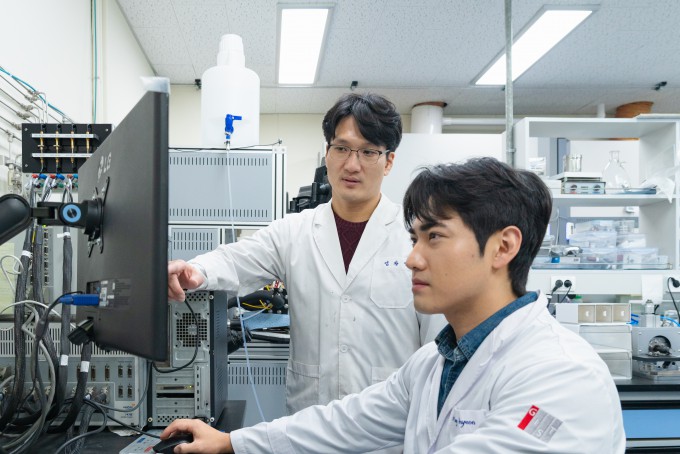
Prof. Eum Kwang-seop (left) and PhD student Lee Chang-hyun in their research institute laboratory. (GIST)
A research team led by Prof. Eum Kwang-seop at the GIST Next-Generation Energy Research Institute developed a technology to form the anode interface of a lithium metal battery in just two minutes using an electrochemical pulse deposition process. This is evaluated as a step closer to commercializing next-generation high-energy batteries for electric vehicles (EVs) and energy storage systems (ESS). The technology also aligns with the AI and Energy Capital vision of the Jeonnam-Gwangju Integrated Special City.
Compiled by Amy Park.
Amy Park is a program officer for Asian Legal Resource Center (ALRC Korea) based in Gwangju. She helps build the organization’s foundation and supports new efforts in human rights advocacy and resource sharing.