

Tea with Activist Ohara Tsunaki of No-Nukes News
By Chung Hyunhwa ||
I first met Ms. Ohara Tsunaki several years ago at the No-Nukes News booth during an Environment Day event in front of the Asian Culture Center. I learned she was from Japan, but her Korean was so fluent that I never would have guessed had she not mentioned it. After that first encounter, I began noticing her name whenever there were actions or events related to anti-nuclear movements. Recently, with the decision to establish an AI semiconductor facility in Gwangju, power supply has become a major issue. On top of that, the Ministry of Environment recently announced plans to extend the lifespan of two reactors in Yeong-gwang and build two new nuclear power plants. Driven by these developments, I arranged to meet Ms. Ohara to learn more about her and the activities of the No-Nukes News.
How Ohara Became Engaged in the No-Nukes News
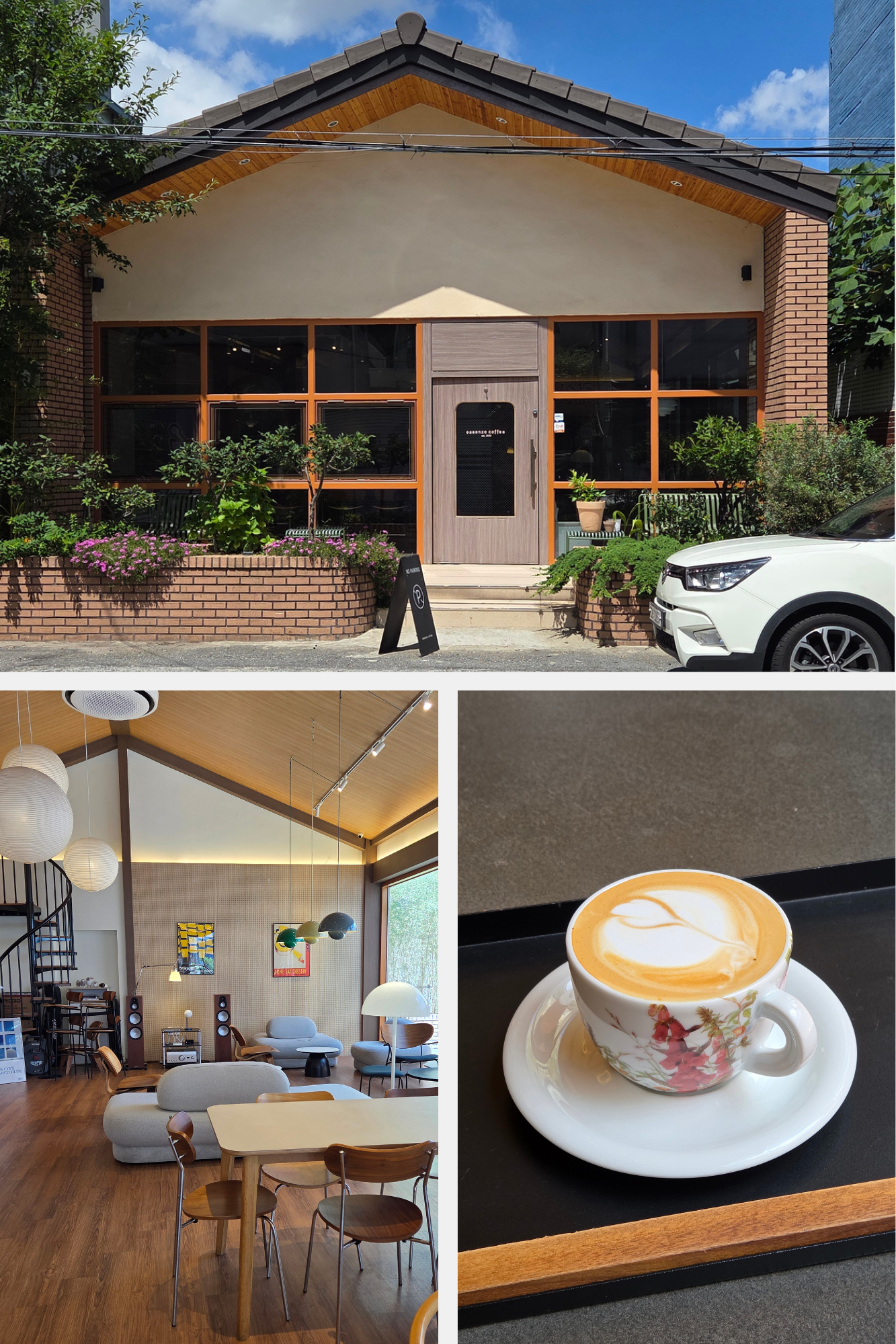
We met at a black tea café in Dongmyeong-dong. Ms. Ohara was a healthy, energetic woman in her early 50s who enjoyed the café’s signature milk tea topped with ice cream. Curious about how she came to live in Korea, I asked about her background. Twenty-six years ago, while attending college, she came to Gwangju as an exchange student upon her professor’s recommendation. Her growing interest in environmental issues led her to join the Gwangju Federation for Environmental Movements in 2007. She shared that her surname Ohara sounds much like a Korean name, which has made living in Korea quite convenient.
When the catastrophic accident occurred at TEPCO’s Fukushima Daiichi Nuclear Power Plant in Japan in March 2011, environmental and civic groups formed a coalition called Gwangju-Jeonnam Action for a Nuclear-Free World. Deeply shocked by the disaster, she joined as an active member. Later, she began working with the media cooperative No-Nukes News, where she currently serves as an editorial board member and secretary-general.
“I knew about the hazards of nuclear power, but I never imagined such an accident could happen in Japan, a country known as a technical power,” she told me. “I reflected deeply on how I had failed to fully grasp the dangers of nuclear energy. I resolved to take on the role of informing people in Korea about what would unfold in Fukushima.”
The Changes in the Nuclear Power Plant Policies
Ohara continued, saying that the Fukushima disaster had broadened the scope of the anti-nuclear movement in Korea. Previously, it had been centered mostly around residents living near nuclear plants, but after Fukushima it evolved into a broader nuclear-free movement – a collective demand for a safe world shared by everyone who consumed electricity.
At one point, she believed public opinion in Korea demanding an energy transition away from nuclear power had exceeded 80 percent, though that momentum was short-lived. She explained that the Moon Jae-in administration had declared a nuclear phase-out, but it was mere lip service, while the Yoon Suk Yeol administration had taken the opposite route, aggressively promoting nuclear energy. The current administration, she said, had inherited and was actively pushing forward the construction of new nuclear plants and the lifespan extensions of aging reactors decided under the previous government.
She added that Yeongdeok County in Gyeongbuk Province had recently been selected as a candidate site for two new large-scale reactors, along with plans for one SMR unit with four reactors in Gijang, Busan. The government, she noted, is even implying that construction of more nuclear power plants be considered.
Isn’t Nuclear Power Clean?
Hearing this from Ohara, I asked, “Many people still view nuclear power as a clean energy source. What would you say to them?”
With a grave expression, she replied, “Nuclear power is by no means clean. While it does not emit carbon dioxide during the generation process, the thermal discharge released during operation raises ocean temperatures, contributing to global warming. High-level radioactive waste is another major issue. Methods for safely handling spent nuclear fuel remain uncertain and extremely limited. Ultimately, it must be stored safely 300 to 500 meters underground for over 100,000 years, but it remains doubtful whether South Korea can ever secure a suitable site.”
Ohara explained that if even a single accident were to occur, irreversible contamination would persist for centuries. She pointed out that the Chernobyl disaster in the former Soviet Union and the Fukushima disaster in Japan clearly illustrated this reality. She added that even without an accident, studies had shown higher incidence rates of thyroid and other cancers in areas surrounding nuclear plants. Ultimately, she argued, nuclear power is neither clean nor safe, and treating nuclear energy as a solution to the climate crisis is the wrong choice.
Are SMRs Going to Become the Alternatives?
I then asked Ohara if small modular reactors (SMRs) could serve as a viable alternative for next-generation nuclear power. She pointed out that SMR technology remains completely unproven: “Even frontrunners like NuScale and TerraPower in the United States are facing various setbacks, with their stock prices fluctuating wildly.”
Ohara continued, “Even if built and operated, SMRs lack economies of scale due to their smaller size, making their electricity generation costs far higher than those of conventional large-scale reactors. Like traditional plants, they require vast amounts of cooling water and carry undeniable accident risks, meaning they cannot be built in urban areas. Consequently, this fails to resolve transmission tower disputes. Furthermore, SMRs generate 20–30 times more nuclear waste than conventional plants. SMRs are nothing more than a rosy illusion chased by the nuclear industry.”
The Right Way to Go
I also asked about the best path forward, given that 26 reactors are currently operational in Korea and considering how difficult it is to shut down or dismantle nuclear plants once started.
Ohara quickly responded, “First, electricity demand forecasts are consistently inflated. Over the past decade, the power reserve margin has never fallen below 5,500 MW (5.5 GW). Even during ordinary times, tens of gigawatts of electricity remain in excess, with average reserve margins ranging between 30 and 40 percent.”
Ohara stated that claims suggesting AI would cause electricity demand to skyrocket were being used to justify building new plants. However, she emphasized that constructing a new nuclear facility takes at least 13 to 15 years from site selection to operation. She argued that saying more nuclear plants needed to be built immediately because of AI simply did not add up.
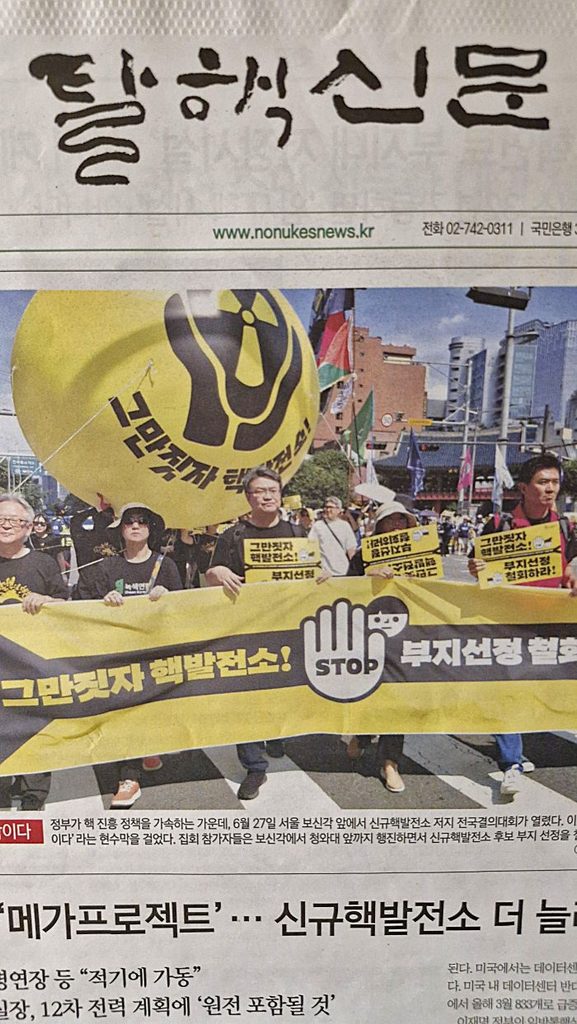
The print edition of the No-Nukes News.
“Critics argue,” she added, “that renewable energy is affected by weather and offers an unstable power supply. However, reducing coal and thermal power, while increasing renewables, is imperative to achieving greenhouse gas reductions. Yet nuclear power plants, which cannot flexibly adjust their output, fail to support a stable grid alongside variable renewable energy sources. The government claims to pursue an ‘energy mix’ by expanding both renewables and nuclear energy, but considering the inherent characteristics of these two sources, this policy is contradictory.”
Ohara remarked that while it was not possible to shut down all nuclear plants overnight, gradual efforts had to be made to reduce nuclear power so as not to pass the burden on to future generations. She explained that the current issue was not a shortage of electricity but rather the inefficient distribution of the power already generated. To address this, she stressed the urgent need to expand renewable energy while simultaneously increasing battery energy storage systems (BESS) to buffer intermittency and constructing an efficient power grid system. She concluded that blindly increasing nuclear power simply because demand rose was not the right approach.
The Focus of the Movement in Jeonnam-Gwangju
I then asked Ohara what current initiatives the anti-nuclear movement in the Gwangju and Jeonnam region is focusing on.
Her reply was quick: “On June 29, the government announced three mega-projects. The AI Data Center alone requires 18.4 GW of power, and the Gwangju Semiconductor Cluster requires 6.3 GW. Consequently, government officials have begun floating the idea of building additional nuclear power plants.”
Ohara explained that for Gwangju and Jeonnam, there were calls to build two additional reactors at the Hanbit Nuclear Power Plant site in Yeong-gwang. She noted that since the first reactor had been constructed at Hanbit in 1986, a total of six reactors had been built during the early 2000s. She pointed out that the lifespan of a nuclear reactor was 40 years and that lifespan extension procedures for Hanbit Units 1 and 2 were currently underway for an additional 10 years. She emphasized that civil society in Gwangju and Jeonnam had consistently opposed extending the lifespan of aging reactors, and she argued that using the semiconductor cluster as an excuse to take life extensions for granted was unacceptable. She added that they were raising their voices to stop what she described as an anachronistic expansion of nuclear power disguised under the pretext of three mega-projects and to steer toward a sustainable path.
Words to the Readers
As the interview drew to a close, I asked Ohara if she had a message for our readers. She concluded with the following: “My home country, Japan, has experienced three nuclear disasters: the first and second were the atomic bombings of Hiroshima and Nagasaki in 1945, and the third was the Fukushima nuclear accident. Although nuclear weapons and nuclear power take different forms, they are identical in that both carry the immense hazard of radiation. There is no such thing as safe nuclear energy. Moving toward a nuclear-free world is an inevitable choice that humanity must make. Though difficult, I hope we can forge this path together with many people without giving up. I would be deeply grateful if readers of the Gwangju News would take a keen interest in this issue and join us.”
Closing
Meeting Ohara Tsunaki in person and listening to her story was meaningful in many ways. She shared that operating in a local community using a language other than her native tongue was challenging for many years. Yet today, she stands as someone who has overcome those difficulties and found her place. Someone once said, “Green is the new Red.” Though we have heard the term “climate crisis” for a long time and experience abnormal weather every year, talking about the environment often elicits a lukewarm “Why go that far? Things will work out” attitude, or even a glance that treats environmentalists like radicals – hence the green–red saying.
Ohara has shown remarkable courage and perseverance in living in a foreign land with a foreign language to ensure that the lessons of Japan’s nuclear accident are not forgotten, serving as an inspiring example. Fortunately, her face still looks bright, determined, and full of hope. Leaving the café, we said our goodbyes; she headed to catch a bus, and I rode away on my bicycle. As I pedaled home, I knew that meeting her would remain one of the most memorable encounters of my life.
How to Read and Participate in the Anti-Nuke Newspaper
Published monthly since June 2012 in a 16-page tabloid paper format, the No-Nukes News is also available online. As a media outlet independent of political power and capital, it serves as an invaluable record of South Korea’s anti-nuclear movement while covering global nuclear trends, Fukushima recovery updates, and anti-nuclear perspectives through literature, music, photo, and video art. Though nuclear power issues can feel complex and unfamiliar to the public, the newspaper is produced to offer people opportunities to reflect on these matters and play a vital role in achieving a nuclear-free world. Local reading groups are active across the country, including two open-to-all groups in Gwangju. Use the contact information below to participate.
- Website: https://www.nonukesnews.kr/
- Facebook: https://www.facebook.com/nonukes.kr
- Instagram: https://www.instagram.com/nonukes.kr/
- Phone: +82 2-742-0311
- Bank account for donation to support: 국민은행 344901-04-103190 (탈핵신문미디어협동조합)
The Author
Chung Hyunhwa, a native of Gwangju, recently worked for a local horticultural company. She led the international eco-hike group Gwangju Hikers at the GIC in 2020 and 2021. Previously, she taught English at Yantai American School and Yantai Korean School in China and worked in school administration at Branksome Hall Asia in Jeju. She holds a master’s degree in TESOL from TCNJ in the U.S. and has a license to teach Korean. She loves plants, birds, dogs, and repurposing items creatively.
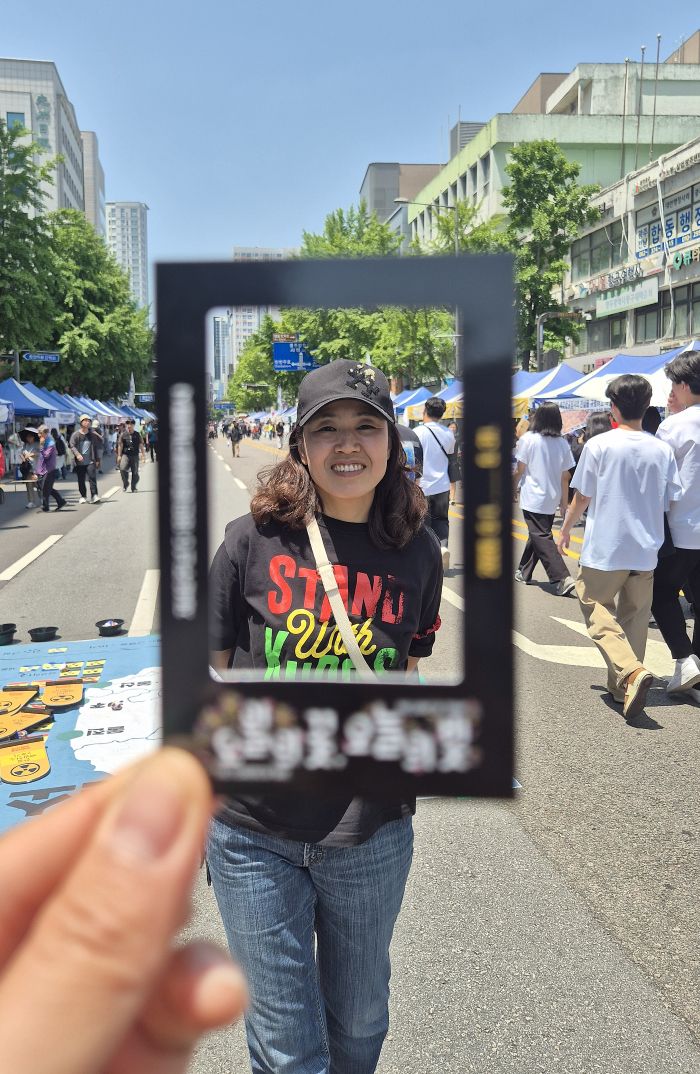
Cover Photo: Ohara Tsunaki attending an anti-nuclear event. (Courtesy of Ohara Tsunaki)