

Special City News – September 2026
Semiconductor Cluster and Airport Relocation: A Test for Jeonnam-Gwangju
Just two months after its launch, Jeonnam-Gwangju Special Metropolitan City faces a major challenge: the development of an 800-trillion-won semiconductor cluster in the Honam region. Planned investments by Samsung Electronics and SK Hynix are seen as an opportunity to develop Jeonnam-Gwangju into the nation’s second major semiconductor production hub after the Seoul metropolitan area. However, significant challenges remain because the industrial complex project is closely tied to the relocation of Gwangju Military Airport.
According to the government’s announcement, Samsung Electronics plans to invest approximately 425 trillion won in Gwangju, including two semiconductor fabrication plants. SK Hynix is also pursuing a total investment of 470 trillion won, including plans to build two fabrication plants in the southwestern region. On the day of its launch, the special city promulgated the Semiconductor Strategic Investment Support Ordinance as its first ordinance and designated approximately 8.26 million square meters around Gwangju Military Airport as a semiconductor development site. The target date for mass production is June 2030.
The relocation of the military airport is the biggest variable. Since the proposed semiconductor site overlaps with the area occupied by the First Fighter Wing at Gwangju Military Airport, factory construction cannot proceed in earnest without first relocating the military facilities. If building a new military airport takes six to seven years, the 2030 mass-production target could be delayed. The government is therefore considering a phased relocation plan, under which approximately 1.98 million square meters of ammunition depot land would be developed first as an industrial complex.
Other remaining tasks include a residents’ referendum in Muan, consultations with the United States regarding land provided for U.S. military use, concerns about gaps in military training operations, and the securing of 1 GW of electricity and 100,000 tons of water per day. The semiconductor cluster is more than a conventional industrial-complex project: It could reshape the industrial landscape of Jeonnam-Gwangju as well as the national semiconductor supply chain. Its success will depend on balancing speed with security, public acceptance, and infrastructure development.
Jeonnam-Gwangju Launches Initiative to Improve Living Conditions for Semiconductor City
Jeonnam-Gwangju Special Metropolitan City has launched an initiative to attract talent and create stable residential and living environments to ensure the successful establishment of the Honam semiconductor cluster. The goal is to build a national semiconductor industry hub equipped with work–life proximity and life cycle-tailored infrastructure, going beyond mere industrial complex development.
On August 14, Jeonnam-Gwangju held its first meeting of the Livable Semiconductor City Living Conditions Innovation Task Force at its Gwangju office, launching the formulation of an integrated living infrastructure strategy. The task force comprises 20 members in total – 12 external experts and 8 internal operations staff – co-chaired by Vice Mayor for Safety and Livelihood Koh Kwang-wan and Professor Lee Hyo-won of Chonnam National University’s Department of Architecture.
The key agenda item is formulating a comprehensive urban spatial strategy encom-passing housing, transportation, education, healthcare, and social infrastructure (SOC). Specific plans include supplying housing for construction workers within a five-kilometer commuting radius of the military airport site; building a transportation network connecting the industrial complex, residential areas, and the downtown area within 30 minutes of each other; developing educational infrastructure such as international and foreign language schools; and expanding five-star hotels and fostering the MICE industry.
The special city will prepare a phased implementation plan aligned with the 2030 semiconductor mass production timeline. Short-term 100-day projects will be selected by the end of this year, detailed implementation plans will be finalized by the second half of 2027, and priority projects will be pursued in conjunction with the military airport relocation through 2029. The city aims to complete living infrastructure construction in line with semiconductor fabrication plant building and mass production by the first half of 2030.
Park Keum-hwa, director general of the Urban Space Bureau, stated, “We will build a foundation where outstanding talent and their families – the key to the success of the semiconductor industry – can settle stably. We will proactively establish a living environment that integrates housing, transportation, education, and culture.”
The Gwangju Biennale Opens: “You Must Change Your Life”
The Gwangju Biennale, Asia’s oldest international art festival, founded in 1995, is in the final stages of preparation for its 16th edition. The event will open on September 4 and run for 72 days through November 15 across Gwangju.
The exhibition theme is “You Must Change Your Life,” inspired by the final line of Rainer Maria Rilke’s poem Archaic Torso of Apollo. It explores whether art can serve as a practical force for change amid global crises such as climate change and social inequality. Singaporean artist Ho Tzu Nyen serves as artistic director, with curators Che Kyongfa, Brian Kuan Wood, and Park Gahee collaborating.
The main exhibition at the Gwangju Biennale Exhibition Hall features 43 artists and groups – the smallest number in the biennale’s history, reflecting a curatorial emphasis on depth and duration over scale. Commissioned works reflecting Gwangju’s history and sense of place will also be presented. Pavilions from approximately 30 countries, including France, Italy, Malta, and Brazil, will open simultaneously at approximately 23 venues across the city.
Exhibition hall construction and artwork installation is completed. An unboxing ceremony was held on August 18, fifty docents have undergone training, and an International Curator Course with 20 participants from 11 countries began on August 29. Artistic Director Ho Tzu Nyen announced, “In Gwangju, change is not an abstract concept – it is lived history.”
World’s First Island Expo Opens in Yeosu
The 2026 Yeosu World Island Exhibition, the first international exposition dedicated to islands, opens on September 5, marking the first international event since the launch of Jeonnam-Gwangju Special Metropolitan City. The expo runs for 61 days through November 4 across Yeosu.
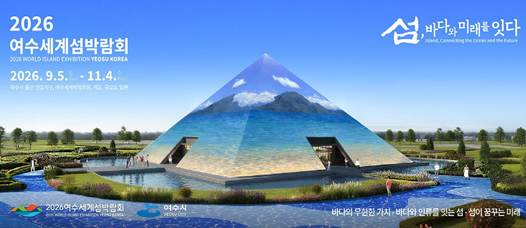
The Yeosu Expo: Connecting the ocean with the future. (2026 World Island Fair Yeosu Korea)
Under the theme “Connecting Islands, the Sea, and the Future,” the expo transforms the entire city into an exhibition space, leveraging Yeosu’s geography of 365 surrounding islands. The main venue is located in the Dolsan-Jinmo district, with satellite venues on Gae-do and Geumo-do islands and at the Yeosu World Expo site. The Expo aims to attract 30 participating countries and three million visitors.
The main venue features eight exhibition halls – including a Theme Pavilion, Island Marine Ecology Pavilion, Island Culture Pavilion, Island Future Pavilion, Joint Pavilion, Market Pavilion, and Island Playground – along with the exceptional Theme Island. Immersive media tunnels, holograms, and VR experiences are integrated throughout. A 3,000-seat open-air cultural space overlooking the sea will host 133 performances, including K-pop concerts and performances by international art troupes.
The total project cost is 70.3 billion won, with an estimated economic impact of 400 billion won. Tickets are priced at 15,000 won for adults, with a 20-percent discount for advance purchases before September 4.
Future Industry Fair Opens at Kim Daejung Convention Center
The 2026 Jeonnam-Gwangju Future Industry Fair is being held for four days, September 2–5, at the Kim Daejung Convention Center in Gwangju. Hosted by Gwangju Special City, the event will take place in Exhibition Halls A, B, and C, as well as in the multipurpose hall.
The Fair is an integrated industrial exhibition covering five key sectors: future mobility, the root manufacturing industry, Internet of Things (IoT) appliances and robotics, drones and urban air mobility (UAM), and medical and healthcare technology. It will showcase a broad range of fields, from core manufacturing technologies to advanced mobility and robotics industries.
The organizing committee aims to host approximately 300 companies across 700 booths and attract 30 overseas buyers. The Gwangju Tourism Organization and the Gwangju Future Mobility Promotion Agency will participate as organizing bodies.
At the satellite venues, Geumo-do offers an 18.5-kilometer coastal trail trekking program, island camping, and a haenyeo (female diver) kitchen experience. Gae-do features marine leisure activities, while the Yeosu World Expo site hosts the International Island Forum and other academic events.
Content Creator
Jeong Chanjong has been working with the Gwangju International Center since March 2026. He is teaching humanities at Chonnam National University.
¹ https://creativecommons.org/licenses/by-sa/4.0/deed.en
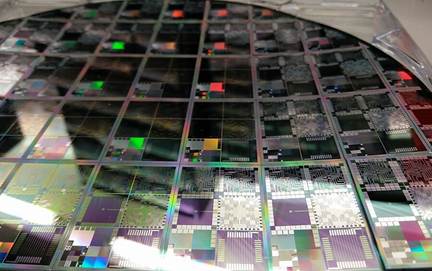
Cover Photo: Twelve-inch semiconductor wafer of microelectronics. (Dr. Hugh Manning, CC BY SA 4.0¹)