


Beyond the Astronaut: Coffee with Soyeon Yi
Eighteen years after becoming the first Korean in space, Dr. Soyeon Yi reflects on identity, responsibility, Korea, and finding her next frontier.
Dr. Soyeon Yi (이소연) was trained for launch, spaceflight, and re-entry. She was not trained for what would happen after she came home.
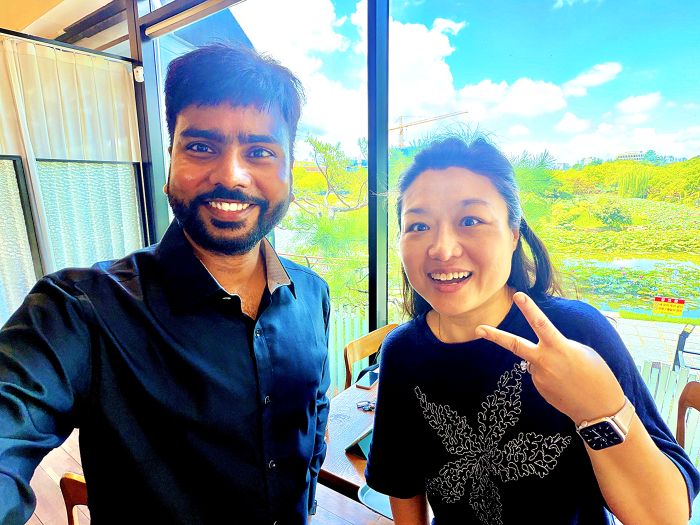
On a summer morning at Chonnam National University (CNU), we met at a café beside the campus pond. Our conversation lasted a little over an hour, moving from Gwangju and spaceflight to family, public life, Korean society, and the uncertainty she still feels about her own future.
Yi became the first Korean to travel to space in April 2008, when she flew aboard Soyuz TMA-12 to the International Space Station. That achievement has followed her ever since. Yet during our conversation, the flight itself often seemed less important than everything that came after it.
This summer brought an unusual homecoming. Born and raised in Gwangju, Yi left the city for university and later built a life that took her from laboratories to Russia, the International Space Station, the United States, and many places in between. She continued to visit her parents in Gwangju but usually only for a few days. This time, she stayed for several weeks to teach a course on Working in Teams at CNU. The city felt at once familiar and unfamiliar. Neighborhoods she remembered from the 1980s and 1990s had changed, and CNU itself was still new territory. She had left Gwangju as a student and returned as a teacher. As she spoke, however, it became clear that she had also returned as someone once again asking what she might become next.
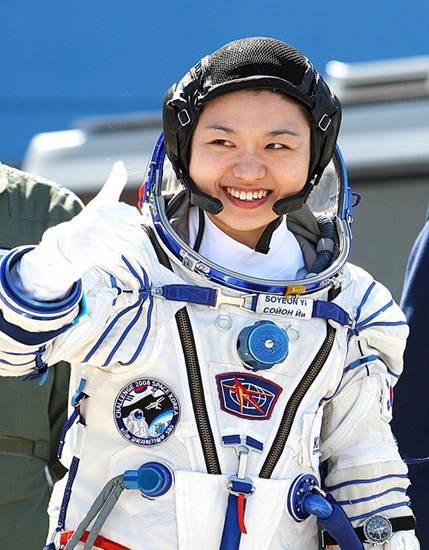
Soyeon Yi before the Soyuz TMA-12 launch at Baikonur Cosmodrome in April 2008. (Courtesy of Dr. Soyeon Yi)
Astronauts are often asked how seeing Earth from space changed them. The expected answer usually involves beauty, fragility, or the absence of visible borders. Yi’s answer was different. Looking down at Earth, and especially at the Korean Peninsula, one question came to her immediately: “Why on Earth was I born there?” From orbit, she began thinking about the circumstances that shape a life before a person makes a single decision. “You never picked your country,” she said. “And not only geographically, but also in time – you never picked the year you were born, and you never picked your family.”
Until then, she had naturally connected her achievements with effort: studying hard, attending KAIST, pursuing a doctorate, and eventually becoming an astronaut. From space, she began to see how much of the foundation beneath those achievements had simply been given to her. She had never applied to become her mother’s daughter or taken an examination to be born a Korean citizen. Yet the family, country, era, and circumstances into which she was born had shaped nearly every opportunity available to her. “I strongly believe that the rest of my life is a process of becoming qualified for what I was given,” she said. She still returns to that question when making important decisions: Am I living in a way that deserves the opportunities and identities I have inherited, including the one I acquired in 2008?
I expected launch, astronaut training, or re-entry to have been the hardest part of her journey. She disagreed. “Training, launch, and coming back were frankly not that tough,” she said. There were procedures to learn, examinations to pass, and protocols to follow. The real difficulty began after she returned. “I was not ready for the reaction of the general public of my country. I was not ready to understand the nature of journalism or politics at all,” she said. At the time, Yi was in the middle of her PhD and had spent most of her academic life among engineers and scientists. She knew how to speak to colleagues. Suddenly, her words were being interpreted by journalists, politicians, children, and millions of people who did not share the same language or assumptions. “After everything was finished, and I came back to Korea, I realized I was the center of everybody’s attention, and everyone was watching me. That was the toughest part.” Korea had prepared its first astronaut for space. It had not prepared her, or itself, for the attention waiting on the ground.
Looking back, Yi believes Korea’s first astronaut project produced lessons that extended beyond science and technology, particularly about public communication and what should follow short-term but large-scale national science and technology projects.
Her own struggle with identities was more personal. After leaving Korea during a difficult period, she tried to divide herself into separate versions: Soyeon the astronaut, Soyeon the researcher, Soyeon the daughter, Soyeon the wife, and Soyeon the friend. Eventually, she realized the division was impossible. “I don’t think I can live as an astronaut every day, but at the same time, I do live as an astronaut every day,” she said. An engineer does not stop thinking like an engineer at home, and a daughter does not stop being a professional at work. “At some point, I decided to embrace everything.” Rather than trying to switch identities on and off, she chose to carry them together.
During one particularly difficult period, Yi went looking for guidance. She spoke with a mentor she deeply respected and asked what she should do about a major decision. He listened carefully and promised to think about it. They agreed to meet again one week later. When they met, he admitted that he had barely thought about her problem. Yi was disappointed at first. Then he explained that he had his own company, family, responsibilities, and worries. Her decision, however serious, could never occupy his mind in the same way it occupied hers. “It is your life, not my life. You are the owner of your life,” she remembers him telling her.
The comment initially felt harsh. A few seconds later, however, it made complete sense. “Who should be the most serious concerning my problem? – Me.” That lesson now shapes the way she mentors students. She can listen, share what she might do, and offer a perspective, but she cannot live another person’s life for them. The lesson also shapes her advice to young people. “There is no fixed age by which you have to decide your career,” she said. Parents and teachers may offer advice, but “your life is yours, not your parents’.”
Our conversation gradually moved from individual choices to Korean society. Yi belongs to a generation that witnessed Korea’s remarkable transformation. She respects the discipline, speed, competitiveness, and efficiency that helped build the country, but she also wonders whether a society shaped by rapid development sometimes struggles to notice when the circumstances have changed. “Korea itself is now a very advanced, fully developed country,” she said. Earlier generations often had to choose careers mainly for financial stability. For many young people today, she believes there is more room to ask a different question: What kind of life do I actually want? “We are no longer playing only a survival game.”
“After everything was flnished and I came back to Korea … everyone was watching me. That was the toughest part.”
That transition also appears in Korea’s famous ppalli-ppalli (“hurry-hurry”) culture. “Efficiency is one of the most important things in Korean culture,” Yi said, but she does not think efficiency should govern everything. “If you are enjoying time with people you love, do you really need efficiency?” Perhaps, she suggested, modern Korea can afford “some inefficient days”: slow food, slow walking, or simply waiting without treating every unproductive minute as a loss. Still, she does not dismiss the culture that helped build the country. “That ppalli-ppalli culture helped create Korea as it is today. We cannot hate it, and we should not hate it.” Instead, she sees Korea as undergoing another transition: “It is a kind of growing pain.”
Yi remains optimistic about Korea’s future in space. She believes the growth of commercial space creates opportunities in fields where Korea is already strong, including semiconductors, AI, computing, software, and satellite-data applications. “Space technology is almost like air,” she said, noting that people rely on satellites for navigation, communication, forecasting, and infrastructure without often noticing them. “Space technology is already part of our lives.”
Yi is also conscious of what her career represents to younger women in science. She wants to encourage them not to give up and to show that they can build long, meaningful careers in science and engineering. Gender inequality, she added, is “everybody’s problem,” because discrimination affecting a wife, daughter, or colleague also affects those around her.
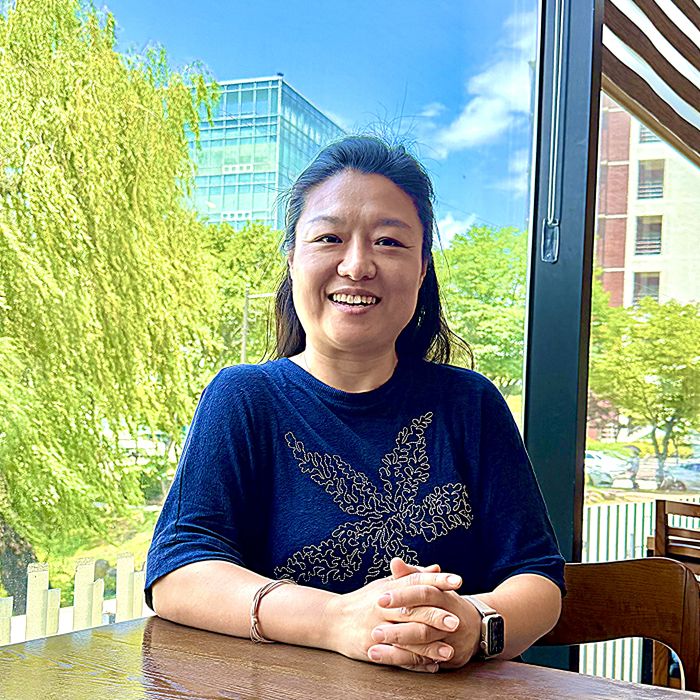
Dr. Soyeon Yi at her café interview Chonnam National University. (Courtesy of Vibhanshu Maurya)
When I asked what young people should cultivate for a future shaped by AI, space technology, and international collaboration, Yi did not choose coding, engineering, entrepreneurship, or English. Her answer was health – physical health, certainly, but also mental health, something easily neglected in the pursuit of achievement. “Once you have that,” she said, “then you can do whatever you want.”
Toward the end of our conversation, I asked what she would tell the young researcher who applied to Korea’s astronaut program without knowing where it would lead. She answered without hesitation: “You are doing well, so don’t worry and just enjoy the moment.” She would tell her younger self not to become so focused on racing toward the goal that you forget to notice the process, and especially not to lose people along the way. “If you focus only on efficiency and results, you will lose the people around you,” she said. Competitors may later become colleagues. Someone you defeat today may be the valued colleague whose help you need tomorrow. “There is no forever enemy and no forever competitor,” she said. “Walking together as human beings is so important.”
Finally, I asked the question that seemed most obvious for an astronaut: What is your next frontier? Yi laughed. She knows she wants to continue contributing to Korea, but she is still deciding how. Should she remain involved with the space industry, help Korean startups expand internationally, focus more on education and STEM, or pursue something she has not yet imagined? “For the last two or three years, I have been almost like a fresh college graduate thinking about my next job,” she said. The uncertainty sometimes makes her nervous. Then she catches herself doing exactly what she tells younger people not to do: “You always tell your mentees to enjoy the process, but you are not enjoying your own process.” So, she is trying something different: allowing the uncertainty to exist. “Now I am trying to enjoy this somewhat blurred and ambiguous period,” she said.
As our interview ended, Yi declined my invitation to lunch. She was leaving Korea soon and had promised to eat with her parents. After more than an hour talking about space, national responsibility, public life, and the future, she gathered her things and went home for lunch. She is still deciding what comes next. “I am kind of like a nomad right now,” she said. The uncertainty did not sound like being lost. It sounded like another beginning.
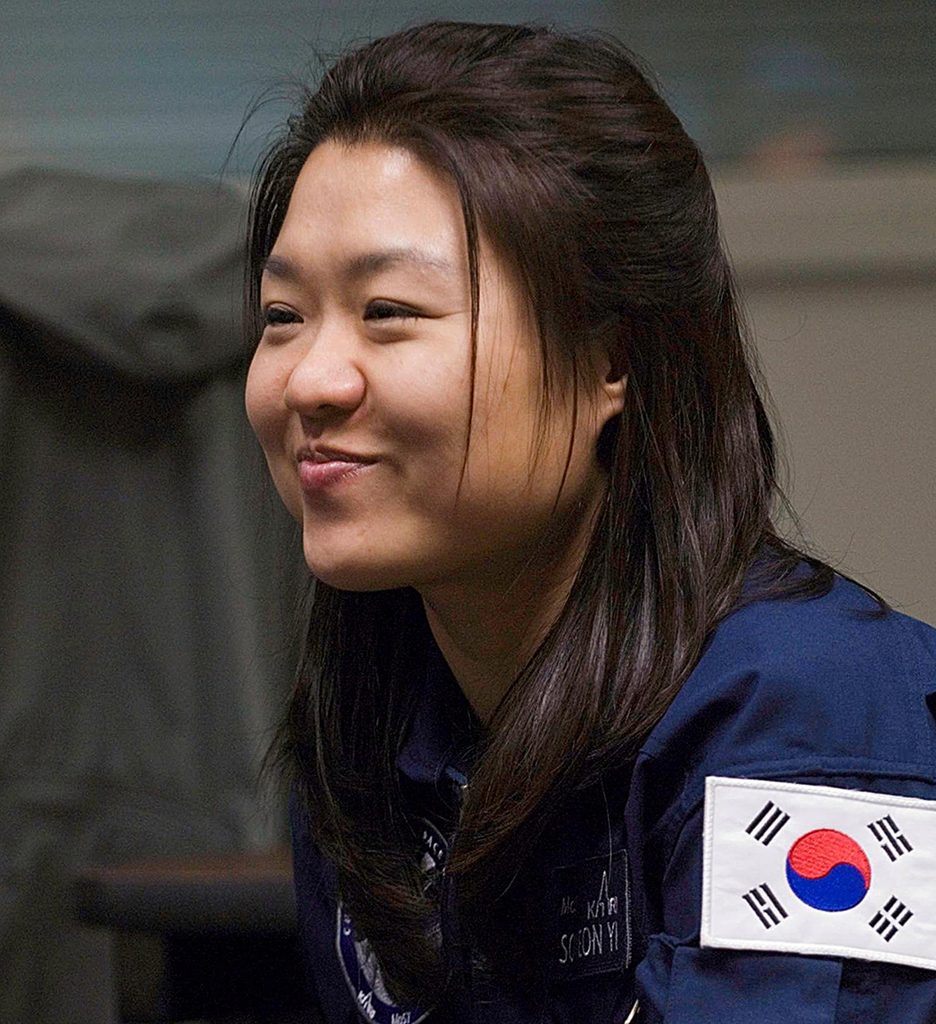
Astronaut Soyeon Yi
Born and raised in Gwangju, Soyeon Yi earned degrees in mechanical engineering and a doctorate in bio-and brain engineering from KAIST. Selected through the Korean Astronaut Program, she launched aboard Soyuz TMA-12 on April 8, 2008, becoming the first Korean in space. She spent 11 days in space, including nine days aboard the International Space Station, where she carried out 18 scientific experiments organized by the Korea Aerospace Research Institute (KARI). She returned to Earth aboard Soyuz TMA-11 on April 19. After the mission, Yi worked as a KARI researcher and Korea’s space ambassador, and later earned an MBA from the University of California, Berkeley’s Haas School of Business. She has since worked across space, biotechnology, business, education, and international collaboration.