

Chuseok: A Fading Tradition, A Lingering Memory
By Shin Gyonggu ||
Chuseok: The Most Memorable Festival
For most of my life, Chuseok was not merely a holiday marked on the calendar; it was the emotional and spiritual center of the year, carrying more weight for me than even Seol, the Lunar New Year holiday. I have often reflected on why this was so. Probably because Chuseok arrived just after the rice harvest, when granaries were full and tables could finally hold abundance; Seol fell in the depth of winter, when resources were leaner and the mood more austere.
But abundance was not the only reason Seol felt diminished to me as a child. I did not understand, at the time, why the government discouraged celebrating the lunar new year. We were forced to go to school on Seol, straight after morning memorial rites at home. Worse, we were taught to call the solar new year holiday Shin-jeong (“New Seol”) and the lunar new year Gu-jeong (“Old Seol”) – language that quietly trained us to prize the Western calendar over our own Korean lunar calendar. I believe it was the college students of the 1980s who first pushed back against this, and that their efforts helped seed the Korean cultural revival we see today, through the recovery of old traditions such as the farmers’ dance and traditional instruments.
Chuseok, by contrast, was left alone by this state intervention – perhaps simply because it did not compete with a foreign calendar or because it was never deemed as politically significant as Seol. To me as a boy, it meant something simpler and more immediate: a day off from school and better food than usual.
Chuseok: A Time to Show Respect to Ancestors
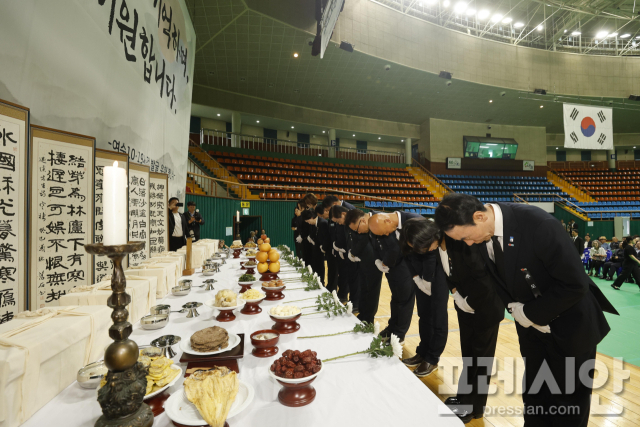
My clearest memories of Chuseok when I was growing up center on jesa, the ancestral memorial rites, particularly charye, in the late 1950s after the Korean war. The morning of the rite felt almost sacred. Elders dressed in freshly ironed hanbok attire, sometimes topped with a formal durumagi overcoat, while we children wore our cleanest clothes and were told, without needing to be told twice, that this was not an occasion for noise. Even relatives who were usually talkative fell silent. We bowed before ancestral name plates written in Chinese characters we could not read – a detail that, looking back, tells me how much of the tradition was already slipping beyond our generation’s grasp even as we performed it.
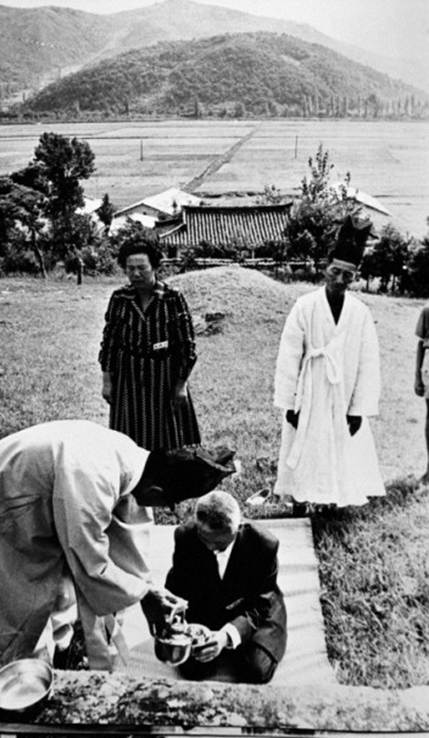
Performing the gravesite ritual of seongmyo at Chuseok, 1975. (National Archives of Korea)
Chuseok: A Time for Gatherings of Relatives
Relatives would travel long distances – not only immediate family but relatives connected as distantly as the eighth degree of kinship (palchon/팔촌, relatives with the same great-great-grandfather) would appear at the family rite, a sign of how expansive our sense of “family” once was. These days, relatives beyond the fourth degree (sharing the same grandfather) rarely feel close at all. Chuseok was the time I confirmed my place among relatives; it also taught us the hierarchy and distance between them. I felt both uncomfortable and quietly proud when older relatives addressed me with polite language, since I belonged to a senior line of the family.
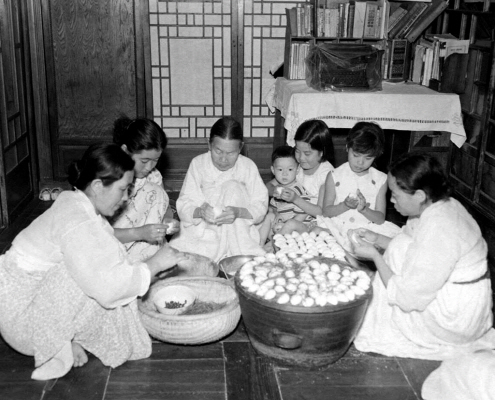
The womenfolk of the extended family preparing Chuseok’s song-pyeon rice cakes, 1957. (National Archives of Korea)
Food Was Central to It All for Me
Songpyeon rice cakes, apples, pears, and dried croaker fish were arranged with care on the ancestral table. As a boy, I found it strange that food offered to our ancestors was then eaten by us once the rite was completed. I still vividly remember the taste – perhaps because these foods were scarce, perhaps because so many young mouths were competing for a limited supply. Oddly, the same dishes today never taste quite the same; I suspect what I remember was never really about the food but about the whole fabric of the occasion.
Women Were Not Treated Equally
That fabric, however, rested on an unequal foundation. In advance of the holiday, women, young and old, spent days in the kitchen preparing enormous quantities of food, while it was the men who performed the rite in formal attire. The women were expected to prepare for the rite, serve the men, and then clean up afterward, while the men simply enjoyed the food.
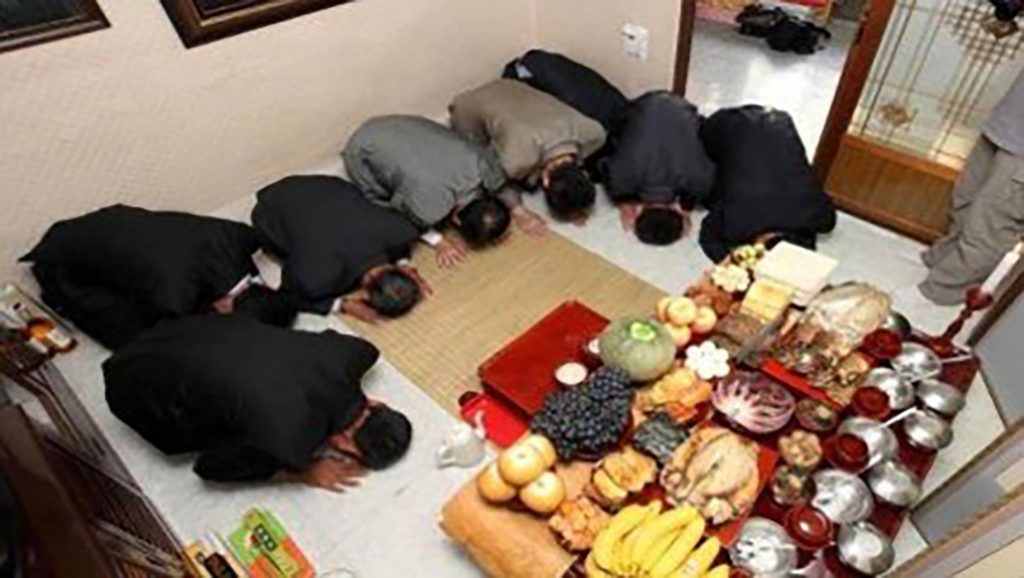
Charye, the ancestral rite of paying respect to five generations of ancestors with a ceremonial table offering a wide variety of foods. (National Folk Museum)
The Tradition Quickly Diminished
For me, change came quickly and personally. Following my mother, I attended a Christian church that taught that jesa were idol worship, and she herself discouraged me from joining the extended family rites. When we left our clan-centered farming village for a larger town in 1961, and when my father died a few years later, the tradition simply slipped out of my life. I never revived it.
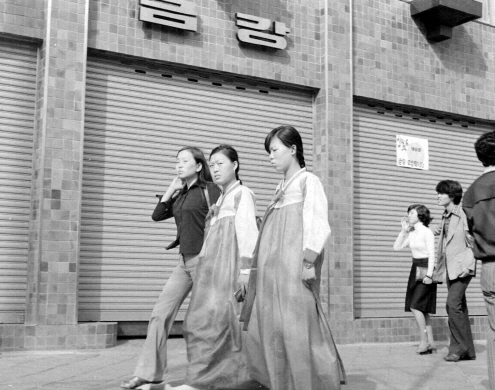
Young ladies on Chuseok. The hanbok-wearing tradition was already beginning to disappear, 1977. (National Archives of Korea)
Across Korean society, the same shift unfolded more gradually. Women increasingly resisted the unpaid labor Chuseok demanded of them. Industrialization drew people out of villages to larger cities, scattering the extended families that had once gathered easily. As elders died, they took with them both their moral authority and their firsthand knowledge of how the rites should properly be conducted. Migration to the cities has consistently outpaced any return to rural hometowns, hollowing out the villages where families once reassembled each autumn for the holiday.
“Chuseok remains a national holiday, but its deeper meaning has thinned.”
My own family no longer performs charye at Chuseok. I privately remember the anniversaries of my parents’ death in my own way, but I no longer hold rituals to honor my ancestors. What saddens me is not only the decline of the jesa rites but what it made possible: a guaranteed, recurring reason for the extended family to gather face to face to reaffirm ancestral bonds and family ties. Chuseok remains a national holiday, but its deeper meaning has thinned, as the majority of the population – my own family included – no longer observes jesa. Nuclear families still gather; the palchon kinship groups of my childhood don’t any longer.
The Author
Shin Gyonggu has served the Gwangju International Center as its volunteer director for the past 27 years. He served as a professor for more than 30 years at Chonnam National University until his retirement in 2013. Dr. Shin is also the publisher of the Gwangju News.
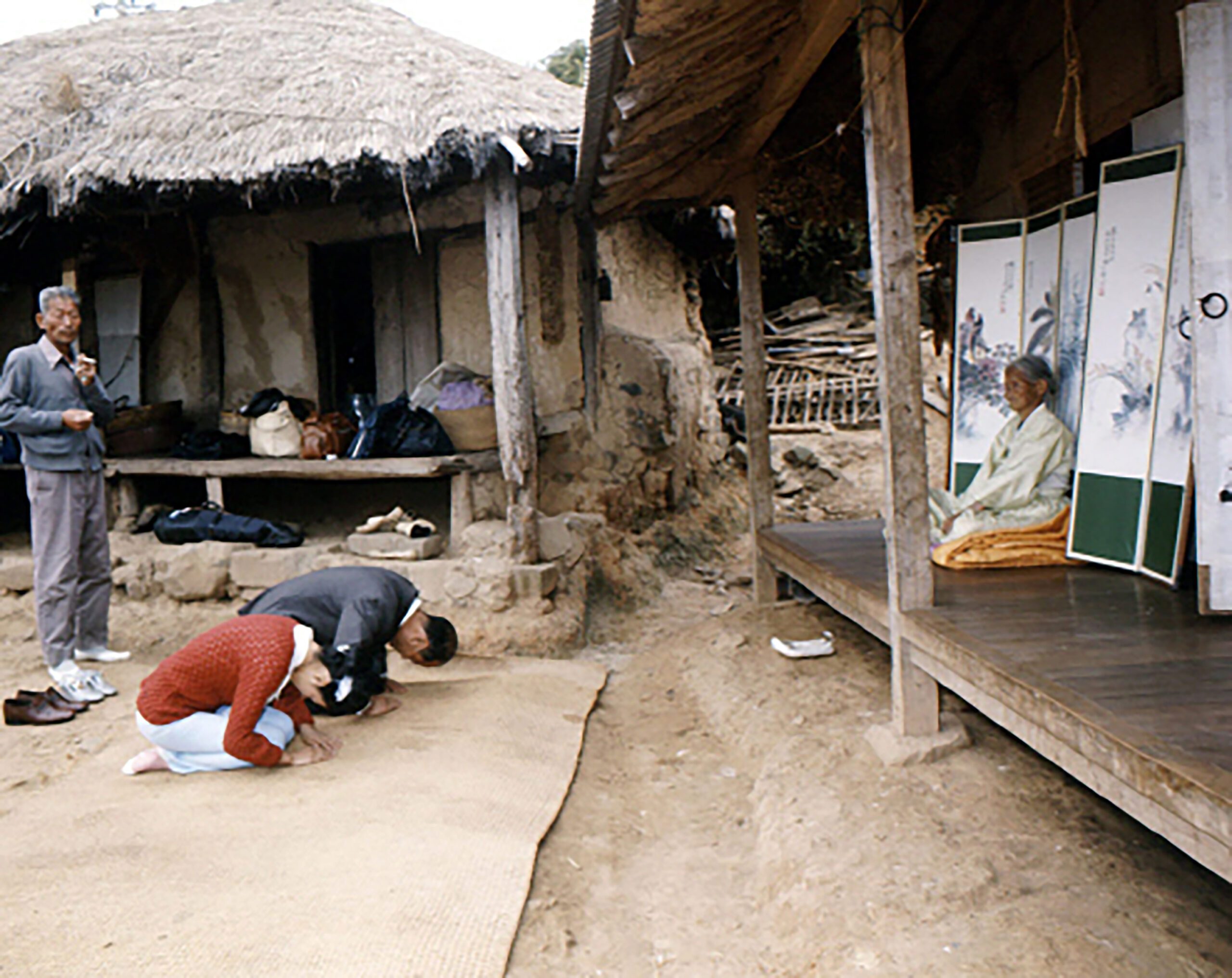
Cover Photo: Greeting elders at Chuseok, 1977. (National Archives of Korea)