
From Human Rights to Spatial Justice: Learning from Gwangju
By Lily Song ||
Gwangju has a global reputation as a beacon of democracy and human rights struggles in South Korea. Along with the K-wave’s popularization of Korean cultural content, Han Kang’s novel Human Acts (2016)¹ and Jang Hoon’s film A Taxi Driver (2017)² have broadened awareness of the 1980 Gwangju uprising and democratization movement against successive military-authoritarian regimes. Earlier this year, global audiences followed news of the controversy surrounding Starbucks Korea’s “5.18 Tank Day” promotion (see Shin, 2026), evoking the military dictatorship’s brutal crackdown on pro-democracy protestors and Gwangju residents in 1980. The marketing blunder triggered widespread public outrage and boycotts, drawing condemnation from the South Korean president and resulting in the dismissal of Starbucks Korea’s CEO.
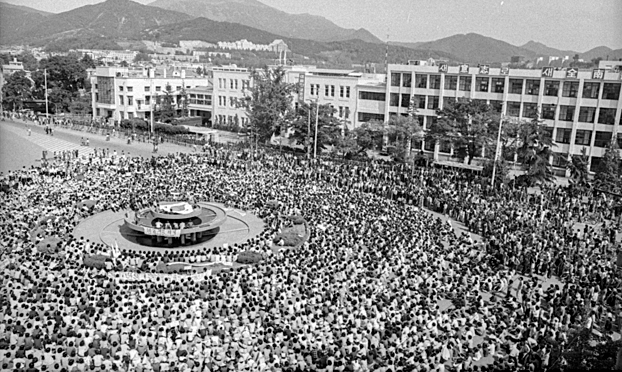
Planning an upcoming visit to Gwangju, I’m drawn to the various sites related to the May 18, 1980, uprising. In the heart of the city, 5.18 Democracy Square is where Gwangju citizens held assemblies, speaking out against the military dictatorship and demanding democratic elections, civil liberties, and worker’s rights. At the South Jeolla Provincial Office, citizens committees coordinated medical care and communal funerals for victims of the state violence, formed civil militias to resist brutal martial law forces, and directed traffic control and public patrols to maintain order during the city’s brief liberation from the army. Nearby, Jeonil Building 245 bears the marks of 245 bullets from the military helicopter machine guns that fired directly onto news reporters inside during the final raid on the provincial office.
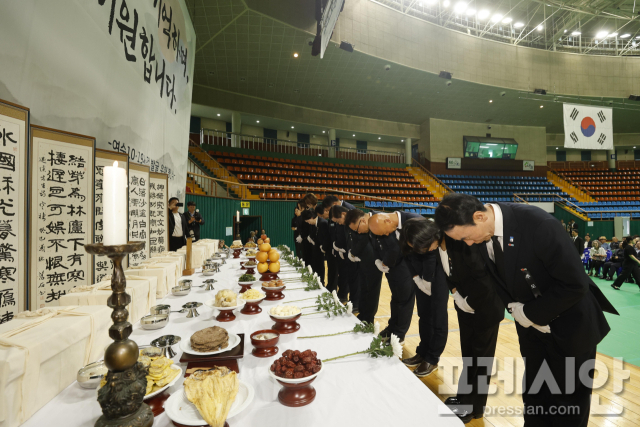
Despite its tragic end, the Gwangju uprising catalyzed a massive, nationwide democratic struggle that finally toppled the military-authoritarian regime in 1987. Following direct presidential elections and the restoration of civil liberties, the South Korean government compensated victims of state brutality in Gwangju and brought responsible military leaders to justice. It also gave official apologies, established memorials, and supported public education to prevent the repetition of past wrongs. Among local repositories and memorials, I intend to visit the 5.18 Archives of the democratic uprising located on Geumnan Street, the 5.18 Memorial Park on the western edge of the city, and the 5.18 National Cemetery for those who participated in the uprising.
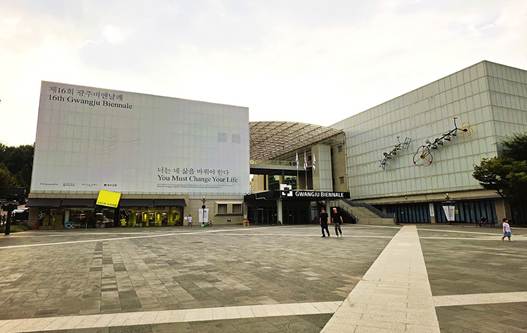
Gwangju Biennale Exhibition Hall. (Kim Hyeon/Gwangju Biennale Foundation)
As an urban planner, I’m intrigued to see how the process of transitional justice has shaped Gwangju’s spatial environment over the past two decades. Urban researchers and scholars have traced Gwangju’s rebranding as a creative city through national designations, policies, and funding to foster the growth of its information and cultural industries (see Lee, 2007; Shin, 2020). I’m keen to observe spatial manifestations such as the Gwangju Biennale Exhibition Hall (1995) and National Asian Cultural Center (2015) as well as the transformation of the former Sangmudae military base, the martial law command headquarters during the May 18, 1980, uprising, into the modern Sangmu district. In part, these urban redevelopment projects counteract the long history of state disinvestment and corporate discrimination in the Honam region.
Besides culture-based urban regeneration, Gwangju residents and leaders have rallied around localizing human rights values and principles (see Shin et al., 2019, for a comprehensive overview). After first enacting a human rights ordinance in 2007, the city established a human rights citizens committee (2009), a human rights department (2010), and a human rights ombudsman (2013) to advance related efforts in local government. As the first Asian city to adopt a human rights charter (2012), Gwangju completed two rounds of human rights five-year plans (2012 and 2018), launched human rights education for civil servants and citizens (2013), and measured human rights indicators and impacts (2017). For 15 years, the city has also hosted the annual World Human Rights Cities Forum, uniting cities, international organizations, and civil society to expand the global human rights movement.
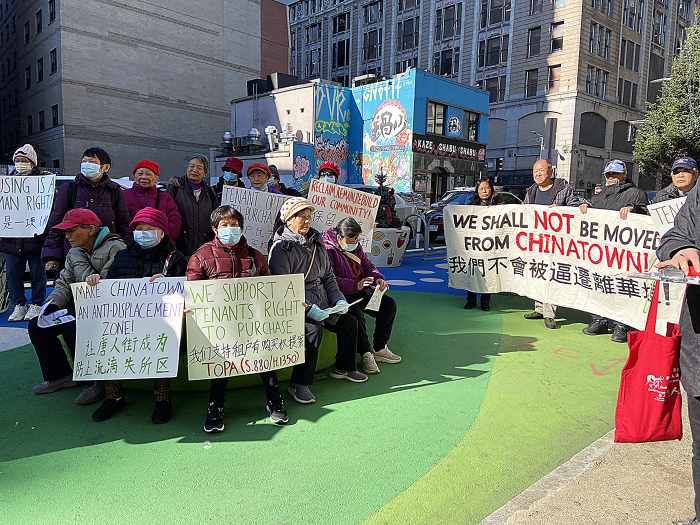
Residents of Boston’s Chinatown mobilize for tenant rights and housing justice. (Courtesy of the author)
What has been less documented and drives my investigative trail in Gwangju is the question of how culture-based urban regeneration and human rights initiatives have interacted at the local scale, in other words, how transitional justice has spatialized in Gwangju. In the 21st or “urban” century, cities have become engines of economic growth based on knowledge and service sectors while housing has become commodified as financial assets. In this context, culture-based urban regeneration projects have widely triggered gentrification and displacement of long-time working-class residents. At the same time, grassroots mobilizations for the right to city and community stabilization have also integrated arts and culture as well as human rights discourses into social activism and place-based struggles.
Gwangju pro-democracy activists were trailblazers in staging creative public protests with traditional drumming, folk music, and outdoor theater leading up to and following the May 1980 uprising. When the Gwangju Biennale launched in 1995, local organizers and artists staged a grassroots counter-exhibition to critique the official state-led project art-washing historical trauma without directly engaging Gwangju’s democratic movement. Located at the Mangwol-dong Cemetery, the original burial site for May 18 victims, the counter-biennale featured 1,200 traditional funeral banners inscribed with political slogans and statements of solidarity created by artist-activists from across South Korea. Frictions between radical grassroots politics and global contemporary art culture have since resurfaced during controversies over corporate-art prizes (see ArtReview, 2023) and art censorship (see Sutton, 2014).
Among the pitfalls of transitional justice is its framing in negative terms of undoing past abuses and injuries. What would it mean for the Gwangju spirit of civic courage, solidarity, self-sacrifice, and moral resistance that previously guided the minjung “common people’s” movement, championing labor and human rights in the 1980s, to drive the city’s urban vision and agenda? Beyond democratizing the political system and protecting citizens from state violence, how might Gwangju lead Korean cities in driving down the extreme competition in employment, housing, and childcare that is associated with the country’s ultra-low birth rate? How might human rights be reconceived and implemented in collective, substantive ways that provide Gwangju residents access to family-sustaining jobs, affordable housing, public transportation, climate resilience, and education?
The story of Gwangju continues to touch and inspire people around the world. In the United States, where I teach architecture and urban planning to university students, democracy and human rights are under threat from the rise of far-right nationalism and authoritarian leadership, weakened legislative and judicial oversight, and heightening press restrictions and misinformation campaigns. American corporate power and profitability are at historic peaks, with billionaires exerting untold political influence while many families struggle to put food on the table and afford housing as inflation and costs of living outpace worker pay. Besides the example of ordinary citizens uniting in radical solidarity and mutual aid against a ruthless military dictatorship, might we look to Gwangju as a test bed and urban hub for transitional justice that serves the “common people” and their demands for social, economic, and spatial justice?
Notes
¹ Human Acts: A Novel: https://www.penguinrandomhouse.com/books/536652/human-acts-by-han-kang/
² A Taxi Driver: https://www.imdb.com/title/tt6878038/
References
- ArtReview. (2023, May 12). Gwangju Biennale abolishes Park Seo-Bo Art Prize amid protests. https://artreview.com/gwangju-biennale-abolishes-park-seo-bo-art-prize-amid-protests/
- Lee, K.-S. (2007). Questioning the neoliberal urban regeneration policy: The rhetoric of “cities of culture” and the city of Gwangju, Korea. International Journal of Cultural Policy, 13(4), 335–347. https://doi.org/ 10.1080/10286630701683201
- Shin, G., Ahn, J., & Chon, J. (2019, September 30–October 3). Human rights city Gwangju: Its development, achievement, and limitation [Conference paper]. 2019 World Human Rights Cities Forum, Gwangju, South Korea. https://rwi.lu.se/wp-content/ uploads/2021/06/Human-Rights-City-Gwangju-FINALR.pdf
- Shin, H. (2020). The cultural politics of urban development in South Korea: Art, memory, and urban boosterism in Gwangju. Routledge.
- Shin, M. (2026, May 25). Starbucks Korea’s Tank Day Promotion on a massacre anniversary causes a political firestorm. The Diplomat. https://thediplomat.com/2026/05/starbucks-koreas-tank-day-promotion-on-a-massacre-anniversary-causes-a-political-firestorm/
- Sutton, B. (2014, August 20). Gwangju Biennale president resigns over censorship: Artists call for return of a painting satirizing Korea’s president. Artnet. https:// news.artnet.com/art-world/gwangju-biennale-president-resigns-over-censorship-82587
The Author
Lily Song is an urban planner and activist-scholar who is on the Architecture and Urban Planning Faculty at Northeastern University in Boston, Massachusetts. She is currently working on a book project focused on spatial planning and design initiatives that seek to confront historical injustices in different cities.
Cover Photo: Citizens’ rally during the May 18 uprising. (5.18 Archives)