





More Than Korean Lessons: Inside KIIP in Gwangju
By Vibhanshu Maurya ||
On Sunday mornings, my Korean classroom is rarely quiet for more than a minute. There are questions, mistakes, laughter, repeated pronunciations, imitation, and moments when everyone seems puzzled. At the center of it all is my instructor, Song Kyung-shin, moving between desks, calling students by their name, and making even beginners feel comfortable enough to speak.
What surprised me most was that she did not only remember the students sitting in the classroom. Students from higher levels would often come by to greet her, and she would recognize them immediately, call them by name, and welcome them with the same enthusiasm.
I later realized there is a reason for that. Song has been teaching in the Korea Immigration and Integration Program, better known as KIIP, since 2014. For more than a decade, she has taught every level, from Level 0 (beginners) to the advanced stages of the program. These days, she mainly teaches Levels 0 and 1, introducing Korean to people who may still be nervous about putting their first sentences together. For her, remembering the students’ names is part of the teaching.
She referred to a famous line from Korean poet Kim Chun-soo’s Flower: “When I called his name, he came to me and became a flower.” Calling someone by name, she explained, makes that person meaningful to us. “I memorize all the students’ names from the first class and call them by name throughout the course,” she said. “When I call their names, their eyes light up.”
Why People Come
KIIP is a government-supported program that combines Korean language and culture education with lessons about Korean society. Completing the program can also bring benefits related to residence status, permanent residency, and naturalization.
I joined because I wanted to improve my Korean, and I found the classes genuinely useful. But people sitting in the classroom around me are not necessarily there for the same reason. That diversity is something Kim Young-jin sees from a much wider perspective.
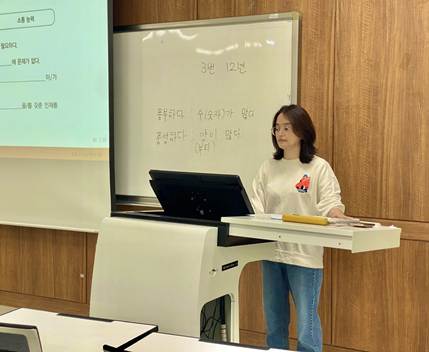
Kim Young-jin teaches a Level 4 KIIP class at Chosun University.
Kim is the dedicated staff member responsible for the Gwangju 2 KIIP regional hub at Chosun University. The hub manages and coordinates KIIP operations across a number of institutions in Jeonnam-Gwangju. Her work involves opening courses, allocating students, coordinating with institutions and instructors, handling evaluations, and managing much of the program’s regional administration. At the same time, she also teaches Level 4 herself. Over the years, she has seen the profile of KIIP students change.
“When the Social Integration Program first started about 15 years ago, most participants were marriage immigrants,” she explained. “There were some international students, and most people were learning Korean to adjust to life in Korea.” Today, she says, most participants are workers, and changing their visa status has become the top reason for enrolling. In the past, she often saw workers trying to move from E-9 to E-7 status, but recently she has seen growing interest in F-2 visas and longer-term residence.
That change also affects what students expect from their classes. According to Kim, students who mainly want to learn Korean language and culture often prefer conversation and cultural activities. Those who are focused on changing their visa status tend to want more preparation for the examinations they need to pass. Song sees the same difference in motivation, but she believes something else eventually matters more.
Students with a clear visa or nationality goal may begin with very strong motivation because they have an immediate target. But, she said, the students who improve most are ultimately those who keep asking questions, remain engaged in class, and genuinely try to learn. In other words, the reason someone enters the classroom may not determine what happens once they are there.
A Hundred Hours Together
KIIP brings together people who might otherwise never share a classroom: workers, international students, marriage immigrants, people preparing for a new residence status, and people simply trying to function more confidently in Korean.
That variety creates difficulties, but it also creates something valuable. Song explained how students from different countries begin teaching one another words and pronunciations from their own languages. Sometimes everyone ends up laughing as they struggle to reproduce unfamiliar sounds. Even during Korean practice, students start correcting each other’s pronunciation, sometimes confidently correcting a classmate while their own pronunciation is still a work in progress. More importantly, students begin to lose their fear of speaking.
At the beginning of a course, some can barely connect a few Korean words. By the end, Song says, they may be expressing their own opinions and emotions. “Classes should, above all, be enjoyable and comfortable,” she said. Learning a new language in an unfamiliar country is already difficult enough. If students are afraid of the teacher or afraid of making mistakes, they will hesitate to open their mouths.
Her goal is therefore not a mistake-free classroom. It is a classroom where making a mistake does not stop the next sentence. Spending so many hours together also creates connections beyond language. Students exchange information about work, immigration, daily life, and living in Korea. Kim noted that because many participants face similar situations, information shared between classmates can be especially useful.
“The students who improve most are ultimately those who keep asking questions, remain engaged in class, and genuinely try to learn.”
Still, spending so many hours in class is not easy. For a 100-hour course, Kim explained, participants currently need at least 80 hours of attendance to become eligible for the next-stage evaluation. Many participants are workers, and courses are therefore frequently held on weekends. A single weekend class may last six to eight hours. Missing only a few days because of work can put a participant’s eligibility for the evaluation at risk.
Song likewise identified time management as one of the biggest difficulties, particularly for people balancing classes with employment, childcare, or other responsibilities. There are academic pressures as well. Korean word order and pronunciation can be unfamiliar to beginners, while participants at higher levels face increasingly tough assessments.
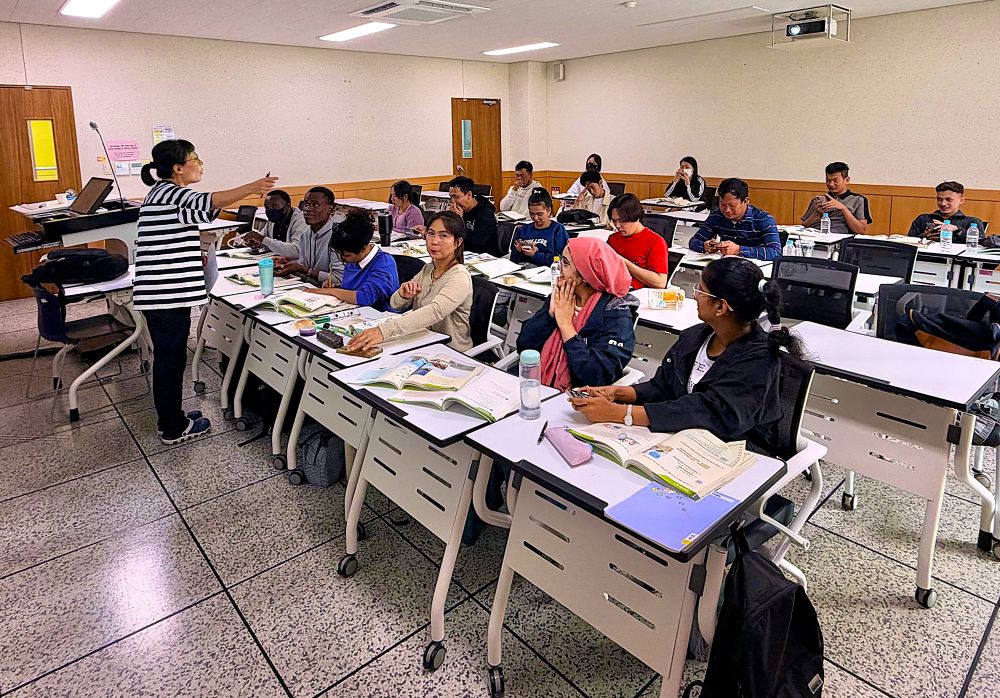
Level 1 KIIP students during class at Chosun University.
And the system has its own teaching challenges. Kim believes KIIP has relatively few teaching hours compared with some other Korean-language programs. That allows students to move through the levels faster, but it also limits how much teachers can do. She particularly worries that workers may develop fairly good speaking skills through daily life while still lacking sufficient writing practice.
Song raised another concern. Under the current progression system, students who do not pass a level evaluation can eventually advance after repeating the course. In her view, this may allow some students to enter the next level without a strong enough foundation, making the new class harder for both the student and the teacher.
For Kim, another problem is the enormous diversity of goals inside a single classroom. If one student wants practical conversation, another needs examination preparation, and another wants cultural knowledge, satisfying everyone is difficult. She believes more customized classes based on participants’ circumstances and goals could make instruction more effective.
Outside Gwangju, there are other practical difficulties. Access to courses in Gwangju and Jeonnam has improved as more operating institutions and online courses have become available, Kim said. Yet outside urban areas, it can still be difficult to find instructors. Weekend-heavy scheduling also makes finding evaluation supervisors challenging. She would especially like to see more younger instructors entering the field.
What Does “Integration” Look Like?
What interested me most in both the Song and Kim interviews was that neither teacher described successful integration simply as finishing the KIIP classes. For Song, success can mean a student no longer needing someone else to make a phone call, visit an office, or handle a problem.
For Kim, language ability is only one part of the process. Students may become much better at Korean after reaching Level 4 and may understand Korean culture more deeply, she said. But many foreign residents still use Korean mainly within the limited spaces of work, school, or family. They need opportunities to use it outside those limited spaces.
She would like to see more chances for foreign residents to participate in local communities and use Korean in real situations. Importantly, she does not see integration as something foreigners have to accomplish alone. Koreans, she said, also need greater understanding of foreign residents,
and communities need policies and opportunities that allow newcomers to participate. That point stayed with me. It is easy to think about integration as a straight line: Learn Korean, understand Korean culture, and adapt to Korea. Real life is messier.
Someone may enter KIIP mainly because they need points for a visa. Someone else may simply want to stop feeling lost during everyday conversations. Another person may want to stay in Korea permanently. They sit in the same classroom. Over time, they learn words and grammar, complain about difficult exercises, laugh at one another’s pronunciation, exchange information, and gradually become less hesitant about speaking.
My instructor jokes that there is also a strange phenomenon among learners: Sometimes, as soon as they open their Korean textbook, they suddenly become sleepy. Her advice is not to worry too much about becoming perfect. “Don’t be too stressed about speaking perfect Korean,” she tells students. “Learning through mistakes is real learning.”
After spending time in KIIP myself, that may be the part I understand best. A person calls your name. You try to answer in Korean. The sentence comes out wrong. Someone corrects you. You laugh, try again, and this time it comes out a little better. For many people, that may be where integration actually begins.
The Author
Vibhanshu Maurya, originally from India, is pursuing his PhD at Chonnam National University. He is a writer for the Gwangju News, where he writes about science, people, culture, and the international community in Gwangju.
(Photographs courtesy of the author)
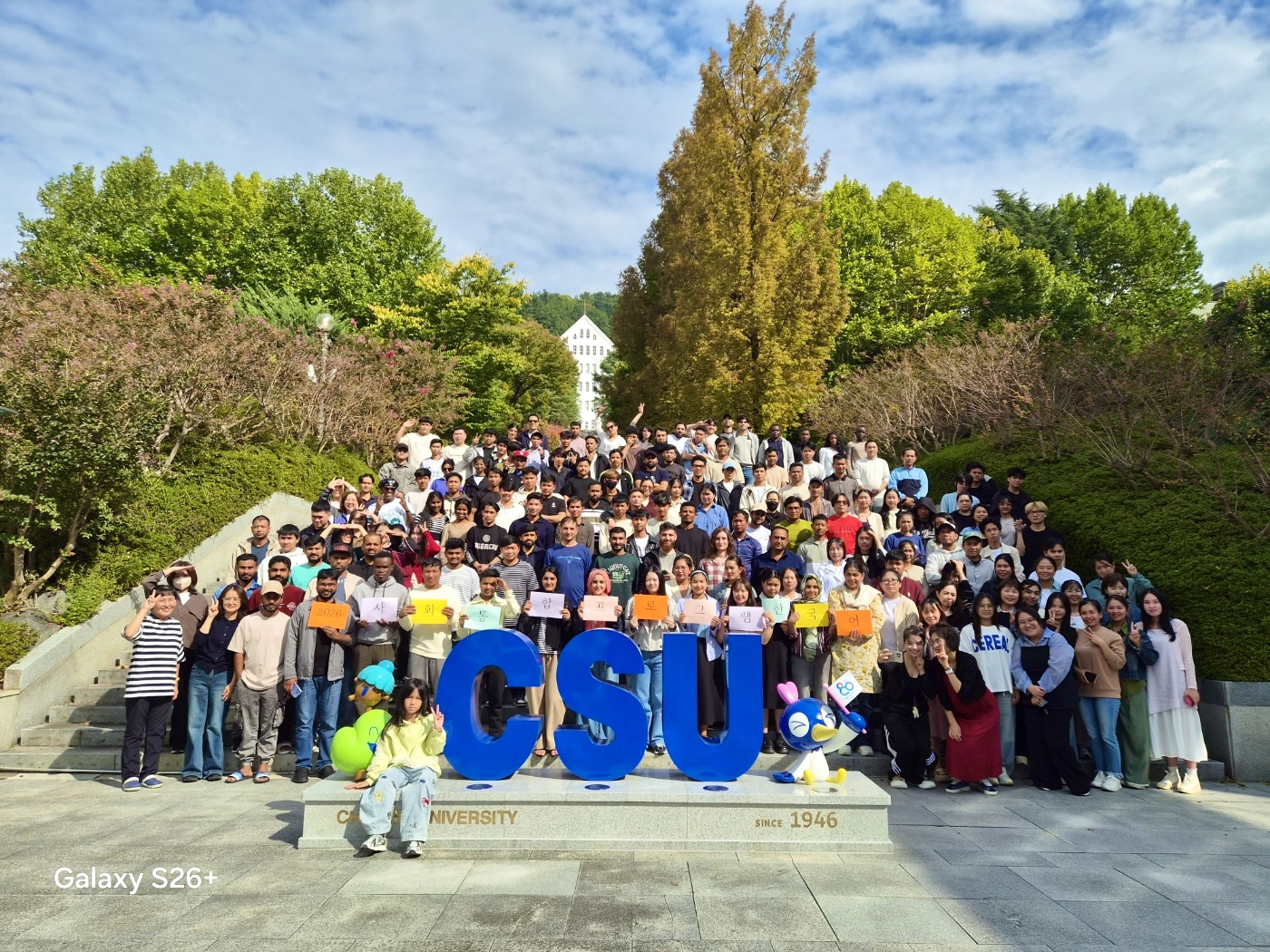
Cover Photo: KIIP students from Levels 1–4 and instructors gather for a group photo at Chosun University.