






Climate and the Cradle
By Siddhant K. ||
The UN now says extreme heat is making pregnancy riskier around the world. Korea, the country with the lowest birth rate on Earth and some of its fastest-warming summers, has more reason than most to listen.
On October 5, at a pre-summit meeting in Fiji ahead of this year’s COP31 climate talks in Antalya, Türkiye, theUN’s top climate official said something that rarely features in climate negotiations. “Rising temperatures mean rising danger in pregnancy,” Simon Stiell told the room. Extreme heat, he said, is increasingly linked to premature birth, stillbirth, low birth weight, and complications for mothers, and pregnancy and birth have become “a new fault line in the global climate crisis.”
He spoke at the release of a new survey commissioned by the health charity Wellcome, which canvassed maternal health professionals across five countries on five continents. The results are striking. Almost three in four said heat-linked cases or complications had increased over the past five years. Nearly all said they had personally cared for a pregnant woman, or a baby, whose health they believed had been harmed by heat.
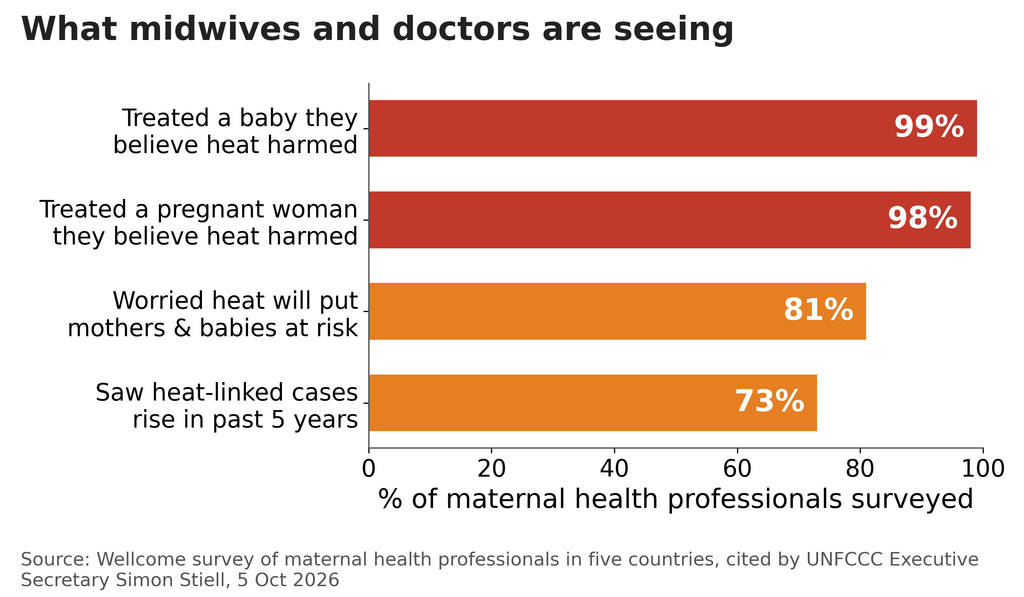
Findings from the Wellcome survey of midwives, nurses and doctors, as presented by the UNFCCC on October 5, 2026.
Read in “Gwangju,” after the summer we have just had, those words land close to home. Korea’s summer of 2026 was the third hottest since nationwide records began in 1973, averaging 25.4°C, 1.7°C above normal, with about twice the usual number of heatwave days. The southeastern city of Yangsan set a new national record of 42.5°C in early August, and by August 4, the government counted 16 heat deaths. The year before, 2025, was the hottest summer ever measured here.
At the same time, Korea is the place on Earth where babies are scarcest. Last year, the country’s total fertility rate, the average number of children a woman is expected to have in her lifetime, was 0.80. A population needs about 2.1 just to hold steady. In a country counting every birth, the question of whether heat makes pregnancy less safe is not abstract. So, what does the science actually say?
Why a Hot Day Is Harder on a Pregnant Body
Think of the human body as an engine that must constantly get rid of its own heat. On a mild day this is easy. On a hot, humid day, the body has two main tricks: it sends more blood to the skin, where heat can escape into the air, and it sweats, cooling the skin as the sweat evaporates. When the air is nearly as warm as the skin and thick with moisture, as on a Gwangju afternoon in August, both tricks work poorly.
Pregnancy makes this harder. A pregnant woman’s body is already working overtime: Her metabolism runs faster, producing extra heat, and her blood volume rises by roughly 40 to 50% to supply the placenta. The baby, meanwhile, cannot cool itself at all. A fetus typically sits about half a degree warmer than its mother and must pass all of its excess heat back through her body.
That creates a tug-of-war. Blood sent to the skin for cooling is blood that is not going to the womb, and heavy sweating drains body fluids. Researchers think this can briefly reduce the flow of oxygen and nutrients to the baby. Heat strain also raises stress hormones and inflammation in the body, and these are among the signals that can start contractions too early. Hot nights add a further burden: When the temperature never drops below 25°C, which Koreans call a “tropical night,” the body never gets its overnight recovery.
“Rising temperatures mean rising danger in pregnancy.” – Simon Stiell, UN Climate Official
What the Numbers Say
The strongest evidence comes from a 2020 review in the BMJ, a leading medical journal, which pooled 70 studies from 27 countries. It found that for every 1°C rise in temperature, the odds of a baby being born preterm, meaning before 37 weeks, went up by about 5%. During heatwaves, the odds rose by about 16%. Stillbirths also rose by about 5% per degree.
Those percentages sound small, so it helps to translate them. If 10 out of every 100 babies in a city are born early, a 5% increase in the odds means roughly 10 and a half. For any one family, the extra risk is modest. Spread across every pregnancy in a country, over summers that keep getting hotter, it adds up to real babies arriving too soon, with the breathing problems, hospital stays, and long-term health effects that can come with an early start.
Korea has its own evidence. A nationwide study published in 2024 examined more than 160,000 preterm births recorded between 2011 and 2019. It found that a 5°C rise in average temperature during the last four weeks before delivery raised the odds of preterm birth by about 3%. The effect was twice as strong, around 6%, among mothers aged 35 and over, and it was also larger among women with less education and in rural areas. An earlier study of more than 800,000 births in Seoul reached similar conclusions.
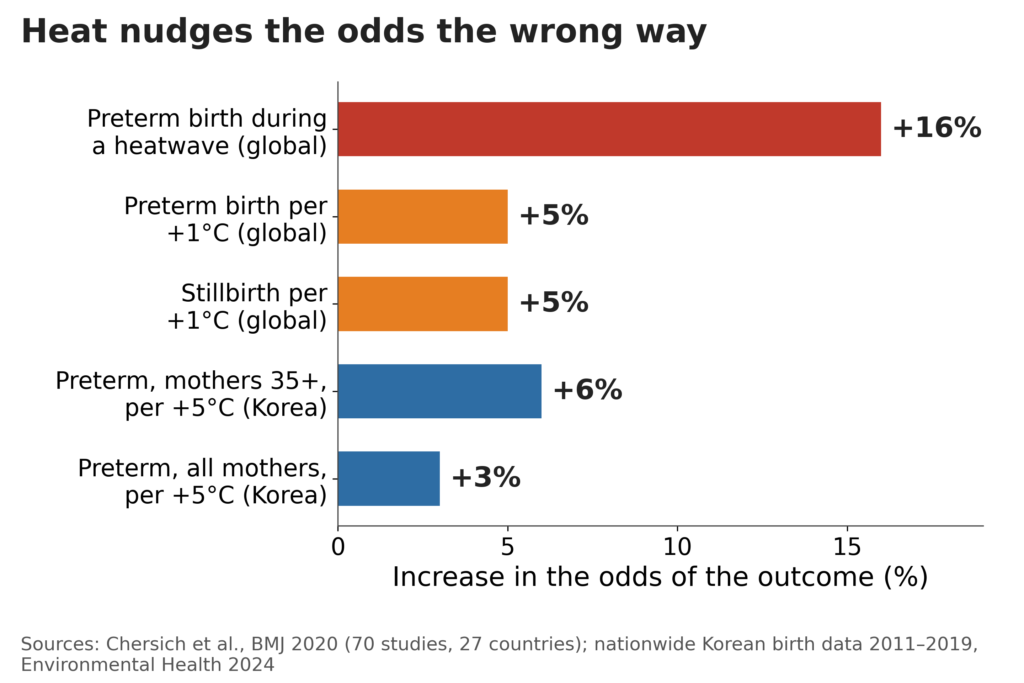
How heat changes the odds of difficult births. Note the different temperature steps (1°C versus 5°C).
Korea’s Particular Weak Spot
That finding about older mothers matters enormously here. Koreans are marrying and having children later than ever. In 2024, the average mother was 33.7 years old when she gave birth, and more than one in three births were to women aged 35 or older. Births to mothers over 40 rose from 5.9% of the total in 2019 to 9.5% in 2024.
Partly as a result, the share of Korean babies born early has climbed steadily, from 6% in 2011 to 10.2% in 2024, about one baby in ten. The main reasons are well understood and have little to do with weather: older mothers, more twins and triplets, and more pregnancies through fertility treatment. But heat does not replace those risks. It stacks on top of them, and it bears down hardest on exactly the group of mothers Korea increasingly relies on.
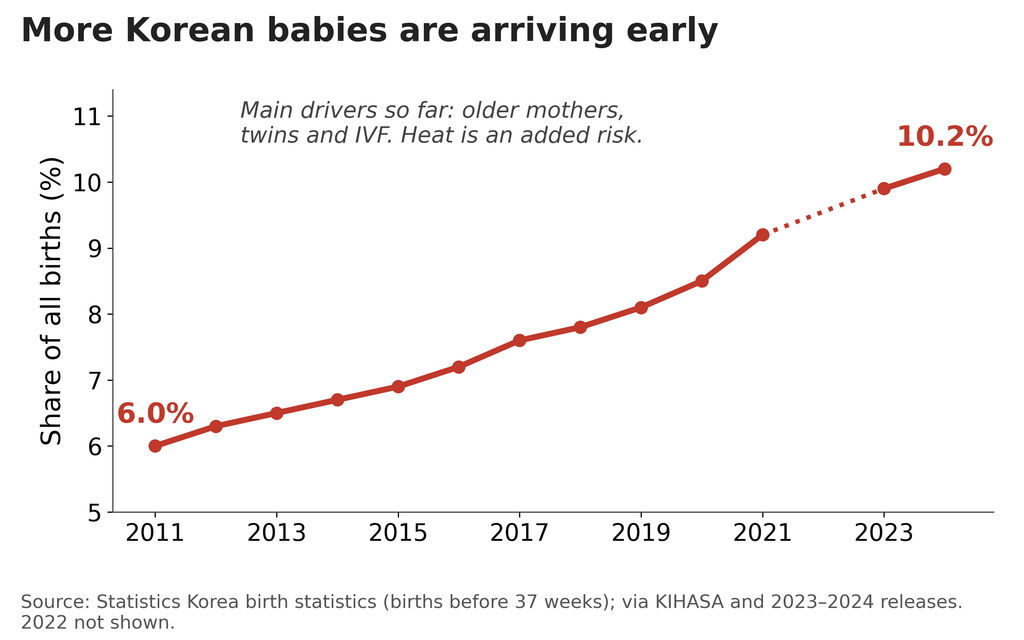
Share of Korean births arriving before 37 weeks.
Before a Pregnancy Even Begins
Heat may also affect how many pregnancies start in the first place. The best-known study, published in the journal Demography in 2018, examined eighty years of American birth records. It found that each additional very hot day, with an average temperature above about 27°C, was followed by a dip in births roughly nine months later. Some of those lost births were made up in the following months, but only about a third. The researchers concluded the dip was most likely caused by heat’s effect on reproductive health, rather than people simply having less sex in hot weather. They also found that air conditioning helped to reduce the effect over time.
Part of the explanation lies with men. The sperm-producing organ lies outside the body for a reason: Sperm are made best at a few degrees below core body temperature, and the process takes roughly three months from start to finish. Large studies of sperm donors in China, a neighbor with a similar summer climate, have found that higher temperatures during those months are linked to lower sperm counts and poorer swimming ability. One study of over 11,000 volunteers in Guangdong identified the period 70 to 90 days before a sample as the critical window. Another linked hot night specifically to reduced sperm movement.
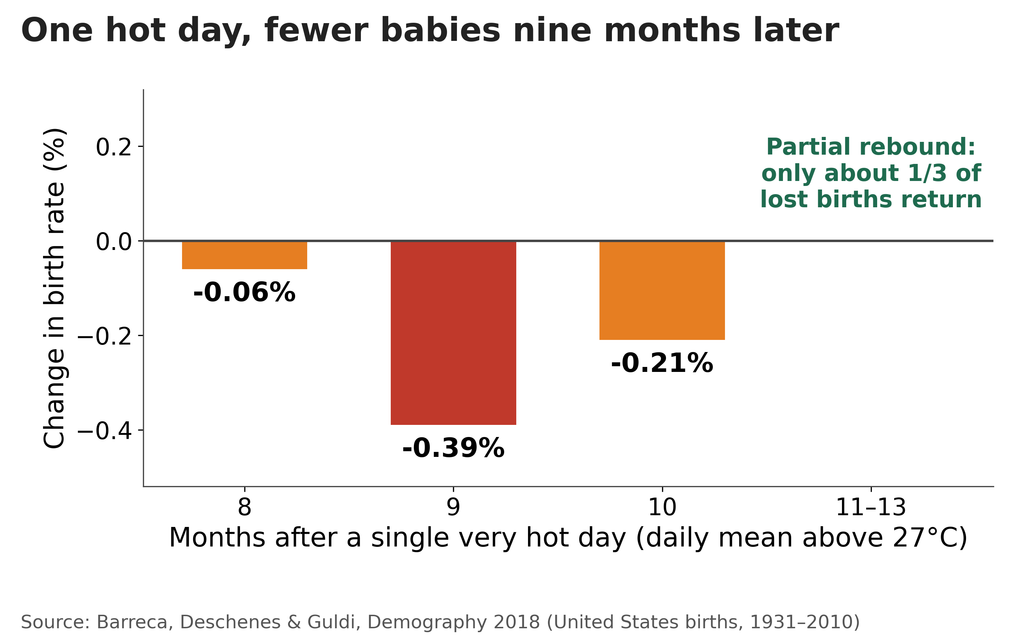
Change in the birth rate in the months after a single very hot day, based on United States records from 1931 to 2010.
So, Is Heat to Blame for Korea’s Baby Bust?
No, and it is important to be clear about this. Korea’s fertility rate began its long fall in the 1970s, well before today’s heat records, and dropped below replacement level in the early 1980s. The causes that researchers and the government point to are economic and social: the cost of housing and private education, long working hours, the career penalties women face after childbirth, and later marriage. The recent rebound, from a record low of 0.72 in 2023 to 0.80 in 2025, has been driven mainly by a surge in marriages after the pandemic.
Meanwhile, the climate has been changing at its own pace. Korea’s average yearly temperature rose from 12.0°C in the 1910s to 13.9°C in the 2010s, and has already reached 14.8°C in the 2020s. Heatwave days have more than doubled since the 1970s. Tropical nights have nearly tripled, and the hot season now begins earlier and ends later than it did fifty years ago.
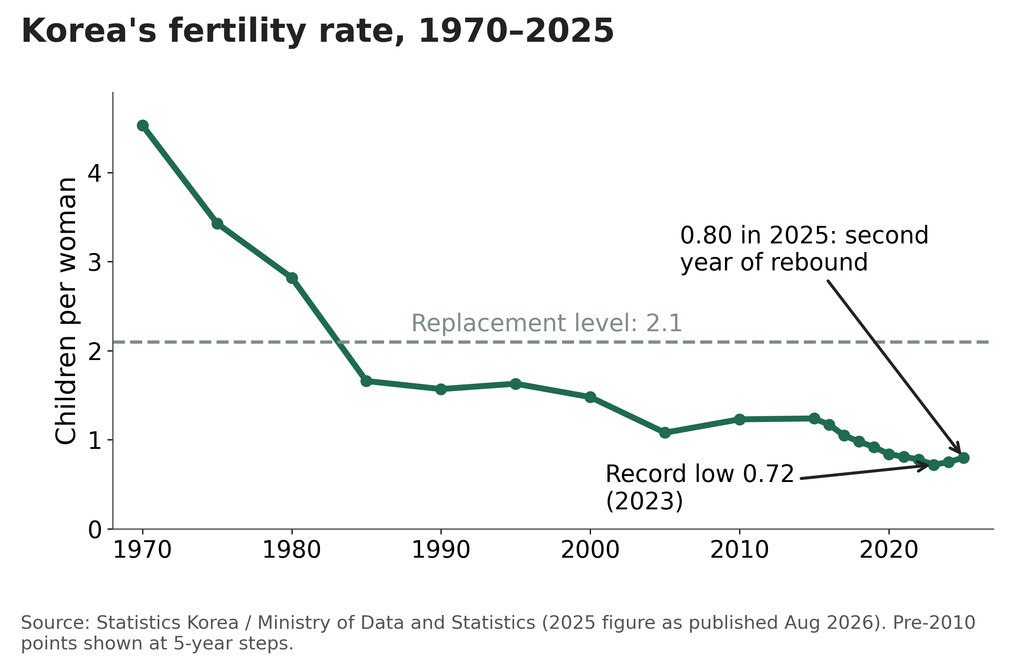
Korea’s total fertility rate since 1970. Most of the decline happened for social and economic reasons.
Two lines moving at the same time do not mean one is causing the other. The honest way to put it is this: Heat did not create Korea’s birth crisis, but it is becoming a headwind against the recovery. It slightly raises the risks for each pregnancy that does happen, and it may quietly trim the number of pregnancies that begin. For a country celebrating a rise of 0.05 in its fertility rate, small headwinds matter.
Our Corner of the Map
This is where the story becomes local. Jeollanam-do (Jeonnam Province) had the highest fertility rate in Korea last year, at 1.09, and Jeonnam counties such as Yeonggwang (1.79) and Jangseong (1.69) were among the highest in the country. Gwangju, at 0.76, was below the national average. Since July, the two areas have been joined as a single special metropolitan city, which now holds both the country’s highest provincial fertility rate and one of its lower urban ones.
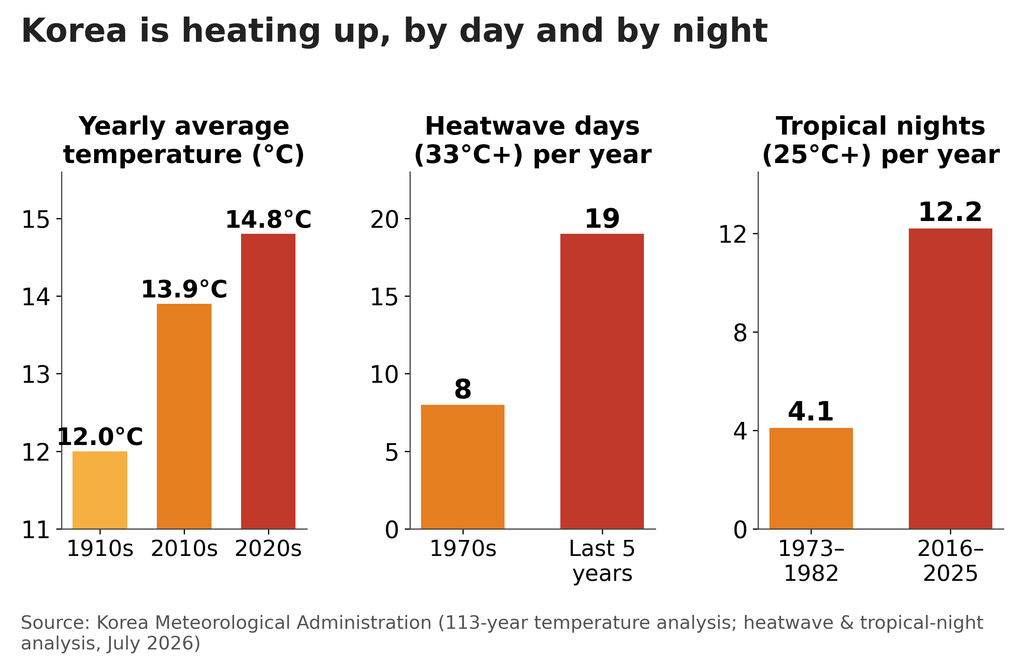
Three ways of measuring Korea’s warming, all from the Korea Meteorological Administration.
It is also a hot region. Gwangju recorded its earliest tropical night on record on June 19, 2025. And the Korean study described above found that heat-related preterm risk was unevenly shared, with rural areas needing particular attention. Much of Jeonnam is rural, with farm work done outdoors and longer journeys to hospitals. Both Gwangju and Jeonnam have set ambitious birth-rate targets, 1.0 by 2029 for Gwangju and 1.5 by 2030 for Jeonnam. Neither target is likely to be reached by protecting babies from heat alone, but neither should ignore it.
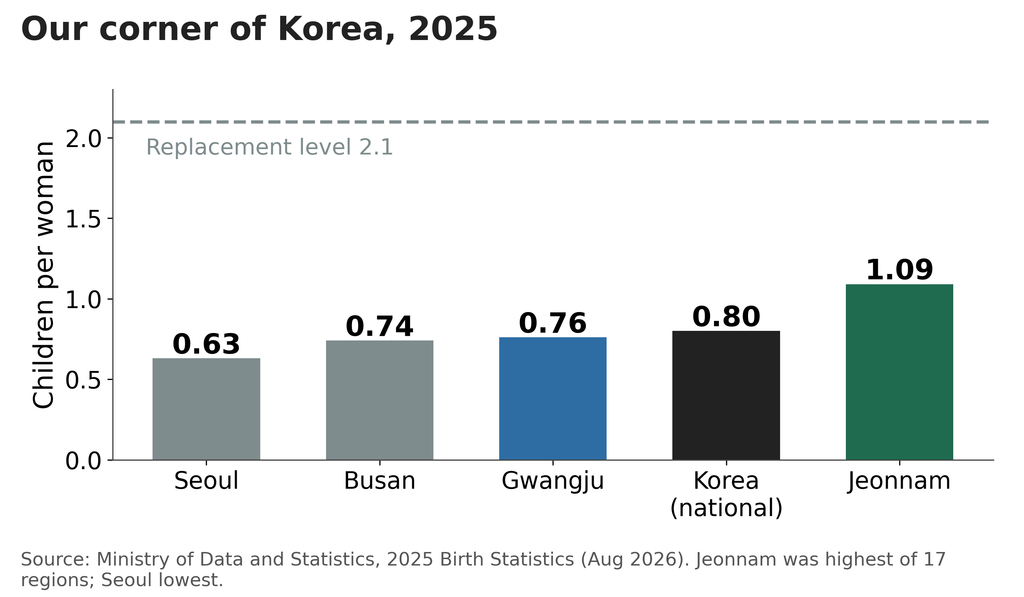
Total fertility rate in 2025 for selected regions of Korea.
Stiell’s three priorities translate well to our region. First, name pregnancy in heat plans: What is not written into a plan is rarely funded. Second, turn evidence into protection, for example by making sure heat alerts and cooling shelters reach pregnant women, who already register with local public health centers. Third, measure what is happening by linking weather records with birth records so that local officials can see where the risks are growing.
A Precious Arrival
“Across every culture, the arrival of a child is precious,” Stiell said in Fiji. Few countries understand this better than Korea, where baby births are now counted, reported, and celebrated as national news. The summers are getting longer and hotter, and they will keep doing so for decades. Making sure that each of those hard-won pregnancies is as safe as possible from the heat is no longer only a climate issue. In Korea, it is part of population policy too.
Pregnancy in a Korean Summer: Practical Tips
- Drink before you are thirsty. Carry water and sip regularly; dark urine is a sign you need more.
- Avoid the worst hours. Stay out of direct sun in the afternoon, roughly 2 to 5 p.m., when heat peaks.
- Use cooling shelters. Community centers and other public buildings open as heat shelters (무더위쉼터, mudeowi swimteo) during heat alerts.
- Protect your nights. Keep the bedroom cool with air conditioning or a fan, and take a cool shower before bed.
- Know the warning signs. Dizziness, confusion, a racing heart, regular tightening of the belly, leaking fluid, or fewer baby movements mean you should contact your doctor right away, or call 119 in an emergency.
Sources
- Stiell, S. UNFCCC (2026, October 5). UN Climate Chief on new data: “As extreme heat worsens; pregnancy and birth are a new faultline in the global climate crisis.” UnitedNations Climate Change. https://unfccc.int/news/ un-climate-chief-on-new-data-as-extreme-heat-worsens-pregnancy-and-birth-are-a-new-faultline-in-the
- Chersich M. F. et al. (2020). Associations between high temperatures in pregnancy and risk of preterm birth, low birth weight, and stillbirths: systematic review and meta-analysis. BMJ, 371, m3811. https://www.bmj.com/ content/371/bmj.m3811
- Min, J. et al. (2024). Nationwide time-stratified case-crossover study of ambient temperature and preterm birth in Korea, 2011–2019. Environmental Health, 23, Article 23. https://doi.org/10.1186/s12940-024-01062-6
- Son J.-Y. et al. (2018). Impacts of high temperature on adverse birth outcomes in Seoul, Korea, 2004–2012. Environmental Research, 168, 460–466. https://doi. org/10.1016/j.envres.2018.10.032
- Barreca A., Deschenes O., & Guldi M. (2018). Maybe next month? Temperature shocks and dynamic adjustments in birth rates. Demography, 55(4), 1269–1293.
- Ambient temperature and semen quality studies: 10,802 men in China (Environment International, 2020); 11,050 volunteers in Guangdong (Environment International, 2023); hot-night exposure in six sperm banks (Biomedical and Environmental Sciences, 2024).
- Korea Meteorological Administration: Summer climate reports 2025 and 2026; 113-year temperature analysis; heatwave and tropical-night analysis 1973–2025 (July 2026).
- Ministry of Data and Statistics / Statistics Korea: Birth Statistics 2023, 2024, and 2025.
The Author
Siddhant K. is a geochemical ocean-ographer and researcher at TMBL at the Gwangju Institute of Science and Technology (GIST). His work focuses on marine minerals, sediment chemistry, and paleoenvironmental change. He is passionate about communicating ocean science to broader communities in Korea.
Cover Photo by GN with Copilot.