






Book Review: The Corrections
Reviewed by Michael Attard ||
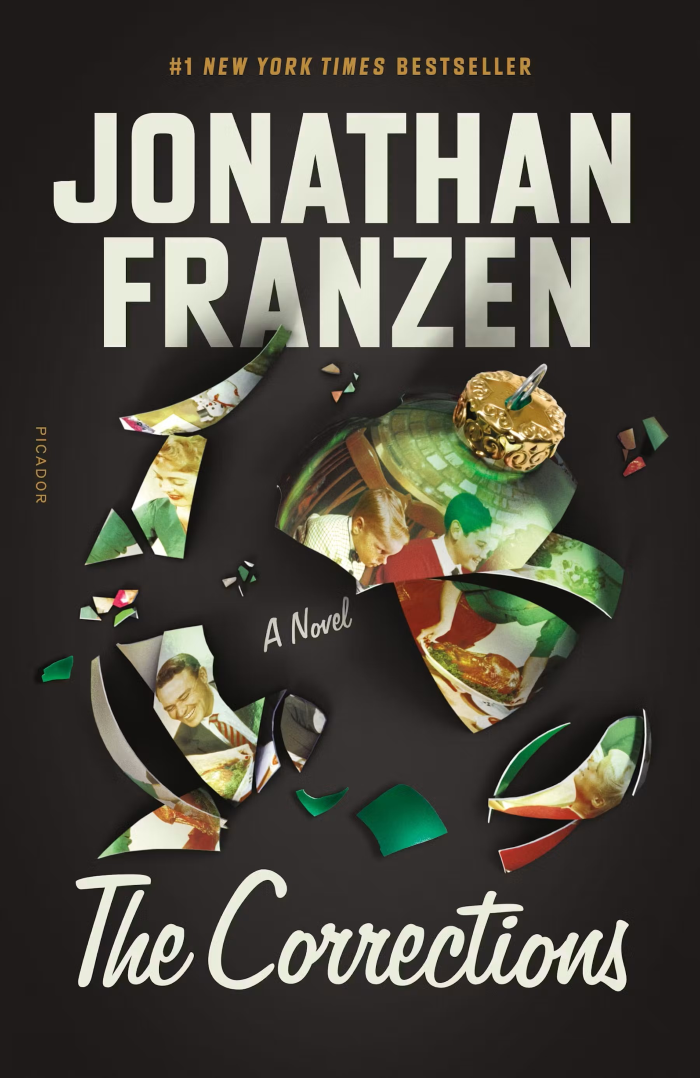
The Corrections
By Jonathan Franzen
566 pages, Picador, 2002 (Original 2001)
The family grew up in the American mid-western town of Saint Jude. Saint Jude is the patron saint of hopeless causes. The German philosopher Arthur Schopenhauer is referred to on several occasions. His writings challenge the value of human existence, and he is known as the philosopher of pessimism. A quick deduction tells you that this is not a happy story.
“All they need in life is a quick easy flx, or correction.”
The main characters are all immediate family. Alfred and Enid have three grown children, Gary, Chip, and Denise. Without subtlety, none of them are likeable, and I almost stopped reading the book a few times. Enid is the least offensive, but her attempts at merriment are more about control. Alfred is being taken over by dementia, and he never was the agreeable sort. After retirement, sitting in his blue chair was the center of his life.
The three adult children are all well-educated and appear materially successful. But, in the Schopenhauer vein, this is mere phenomena and the manifestation of a blind and irrational will. Chip, the anti-capitalist professor has had a series of broken relationships – where he is the one who gets dumped – and loses his teaching job for screwing one of his students. He was hoping for tenure but had to settle for unemployment. He begins to make money by becoming a con man.
Gary, the banker, is stressed. He believes that his wife, Caroline, is purposely turning his three sons against him, by telling them that Gary is depressed. She doesn’t deny this. He also accuses her of eavesdropping, to which she responds, “It is your paranoia, not my eavesdropping.” Enid wants Gary and family to travel to Saint Jude from Philadelphia for Christmas, but Caroline refuses to go, ever. Gary ends up going alone.
“As the story moves on, it’s a bit of a guessing game as to who will make it to Saint Jude for Christmas.”
Denise is the youngest, smart, beautiful, and a well-respected chef, although she is working all the time. She marries Emile, the relationship quickly sours, and “she took comfort in the idea that her trouble with Emile was his gender.” Subsequently, “she glommed onto the belief that she was gay.” Although after she becomes lovers with Robin, she also finds herself having an affair with Robin’s husband Brian. This didn’t help. “Whenever she was with Brian, she would pine for Robin’s body, and sincerity, and good works, and be repelled by Brian’s smug coolness; and whenever she was with Robin, she would pine for Brian’s good taste, and like-mindedness, and wish that Robin would notice how sensational she looked in black cashmere.” Is this the thinking of a reasonable person?
As the story moves on, it’s a bit of a guessing game as to who will make it to Saint Jude for Christmas and how the celebration will go. But there is another storyline. This involves a new, but as of yet unapproved, drug called Corecktall, being touted as a panacea covering Alzheimer’s, Parkinson’s, and depression. This is Enid’s big hope for Alfred, and Gary sees an opportunity to make a lot of money. All they need in life is a quick easy fix, or correction. What they seem to be missing, however, is that without fundamental internal changes, any fix is temporary at best.
There is plenty of dialogue, but if someone isn’t claiming that they are right and that everyone else is wrong, then it’s mumbling under one’s breath about how crappy life is. Gary, against his will, goes to buy a shower stool for his father. The friendly cashier remarks on how super it is. Amiable Gary responds with “You know what these stools would really be good for… would be to hang yourself.” Generally, the conversation is dreary, goes on for much too long, and ends up nowhere.
The reader is given an abundance of information about other characters, leading one to believe that they are important to the story. But they aren’t, leaving the reader somewhat puzzled. The book doesn’t need to be 566 pages. And at page 557, life is still terrible as Alfred begs Chip to help him commit suicide.
It seems that the author doesn’t know how to end the story. Alfred is put into a nursing home. Miraculously, the Earth shifts on its axis. Chip, who had been so anxious to get away, suddenly becomes a good son, stays behind, and fixes up the house. Only a few months after Christmas, Gary returns for another visit, this time bringing Enid’s favorite grandson along. And Denise moves to Brooklyn to work in a new restaurant. Everything is suddenly fine. Enid starts going out to play bridge, she speaks her mind and no longer worries about Denise not having a man in her life. And one more wonder of wonders, also in the last nine pages, Chip meets a “plain-looking Jewish girl from Chicago” whom he gets pregnant with twins and they marry.
The author seems to have enjoyed dwelling on the negativity of life, and without a real story writes an ending totally contrary to the character of everyone involved. Those who praise the writing think that the author understands the misery of being. On the other hand, I think he misses the clarity of human spirit.
The Reviewer
Michael Attard is a Canadian citizen but has lived in Gwangju for over twenty years. He has taught English as a second language in academies and within the public school system. He is officially retired and spends time reading, writing, hiking, and spending time with friends.