




Book Review: The War That Saved My Life
Reviewed by Michael Attard ||
The War That Saved My Life
By Kimberly Brubaker Bradley
316 pages, Dial Books for Young Readers, 2015
The War That Saved My Life, is a Newbery Honor Book. The intended audience is adolescents. The storyline and themes of such books may be easy to understand, but it does not follow that the story is any less interesting, entertaining, insightful, or the prose weaker than in any other novel. And this is certainly true of this book by Kimberly Brubacher Bradley.
Ada, our heroine and protagonist, is ten years old, and she is the narrator of the story. This first-person narration enables the reader to more concisely comprehend the thinking of a ten-year-old, reducing the chance of adult misperception. Additionally, plenty of dialogue keeps the reader tethered to what is of most importance to children.
We meet Ada in London, England, in 1939. She lives with her brother Jamie, who is six years old, and her abusive mother. It is clear that the mother is the antagonist. She is a woman superstitiously obsessed with the misfortune of Ada having been born with a club foot. The mother, referred to as “Mam,” has never allowed Ada to go out, meaning that Ada has not attended school. The mother’s explanation for this is “You think I want the world seeing my shame?”
Ada gains some knowledge of the world from Jamie, and from sitting on a chair by the window. She even learns a bit about a few of the people she sees, waving to some of those who pass by regularly. They in turn have been led to believe that Ada is a simpleton. But all is about to change when word comes that the children living in London will be evacuated because of the inevitable beginning of World War Two. Ada asks, “What about me?”
Mam replies, “Course not. They’re sending kids to live with nice people. Who’d want you? Nobody, that’s who. Nice people don’t want to look at that foot.” Secretly and with help, Ada, along with Jamie, does manage to get away. It is true that they are the last two children to be placed, and it is also the case that Miss Susan Smith is coerced into taking them, but they are out of dangerous London and away from Mam. No one knew what their future would be.
A major theme underlying the daily events is the development of trust that Ada has in Susan Smith and herself. Ada has a strong will, but her reluctance to believe that anyone would be willing to help her and accept her for who and what she is – a girl with a club foot – inhibits her from opening up to people and precludes happiness. For Ada, anything that seemed too good to be true, probably wasn’t true. She says, “I knew that Susan wasn’t real. Or, if she was a tiny bit real, sometimes, at the very best, she was only temporary.”
“A major theme underlying the daily events is the development of trust that Ada has in Susan Smith and herself.”
Young brother Jamie has not escaped the psychological problems created by his plight either. He becomes homesick and a bed wetter. Susan realizes that something is up at school with Jamie. His teacher has interpreted his left-handedness as a sign of the devil and has tied his left wrist to his chair. Susan puts an end to this, and when Jamie adopts a scruffy cat, expressly against Susan’s wishes, the bed wetting ceases.
A soft and touching, almost magical, element of the story involves Ada’s relationship with a pony named Butter. While Susan cares for the pony, its real owner has died, and thus Butter, much like Ada, is alone. The pony provides Ada with unconditional friendship. Metaphorically, Butter is a pathway, a link to healthy human relationships. As Ada gallops away atop the pony, her fears dissipate, and she becomes acquainted with her own inner strength.
In the material world, the war does arrive. Ada’s village gets a close-up look at the war when soldiers from the evacuation at Dunkirk arrive. As the Battle of Britain begins, so do the falling bombs. On the street, “gaps showed in the rows of buildings like missing teeth.” As a historical point, generally, child evacuees from London were not sent to towns near the English Channel, as per the story. Rather they were evacuated north of London and inland.
While the war affects their daily lives from rations to a bomb shelter built in the yard, the greater impending confrontation is going to be with Mam. Mam has not answered any of Susan’s letters, but she knows where Ada and Jamie are. As the reader can easily deduce from the title, there is a happy ending, but the author has left it to the very end before assuring the reader that this is so.
The coming and going of other characters integrated into Ada’s life serve to weave the days together. From Stephen, the boy from home, the elderly blind colonel, and Grimes the caretaker to Doctor Graham, who says that Ada’s foot can be fixed, Ada learns that it is indeed a broad world. More importantly, she realizes that there is a place for her on this planet, and that that place will be as much determined by her as others and circumstances.
The Reviewer
Michael Attard is a Canadian citizen but has lived in Gwangju for over twenty years. He has taught English as a second language in academies and within the public school system. He is officially retired and spends time reading, writing, hiking, and spending time with friends.
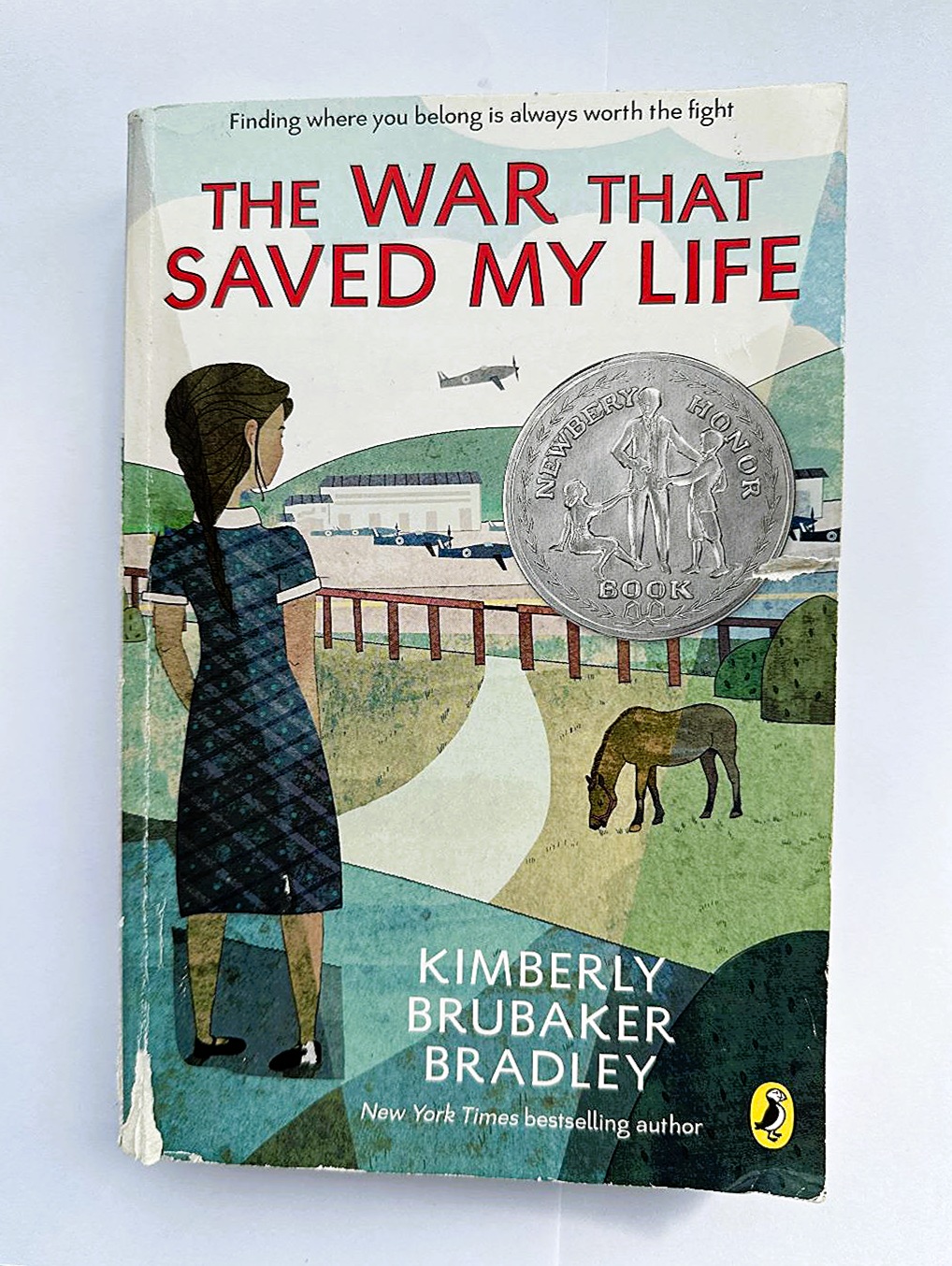
Cover Photo: The War That Saved My Life. (M. Attard)