



Movie Review: The Land of Morning Calm – The Shape of What Remains
By Farrukh Anique ||
In 2024, insurance fraud worth US$870,000 was committed in Korea, roughly half of it carried out through forged medical documents. This film’s story is, on its surface, built on that very subject. It shows a small village on Korea’s eastern coast. The village’s scant population is made up of a handful of fishermen. They put out to sea in their old battered boats and return with two or three baskets of small fish or crabs, which their women dry and sell, and this is the whole of their livelihood. They are fighting for survival against a changing age.
How the village came to this brink of ruin is never revealed, but by the time the film begins, the village is already drawing its final breaths. To all appearances, every household still lights its hearth, still finds two meals a day. Yet whoever you meet in this village wears a sunken face and is ready to snap at the slightest provocation. Nearly all the village’s young have left for the big cities, and the bent backs of their aged parents can no longer carry even their own weight. Those young who could not leave for the city are so crushed beneath the burden of their own failure that their spines are stooped lower than the old folks’.
The film’s title carries the word “calm,” which usually means peace and contentment. But once you watch the film, you understand that “calm” does not yield that meaning here. Here it means stillness and hush. The kind of stillness one often feels in the moments just before death – the kind of silence whose screams can be heard far and wide. At the village’s edge lies the boundless sea, yet everyone is gripped by a strange suffocation. It seems as though each time the waves strike the shore and recede, they carry a little more of the village away with them, and now the village is all but finished.
A small community center is the only place where laughter can still be heard. The old women sit there at their leisure playing cards and passing on the village’s news to one another. Step into the community center and the village seems like one large family, where everyone shares each other’s griefs and sorrows. Perhaps this community center is the last refuge for these forsaken souls.
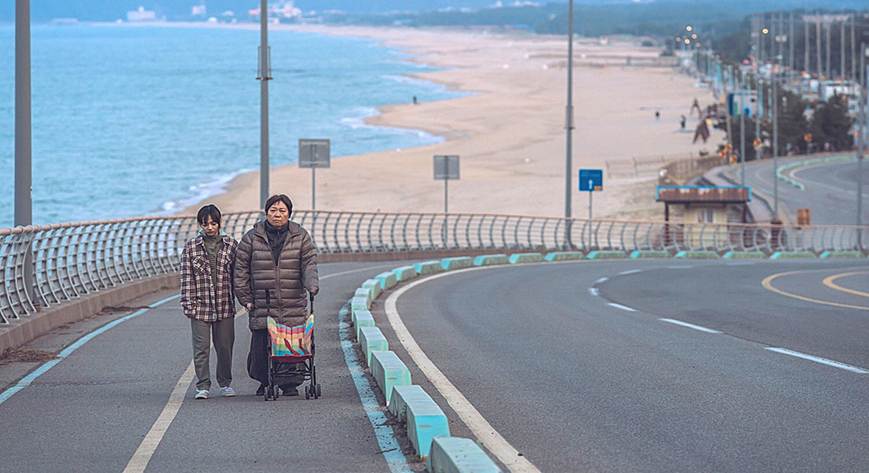
The mother and the wife on their village’s coastal road, with a deserted shore in the background. (Korea Film Council)
It is then that an old fisherman’s apprentice – a man who curses himself day and night over his failure – says to his master one day that he has no future in this village. I have bought myself an insurance policy, he says, and I want all the money to go, after my death, to my Vietnamese wife and my old mother. He tells him, “One night, I will slip quietly out of the village, and afterward, you will tell the villagers that your apprentice fell from his boat and drowned.” The master agrees to play his part in his apprentice’s foolish scheme. Perhaps he wished that the chance to escape this village in his own youth; the chance he had let slip had now been granted by fate to his apprentice, and so he ought to stand by him.
When, in the dead of night, the old fisherman comes to report to the police that his apprentice has fallen into the sea, a storm breaks over the village. The whole village gathers. And calamity falls upon the apprentice’s mother and his wife as well. A team of specialist divers is summoned from the city, and the search begins for the body of a man who, miles away in a small room of some anonymous city hotel, lies staring at a telephone.
The film moves a little slowly, but then, do our own lives not move just so? Does life move swiftly for a mother whose only support has drowned in the sea, his body never even recovered? For a wife who loses her sole protector in a foreign land, where old men leer at her – men whose tongue she cannot even speak? Does her life not come to a standstill? And the despairing old fisherman who, with each passing moment, feels himself condemned before the stony gaze of a frail mother – can even his breath be called life?
There is a great deal in this film. So many themes have been folded into so brief a film that it is, in truth, worthy of admiration. This is not a thriller in which the police are shown investigating a mysterious disappearance. It is, rather, a layer-upon-layer tale of emotion that turns each of its characters inside out, the way mothers turn their children’s white uniforms inside out to hang and dry on the wash line. A son and husband who is willing to go to strange, extreme lengths to fulfill his duty. A mother who sits frozen as a statue on the shore until late into the freezing, marrow-numbing night, on nothing but the hope that any moment now some uniformed man will step off a boat and bring her the glad tidings that can never come true. A wife whose husband’s death has, in a single day, made her a widow and a stranger on borrowed soil cannot even raise a lament. For a lament can only be raised in one’s mother tongue, and who was there to understand hers? A master whose faltering legs can no longer bear the weight of the guilt he is steeped in – a guilt that all the soju in the village’s little tavern cannot drown. Middle-aged policemen and sea divers who cannot meet the frail old woman’s eyes, men in whose lives this was perhaps the biggest case of all, and the very one they failed to solve. And, oblivious to the anguish of all these, the insurance-company and administrative officers and clerks seated in warm offices and comfortable cars, their hands bound by the red tape of files that pass endlessly across their desks.
I usually close by writing of one or two scenes that stay with me. But what is one to do when every single scene of this film cuts at the liver and wracks the soul? The apprentice, taking his leave of the master, sits at his feet and bows to him in prostration – and the master gives him a slap, lifts him up, and says, “Gosaeng-haet-da” (well done). No greater words than these can pass a master’s lips for an apprentice, and least of all, when the master is straining with all his might to hold back his own tears.
There is a mother who receives word that her son has become the prey of the very sea that, for decades, had been the sustainer of the whole village. Think on it. Imagine it. Those who are mothers, place yourselves, for a moment, in this mother’s stead. What would you do? Weep? Cry out? Pull your own hair? Collapse to the ground? Would all of this be a sufficient response to such a loss? Surely not. And yet this seventy-year-old actress pours into fifteen or twenty seconds an anguish greater than the viewer can hold.

Old fisherman at the harbor, the morning after his apprentice falls into the sea. (Korea Film Council)
Nowhere does the director, Park Ri-woong, push the film into manufactured tragedy, nor does he conjure needless sensation. The piercing silence, the imperceptible fatigue, and the heavy, burdened pace of life in a dying village build so gradually toward such intensity that the central event – the disappearance – recedes into the background, and the story’s true emotional reality begins to unfold without the least exaggeration. It is this same restraint that gives the actors their fullest room here. The characters do not shout out their sorrow; they carry it in their withered faces and their lifeless bodies. The two elderly characters, especially, seem to gather into themselves not merely their own private deprivation but the collective defeat of the entire village.
The film’s real virtue lies precisely in this: that it nowhere inflates anything, but instead trusts in the substance of its story, and lays bare before us, with the greatest ease, the cruelty, the despair, and the grief hidden within it. By the end, it feels as though what has gone missing is not a single man, but perhaps the village’s last lamp – which flared up in one full, vivid surge of brightness, and then went out.
The Author
Farrukh Anique, originally from Pakistan, is a PhD student at Chonnam National University. He’s got a real love for the performing arts, culture, literature, and languages. In his spare time, he dives into Korean culture and history, and stories that spark his curiosity. Oh, and he absolutely loves strawberries. Email: farrukh.ask@gmail.com
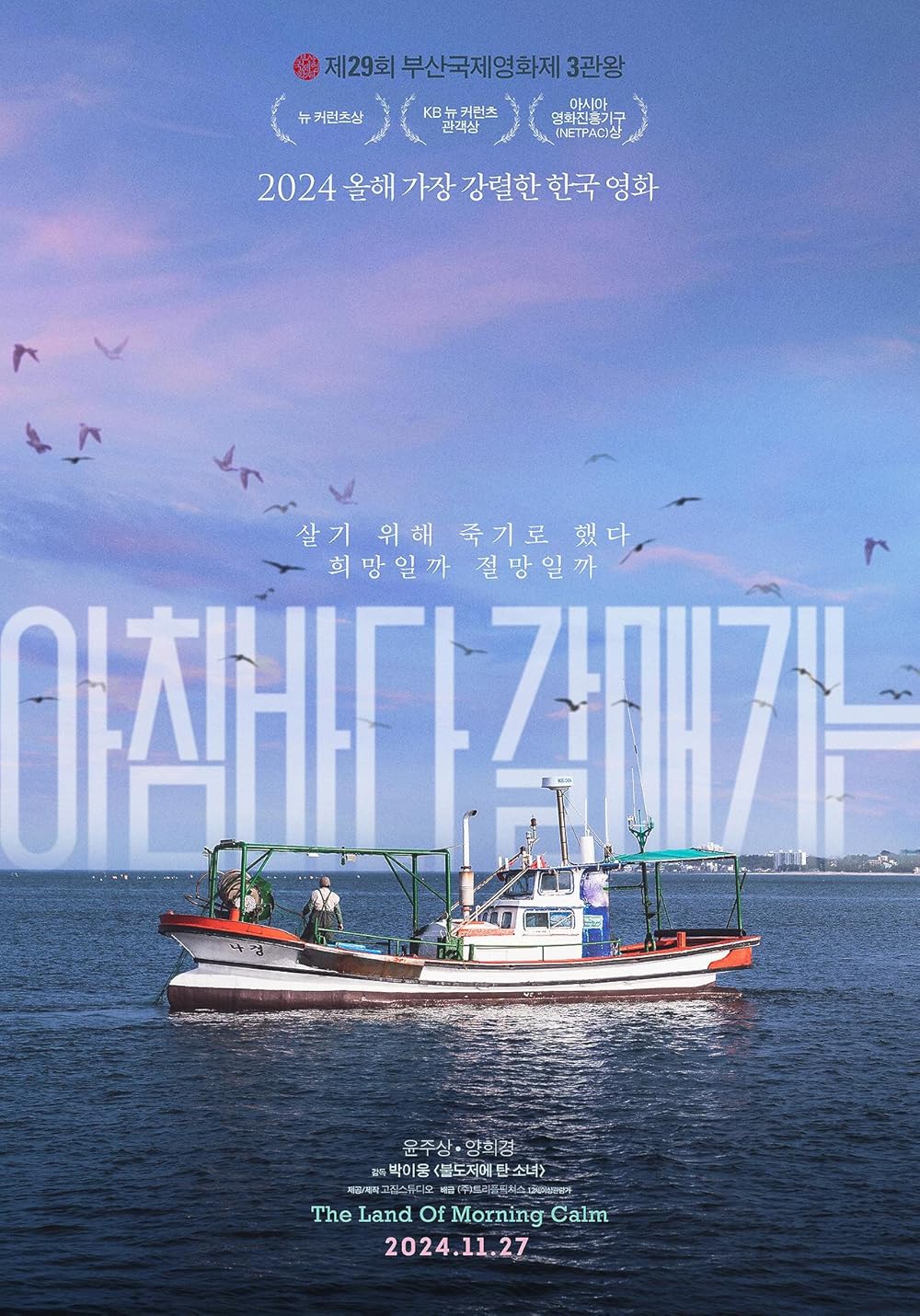
Cover Photo: Korean poster for The Land of Morning Calm. (IMDb)