







Movie Review: The Pursuit of Happyness – Learning the Art of Hopeful Survival
By Tabbu Shaikh ||
At first glance, “happyness” is merely a misspelling on a daycare wall – a careless orthographical error painted over a place meant to nurture the future. Yet, by the end of Gabriele Muccino’s masterpiece, that misplaced “y” in “happiness” becomes a profound, universal symbol of life’s inherent imperfections. The spelling as “happyness” reflects the human condition itself: It is fundamentally flawed, deeply asymmetrical, and stubbornly irregular. It is akin to a moon covered in craters and scars – beautiful not because it is flawless, but because it has endured the violent bombardment of the cosmos and still manages to shine.
The Pursuit of Happyness is far more than a movie; it is a raw, visceral, emotional bridge that connects the audience to the harrowing, unforgiving, yet ultimately hopeful, journey of Chris Gardner and his young son, Christopher.
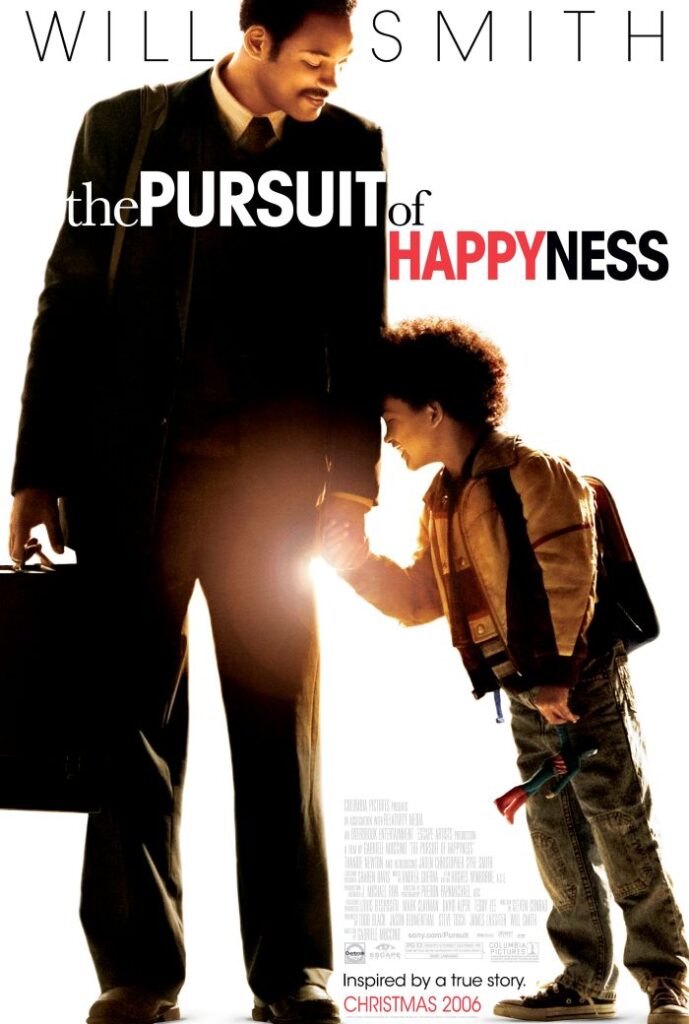
The Pursuit of Happyness, 2006. (IMDb)
The story is intentionally not an easy watch. As the first act unfolds, it actively disturbs the mind, forcing us to sit uncomfortably with the crushing, suffocating weight of systemic poverty. We watch a man do everything “right” – work hard, pitch products, maintain an optimistic smile – only to be systematically stripped of his savings, his apartment, his partner, and his financial dignity. Yet, as the final credits roll, the film does something far more important than merely depressing us: It awakens the soul.
The film teaches us a difficult truth: that happiness is rarely a passive gift bestowed by fate; it is a prize won in the trenches. It is something that must be chased with every ounce of one’s spirit. We see Chris Gardner running literally and figuratively through the streets of San Francisco. He runs against time, against poverty, and against a world trying to steal his dignity. He reminds us that even when you are at “zero,” you must still give your absolute best.
The film’s emotional anchor is the infamous subway bathroom scene – a sequence that stands as one of the most heartbreaking moments in cinematic history. Locked inside a public restroom, a father and son seek refuge from the cold night. To shield his five-year-old son from the devastating reality that they are homeless, Chris uses the power of imagination, pretending that his bone-scanning apparatus is a “time machine” that has transported them back to the era of dinosaurs. At that time, those tears of Chris Gardner break us from the inside out.
Exhausted by long shelter lines and blistered feet, Chris’s armor finally breaks. Yet, he proves that “smooth seas do not make skillful sailors.” In that moment, he shows what truly makes him a great father – not money, but his absolute refusal to let a cruel world crush his son’s happiness.
Perhaps the most hard-hitting and quietly tragic element of the film is the forced maturity of young Christopher (played with profound innocence by Jaden Smith). In a world where childhood should be an unbothered fairytale of toys, playgrounds, and chocolates, Christopher is forced by circumstance to grow up in the margins. He does not throw tantrums when told they must leave their motel room. Maturity at such a delicate age feels like a curse. He implicitly understands the silent, heavy weight of his father’s empty pockets. When he tells his father, “You’re a good papa,” it is a hauntingly beautiful realization.
The climax of The Pursuit of Happyness brings us face-to-face with what can only be described as “a frozen tear.” For months, Chris has walked through the freezing breeze of poverty, rejection, and exhaustion. He could not afford to cry; crying takes energy, and crying implies defeat. His tears were frozen solid by the sheer force of will, locked behind a dam of survival instinct. But when he is finally called into the boardroom and told to wear a shirt again “because tomorrow’s going to be your first day,” the dam breaks. Walking out into the crowded San Francisco Street, surrounded by a sea of oblivious businessmen, Chris begins to clap his hands together, and the tears finally flow.
A frozen tear…
Locked in the cold breeze of life, denied the chance to flow…
Walking this long, difficult path alone… The heart questions, yet the feet move on.
A frozen tear in your mind waiting to flow…
Yet even ice remembers warmth, a whisper of sun, a trembling hope.
And when the heart grows brave enough to loosen what it held too long…
The tear will soften, fall gently to the earth…
To cherish a new blossom and teach you how to live again.
For every frozen sorrow must melt someday,
And the long, dark winter will eventually give a way. Your struggle story is not where the book will stay… It is just a success story in the making, waiting for its day.
The Verdict: A Masterpiece for the Ages
Everyone smiles at the climax, but the collective smile of the audience is for far more than just a corporate job offered or a steady paycheck. It is a celebratory sigh of relief for the beginning of a new era for a father and his son. It is the validation that their suffering was not meaningless.
The Pursuit of Happyness remains a must-watch “feel-good film” yet grounded masterpiece for every generation. It stands as a monumental cinematic reminder that our current stories of struggle are not permanent tragedies – eventually, they are simple success stories in the making.
The Author
Tabbu Shaikh is an international student from India. She has traveled from India to South Korea for the Spring Exchange Program 2026 at Chonnam National University in Gwangju. Being a research student, she is deeply immersed in research work but actively seeks inspiration in the world of nature, capturing those moments through the lens of a poetess.
Cover Photo: T. Shaikh with Samsung Galaxy AI Photo Assist. From luancabj/TMDB