

Art Exhibition: Five Peaks, No Rules – A Conversation with the Past
By Reeti Roy ||
To stand before the Ilwol-obongdo, the folding screen known as the “Painting of the Sun, Moon, and Five Peaks,” is to encounter one of the most quietly powerful visual structures of the Joseon Dynasty. If you have ever wandered through a Korean palace, you will recognize it instantly: five mountains rising in symmetrical formation, twin celestial discs suspended above them, stylized waves churning below, and pine trees that appear forever caught between stillness and motion. The screen is beautiful, but beauty was never its primary purpose.
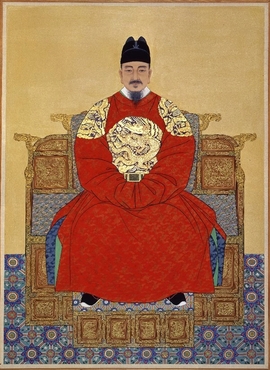
Placed behind the king’s throne, the Eojwa; it functioned as a cosmological stage set. The composition was never meant to stand alone. It became complete only when the king took his seat before it, occupying the invisible point where heaven and earth met. The mountains promised stability, the sun and moon promised cosmic balance, and together they suggested that as long as these elements remained in harmony, the kingdom itself would endure.
In this traditional setting, the “self ” was defined by a royal title. But in her recent exhibition Five Peaks, No Rules, artist Park Yeonhee begins to gently dismantle this architectural certainty. She invites a different kind of occupant to the center: the sovereign self, no longer defined by a kingdom, but by the quiet authority of an individual’s internal world.
Encountering the exhibition feels strangely similar to walking through a Korean city whose foundations remain ancient while its daily life pulses with restless modern energy. The structure is familiar. The symbols are recognizable. Yet the emotional climate within the space has shifted.
Anyone who has spent time in cities like Seoul or Gwangju knows this sensation well. You turn a corner and suddenly find yourself looking at a glass tower reflecting the tiled roof of a centuries-old building. The past does not disappear; it simply learns how to coexist with the present.
Park’s paintings seem to operate in precisely that space of coexistence.
Reimagining the Five Peaks
In traditional depictions of the Ilwol-obongdo, every element carries symbolic weight. The five mountains represent the stability of the kingdom; the red sun and white moon embody a complementary duality: king and queen, yin and yang, presence and reflection. Even the pine trees and stylized waves are visual assurances of continuity.
Park Yeonhee keeps this structure intact. Her canvases still anchor themselves around the five peaks, which remain firmly positioned at the center of the composition. But what happens within that structure is far less predictable. Colors migrate. Surfaces fracture. Symbols emerge and dissolve. What once served as a declaration of political order begins to feel like a map of an interior landscape.
The mountains become less about territory and more about orientation. In her own reflections on the work, Park suggests that the sun represents a source of self-generated light, the self striving to remain centered, while the moon reflects the presence of others: friendships, relationships, and the shifting constellation of human connections that surround an individual life.
It is a subtle but meaningful shift. Where the traditional screen projected the stability of a kingdom, Park’s version begins to chart the fragile equilibrium of a human being. The sovereign self here is not about power over others; it is about the internal agency required to remain whole.
From Royal Symbol to Folk Imagination
To understand why this reinterpretation feels so natural, one must look briefly at the broader history of Korean painting, particularly the world of minhwa, often translated as “Korean folk painting.” Minhwa developed outside the rigid conventions of court art during the Joseon period. Created by anonymous painters, these works took many of the same cultural symbols and reimagined them with humor and warmth. In many ways, minhwa democratized the visual language of power.
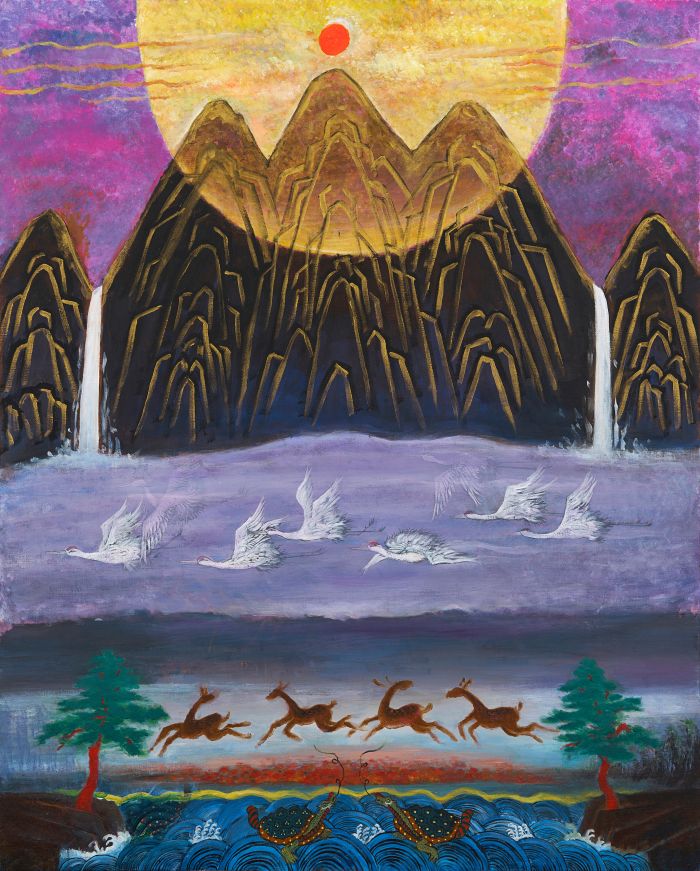
Empress, 90.9 × 72.7 cm, mixed media.
Park Yeonhee’s practice feels like a contemporary extension of that tradition. She refers to one aspect of her process as the “everlayer.” The term describes a technique in which paint is applied repeatedly and then partially removed, leaving behind faint traces of earlier stages. What remains visible on the canvas is not a single finished image but the accumulated memory of multiple images layered across time. The effect is surprisingly architectural.
Standing before these paintings, one begins to sense that the surface behaves less like a flat plane and more like a cross-section of a city wall. Earlier layers remain embedded within the material, occasionally resurfacing through cracks or shifts in texture. For someone who spends much of her time thinking about cities, this layering feels instantly recognizable. Urban landscapes rarely erase their histories completely. They absorb them.
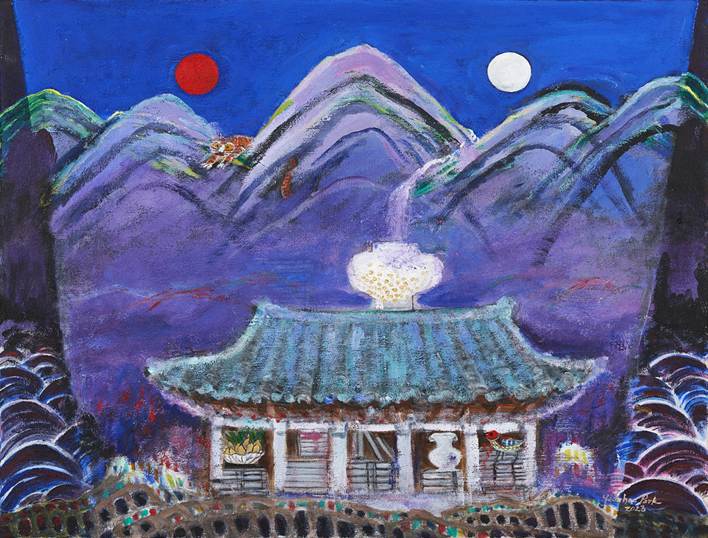
Dream of the Five Peaks, 72.7 × 60.6 cm, mixed media.
The same principle seems to govern Park’s canvases. Fragments of traditional motifs, tigers, deer, jars, appear briefly before dissolving into new configurations. Each layer interacts with the one beneath it, creating a quiet dialogue between inheritance and invention.
The Freedom of “No Rules”
The title of the exhibition carries its own gentle provocation. Within the strict visual grammar of the Ilwol-obongdo, every detail once followed an established order. Symmetry was expected. Colors adhered to convention.
By naming the series Five Peaks, No Rules, Park does not reject the tradition. Instead, she reveals that rules only exist when there is a structure strong enough to support them. The five peaks remain at the center of her compositions. They function almost like a gravitational field. Around them, everything else becomes fluid.
The result is not chaos but a different kind of balance. It suggests that tradition does not dictate a single interpretation of the past. Instead, it offers
a framework within which the sovereign self can unfold many interpretations simultaneously. Seen this way, the subtitle “No Rules” begins to feel less rebellious and more liberating.
The City Within the Peaks
As someone who often thinks about cities as living archives, places where memory accumulates quietly beneath everyday movement, I find Park’s work deeply resonant. A city, after all, is not simply a collection of buildings. It is a layered negotiation between permanence and change. Streets shift, populations evolve, new structures rise, yet certain coordinates remain fixed. The five peaks in Park’s paintings function almost like those coordinates.
In smaller works such as “Garden of the Five Peaks,” the monumental royal symbol shrinks into something more intimate. The mountains no longer dominate the composition. Instead, they appear as elements within a private landscape, less like imperial monuments and more like landmarks within a personal garden. It is a small shift in scale, but it carries a profound implication. The cosmic order once reserved for kings becomes something an individual can inhabit, reshape, and carry within their own life.
Returning to the Center
Park Yeonhee’s work ultimately reminds us that tradition is not a static inheritance. It behaves more like a set of coordinates, points that help us orient ourselves even as the terrain around them continues to evolve.
The mountains stand still. The sun and moon keep their positions. Yet the person who sits before them, the one who completes the composition, is always changing. And so, inevitably, is the world that unfolds around them.
Park’s work suggests that we are all, in a sense, sitting on that throne, navigating the layers of our own history, and claiming the right to define the view.
In addition to being able to view, reflect, and interpret Park Yeonhee’s Five Peaks, No Rules exhibition, I was fortunate enough to be able to interview the artist. The heart of that interview follows.
The Interview with Artist Park Yeonhee
Reeti: If you were to describe this exhibition in one sentence, how would you introduce it?
Artist Park: This exhibition explores the world of “everlayer,” a contemporary reinterpretation of the symbolic imagery of traditional minhwa folk painting. It captures moments when different times and memories overlap within a single canvas.
Reeti: In your work, what does “layer” mean?
Artist Park: Everlayer in my work refers to the overlapping of time, memory, and emotion. It represents a state in which the past and the present coexist within the same space.
Reeti: Why did you choose traditional Korean minhwa as your artistic language?
Artist Park: Minhwa is a symbolic language that contains a deep philosophy of everyday life. From the moment I first encountered it, I was drawn to that philosophy. I felt that by integrating minhwa with the materials and compositional approaches of Western painting, tradition could move beyond the past and come alive again in a contemporary language. This belief continues to guide my work as I expand minhwa through a modern sensibility.
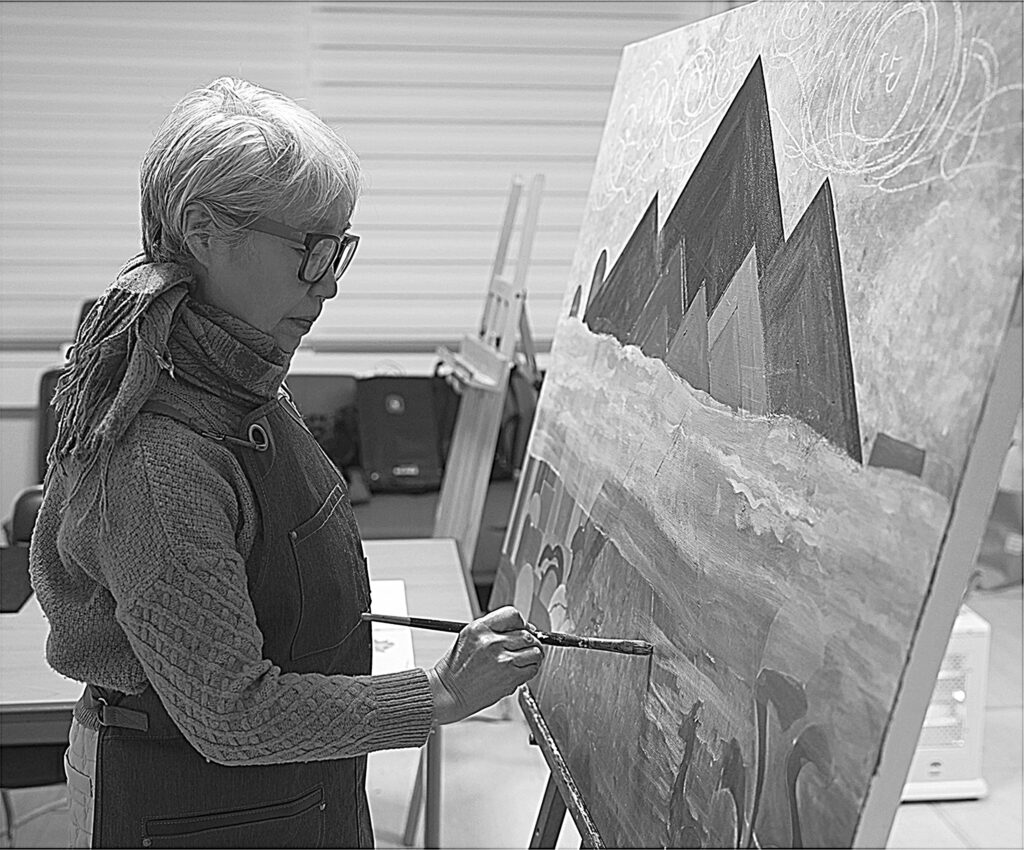
The artist Park Yeonhee in her studio.
Reeti: Why do symbols like the five peaks and jars appear so often in your work?
Artist Park: For me, the five peaks serve as the fundamental structure on which all symbols are placed. Elements such as jars, deer, and tigers exist within this order, and as they overlap, they create another world.
In traditional paintings, the five peaks appear behind the king, symbolizing royal authority. In my work, however, the five peaks function as a stage where the layered world unfolds. The jar in my paintings represents the viewer’s world, or a vessel that holds memories. Animals such as dragons, phoenixes, tigers, turtles, and fish traditionally appear as auspicious symbols and embody human desires and aspirations.
Ultimately, by borrowing these traditional symbols, I seek to express the desires, memories, and structures of existence that shape our lives today, interpreted through a contemporary sensibility.
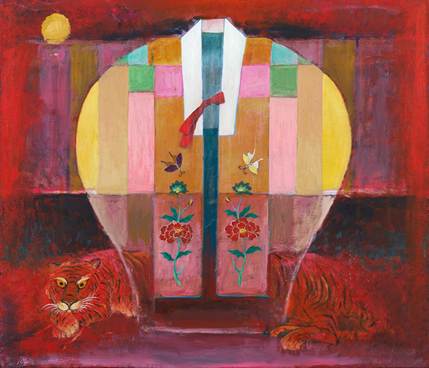
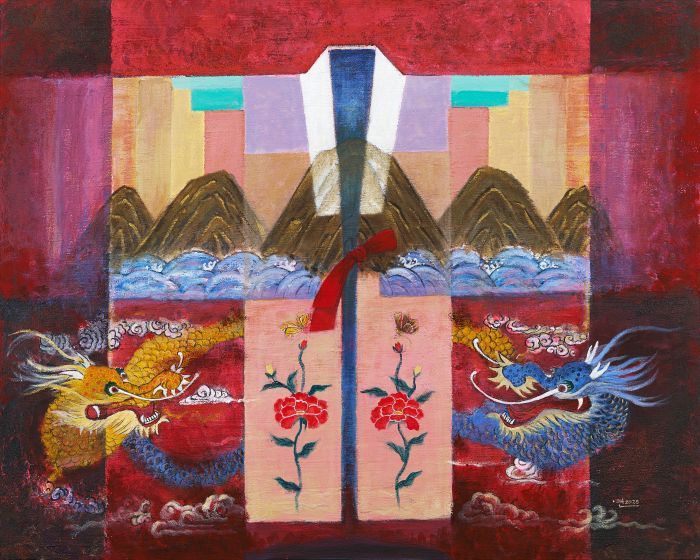
Ours, 90.9 × 72.7 cm, mixed media.
Reeti: What does it mean to reinterpret tradition in a contemporary way?
Artist Park: A contemporary interpretation does not mean mere reproduction. Instead, it means allowing tradition to be reawakened through the sensibility of our time. For me it is not about restoring the past but about expanding it. The concept of everlayer in my work can be understood as one such expansion.
Reeti: What is your working process like?
Artist Park: First, I establish the concept of what I want to express. Then, I select symbols from minhwa that can best represent that idea. The next step is to arrange these symbols in balance upon the fundamental structure of the five peaks.
Most importantly I build up layers of paint dozens of times. I also stamp or scrape the surface using tools other than a brush. Through this process a sense of balance begins to emerge from what first appears to be disorder. Because layers continue to accumulate over time my work always remains in a state of becoming and is never completely finished.
Reeti: Is there a particular work in this exhibition that you feel especially attached to?
Artist Park: Above all “The Time of Everlayer” and “One World, Two Ways.” I believe these two works express the concept of everlayer most clearly. In particular “One World, Two Ways” invites viewers to reflect on how the same subject can be interpreted differently depending on one’s perspective, even within the same space.
Reeti: What direction do you see your work taking in the future?
Artist Park: I feel that I need to continue researching the intersection between tradition and the contemporary. Going forward, I hope to expand the Everlayer series and create even deeper layers within my work. Through this process, I hope my work can become a space where viewers encounter their own memories and perspectives.
Through this dialogue between the inherited past and the fluid present, Five Peaks, No Rules does more than simply modernize an ancient aesthetic. Park Yeonhee successfully untethers the sacred geography of the Joseon court, offering it instead as a sanctuary for the contemporary soul. In her hands, the majestic canvas of the five peaks is no longer a rigid symbol of royal command but an open invitation for each of us to step forward, claim our own inner landscape, and quietly rule from within.
Five Peaks, No Rules, a solo exhibition by Park Yeonhee, was presented from February 25 to March 2, 2026. All photographs courtesy of the artist.
The Author
Reeti Roy is a cultural commentator and art critic who writes extensively about contemporary Asian art, urban landscapes, and the intersection of tradition and modernity. Her essays explore how art and urban spaces shape contemporary identity.
Cover Photo: Everlayer II, 130.3 × 162.2 cm, mixed media.