



Essay: The Architecture of Rupture
By Reeti Roy ||
Autocracy is not static. It moves.
Across cinema, power often reveals itself not through declarations or violence, but through rhythm, through bodies trained to move together, voices trained to repeat, and systems designed to appear seamless. In Satyajit Ray’s Hirak Rajar Deshe (1980), Choo Chang-min’s Masquerade (2012), and Bong Joon-ho’s Parasite (2019), authority survives through performance. Justice, when it arrives, does so through disruption.
In Hirak Rajar Deshe, control is choreographed. Citizens march, sway, and chant in near-perfect synchronization. Individual movement disappears. People no longer walk so much as rotate within the king’s design. Language, too, is mechanized. Rhymes replace reasoning. Call and response replaces thought.
The slogan “Dori dhore maro taan” (short for “pull the ropes [forcefully, and the king will be shattered]”) is central to Ray’s critique. Its sharp consonants and clipped rhythm are designed to be memorable, repeatable, and bodily. The phrase moves faster than reflection. Once the chant takes hold, the body responds before the mind can object. Ray’s warning is clear: A society that no longer tolerates pauses, irregularity, or friction has already surrendered its humanity. Life is uneven. Tyranny prefers the grid.
In Masquerade, power is maintained through ritual rather than slogans. The king’s body is public property, governed by strict protocols that regulate everything from meals to sleep. Authority is sustained by repetition so exact it becomes sacred. When the imposter king Ha-sun disrupts this ritual by feeding a starving servant or speaking out of turn, the effect is destabilizing. Justice enters not through conquest but through a break in rhythm.
Bong Joon-ho’s Parasite stages this choreography in a contemporary, domestic setting. The Park family’s insistence on not crossing the line is a rehearsed performance of civility, one that masks structural violence. The film’s now famous Jessica Jingle operates as its most efficient instrument of deception. Jessica, only child, Illinois, Chicago. A résumé becomes a melody. The song embeds credibility in the listener’s mind, making doubt feel impolite. Once performance replaces proof, fraud becomes fluent.
Lighting, across all three films, functions as a moral language. In Parasite, sunlight is a class marker. The Parks live bathed in it, unaware of its privilege, while the Kim family survives on filtered, reflected light. When the flood arrives, illumination exposes a brutal asymmetry. What is disaster for the basement is mere ambience for the lawn.
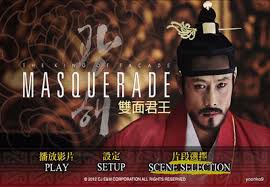
Masquerade, 2012, poster. (CJ Entertainment)
In Hirak Rajar Deshe, the palace is flooded with harsh, unyielding light, an environment of constant exposure that paradoxically conceals truth. Against this glare stands Udayan, the teacher, whose classroom is lit by candlelight. The contrast is deliberate. This is not the light of surveillance but of learning, not exposure but growth. Masquerade echoes this visual grammar, bathing Ha-sun in warm candlelight while the ministers operate in cold blue corridors. Light, in these films, is less about visibility than permission.
Ray’s most radical intervention lies in his treatment of rhyme. Rhymes create closure. They satisfy the ear before the intellect has time to resist. The king’s slogans do not persuade. They condition. Language becomes muscle memory. Citizens are reduced to children, and dissent is reframed as misbehavior rather than reasoning.
Udayan resists by refusing this structure. He speaks in prose. He pauses. He asks questions
that do not resolve neatly. His language is intentionally awkward, and therefore freeing. In Ray’s world, liberation begins with the unfinished sentence.
Masquerade reveals another unsettling truth. Power is performative, and therefore transferable. Anyone who learns the steps can wear the crown. The tragedy is not simply that power is cruel but that it is interchangeable.
Parasite denies this possibility. Bong Joon-ho insists that class is architectural. Performance has limits. Gravity, space, and even smell eventually expose the lie. You cannot rehearse your way out of structure.
What unites these filmmakers is their suspicion of seamlessness. They show how performance does not merely conceal violence. It sanitizes it. It keeps the evidence of struggle out of polite spaces. Social justice, in these films, does not arrive with resolution, but with rupture. When the chant falters, when the imposter king speaks plainly, when the song slips and the truth can no longer be contained.
As a writer, I return to these films as blueprints. They remind me that storytelling is not about smoothing over reality but about revealing its joints. To write, then, is to trace the architecture of control and to resist the comfort of perfect rhythm. When the world demands seamless performance, the most honest response may be to let the pattern break.
The Author
Reeti Roy is a writer, cultural commentator, and creative entrepreneur whose work explores memory, art, identity, and social justice. She holds a BA in English literature from Jadavpur University and an MSc in social anthropology from the London School of Economics. Her essays and criticism have appeared in numerous publications, including Korean media. In September 2025, she had several international engagements in South Korea, including as keynote speaker at KOTE, Insa-dong, and at the Yeosu Egg Gallery.
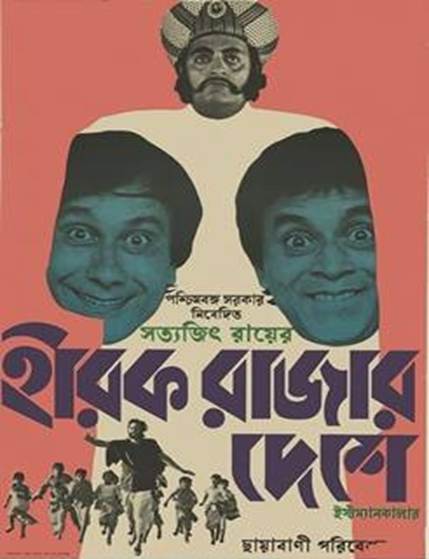
Cover Photo: Hirak Rajar Deshe, 1980, theatrical release poster. (Government of West Bengal)