

Indian Artist Prasanta Sahu at Yeosu: The Archival Body and the Ethics of Presence
By Reeti Roy ||
The exhibition No Words, held at Egg Gallery in Yeosu, South Korea, between December 2025 and January 2026, offered a platform to explore the boundaries of presence, embodiment, and the unsaid. While multiple artists contributed to the exhibition’s investigation of silence, gesture, and materiality, this article focuses on Indian artist Prasanta Sahu, whose work I engaged closely with, navigating a practice that moves fluidly between photography, research, and critical documentation. His work grounds the conceptual tenets of DoSeong Aesthetics – coexistence, material consciousness, and the ethics of making – in the tangible realities of labor.
Egg Gallery was founded in 2021 on the site of a former telephone exchange in Doseong Village, once a Hansen disease settlement located near the current Yeosu airport. Situated on this historical ground, the gallery is not merely an exhibition space but a laboratory for exploring DoSeong Aesthetics – how art can confront the unspoken lives and unrecorded histories of Hansen disease communities. The gallery name “Egg” symbolizes life, resurrection, beginning, and renewal.
Central to Sahu’s approach is the preservation of the student self. In our dialogues, he emphasized, “On a creative journey, after achieving a certain stage, it is very difficult to keep your learning windows open, that is, to keep the student in you alive. I see that most professionals, after attaining a certain point, get saturated and stuck with a few things they’ve achieved. After that point, they are unable to create something new. Most of the time, the student self in them dies.”
The creative act, for Sahu, is a self-reflective monologue that prevents ossification in past achievements. He views the universe as a complex architecture of patterns where every resolution demands new inquiry. “If a creative person can engage themselves at the age of 90 with the questions developed by their practice, that would be the best part of the journey. It’s not about solving problems and always seeking answers; sometimes one can help the world by raising a valuable question too.” This commitment to lifelong questioning shapes both his artistic and teaching practice, emphasizing the ethical responsibility of attention and inquiry.
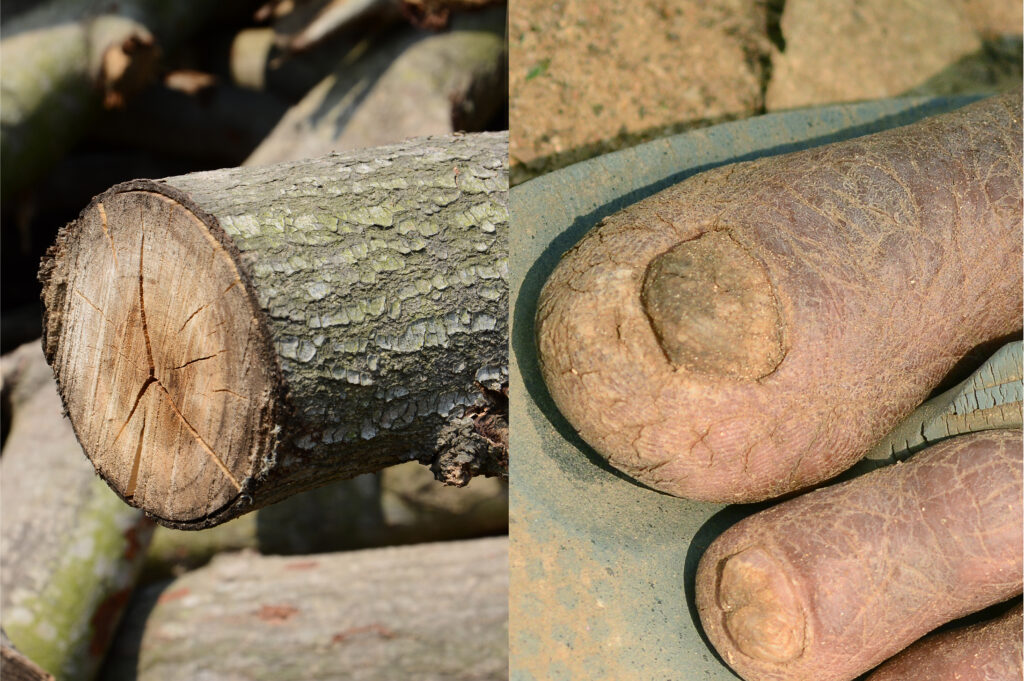
Occupational Bond I. (Courtesy of the artist and Emami Art, Kolkata, India)
Sahu is attentive to temporal depth, seeing both the living body and inanimate objects as layered with history. “The existence of the ancient in almost everything, from the living body to inanimate objects, haunts me. I find myself compelled to trace the echoes of the past that linger within them.” His methodology uses individual case studies, tracing the complexities of singular lives to illuminate the wider social fabric.
The individual becomes a reflection of broader networks, revealing dependencies, labor structures, and cultural patterns. As he expands his perspective, Sahu explains, “As I widen my perspective, the aperture expands, revealing a more intricate, multilayered tapestry. The complexity of our social ecosystem comes into focus, with interconnected threads of dependency that shape our lives. Some of these relationships are visible, while others remain hidden. Through my art, I attempt to decipher and diagram these dynamics, making the invisible visible.” Through this lens, personal narratives reveal wider social, economic, and cultural entanglements.
Sahu is drawn to the enduring dialogue between humans and objects. “Another area that fascinates me is the enduring relationship between humans and objects across centuries. I am drawn to the evolution of object design, functionality, and modification, as well as their recyclability. The shapes of objects, often designed for human interaction, have a lasting impact on us.” Objects carry memory and influence, shaping human bodies as they are shaped in return. Some objects, he notes, “hold ancient wisdom, inviting us to decipher their stories and connect with our collective past.”
These ideas are realized in the sawmill worker from Occupational Bond I and II. In Occupational Bond I, the fractured cross-section of a log sits beside the worker’s calloused toe, abstracting both surfaces into textures that echo each other, collapsing the boundary between human and material. Occupational Bond II continues this exploration, showing a dense pile of timber alongside the worker’s hands, wrinkled, swollen, and marked by repetition. The weight of timber mirrors the invisible accumulation of labor inscribed on the human body. In these works, Sahu transforms ordinary labor into an ethical reflection. The photographs do not dramatize toil; they demand sustained attention, revealing the haptic knowledge embedded in repeated gestures and endurance.
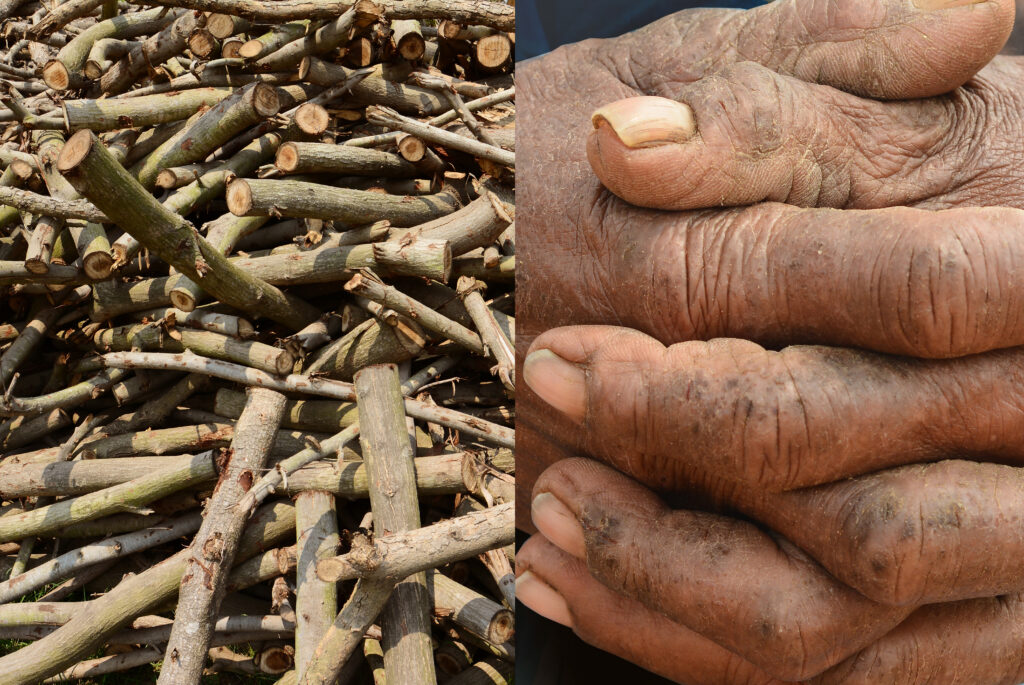
Occupational Bond II. (Courtesy of the artist and Emami Art, Kolkata, India)
Sahu’s commitments are inseparable from his twenty-year tenure as an educator at Santiniketan. He inherits the modernist ethos of Rabindranath Tagore, who championed an education of the senses and harmony between creativity, labor, and nature. This lineage resonates with Ramkinkar Baij’s monumental representations of Santhal life and Manjushri Chaki Sarkar’s Navanritya. Like Chaki Sarkar, Sahu treats the body as both expressive and methodical; gestures of labor become a silent yet eloquent visual vocabulary.
Sahu also critiques contemporary pedagogy, noting its failure to cultivate the generative question. He reflects, “Students prefer to listen… but when I ask them if they have any questions at the end of the lecture, most of the time they remain silent. Actually, the fault lies with our education system at the very primary level We have failed to teach our students to generate questions, and unless one learns to generate a question, how can they grow and contribute something new?” This insight parallels his artistic practice: attention, curiosity, and inquiry are ethical imperatives, not optional.
Experiencing Sahu’s work in Yeosu revealed the resonance between his practice and DoSeong Aesthetics, emphasizing coexistence, material consciousness, and ethical engagement. While multiple artists participated in No Words, Sahu’s work exemplified the exhibition’s central concerns: labor, presence, and the archival body. His practice translated abstract ideas into tactile, corporeal experience, allowing viewers to confront time, effort, and materiality directly.
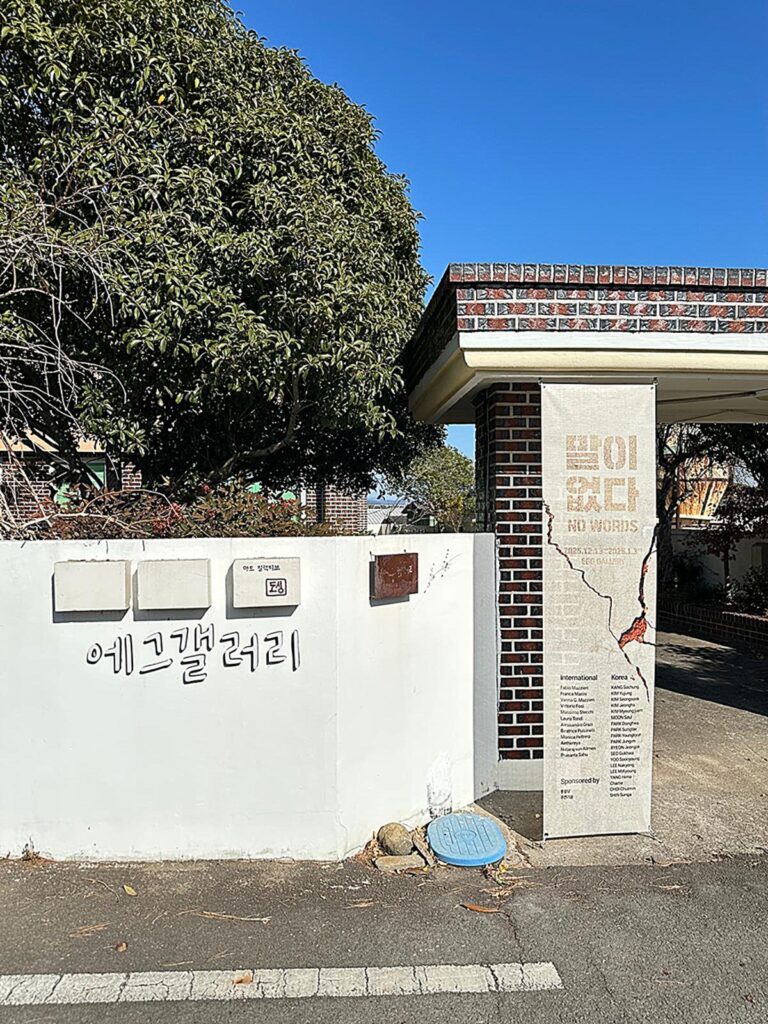
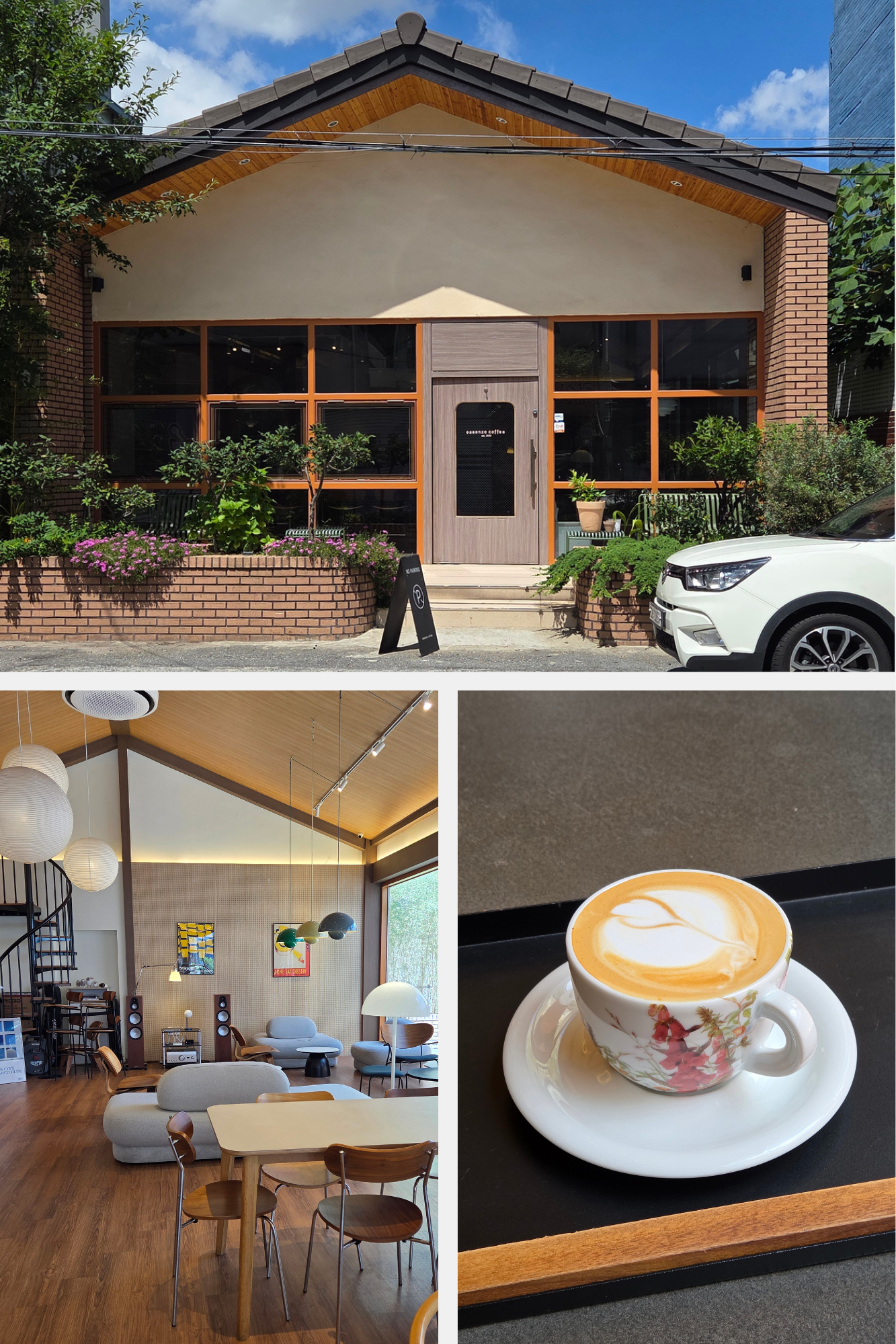
Egg Gallery entrance. (Park Sungtae)
Through our collaboration, it became clear that Sahu’s work functions as an ethical corrective to the transience of modern life. History is not solely held in archives or texts but is continuously inscribed in bodies, objects, and labor. Within his lens, the ordinary becomes monumental through sustained attention. The ethics of presence unfold through the unwavering sincerity of the student self, a self that carries questions across a lifetime until they yield a satisfactory and sometimes silent answer.
The Author
Reeti Roy is a writer, cultural commentator, and creative entrepreneur whose work explores memory, art, identity, and social justice. She holds a BA in English literature from Jadavpur University and an MSc in social anthropology from the London School of Economics. Her essays and criticism have appeared in numerous publications, including Korean media. In September 2025, she had several international engagements in South Korea, including as keynote speaker at KOTE, Insa-dong, and at the Yeosu Egg Gallery.
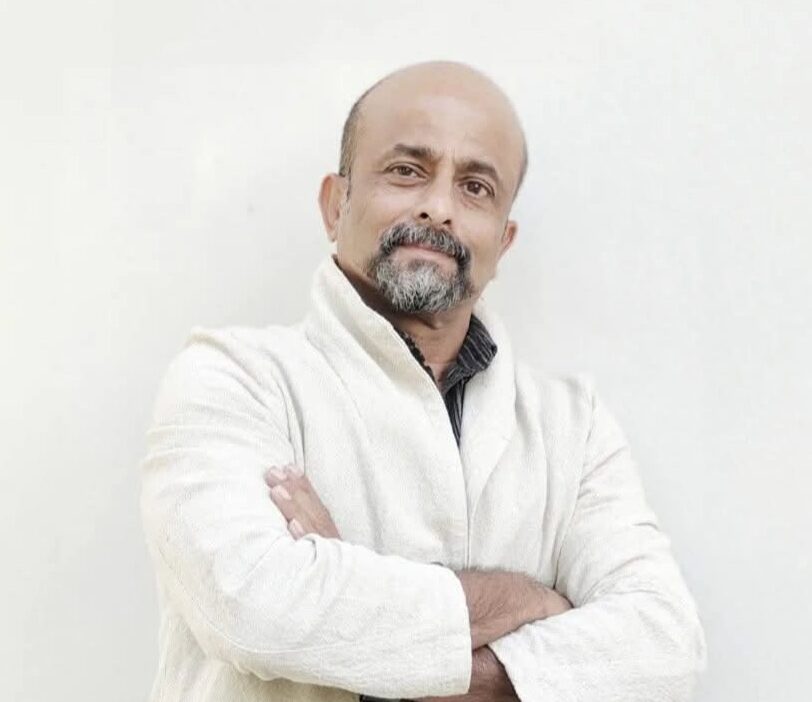
Cover Photo: Prasanta Sahu. (Courtesy of the artist)