





Beyond the Lyrics: BuenRostro in Gwangju
By Vibhanshu Maurya ||
At this year’s Gwangju Busking World Cup, I found myself listening without understanding the words. Besides the songs performed in English, I could not understand much of what the songs were about. I could follow a rhythm or notice a change in a singer’s voice, but I always wondered about the stories being expressed. What did these songs carry from the places where they began?
That question followed me into my conversation with BuenRostro, the Mexican act represented in Gwangju by Abigail Mota and Alfredo Galván. Known as Lupita and Eluterio, the two musicians had traveled to Asia for the first time.
I met them after their October 9 performance. Our conversation gave me a chance to learn what a festival stage could only partly reveal: the hometown behind their sound, the work behind their journey, and the concerns beneath music made for dancing.
The 5th Gwangju Busking World Cup took place during the October 7–11 Chungjang Street Festival of Recollection. To me, this year’s competition at 5.18 Democracy Square felt more subdued than previous editions. The audiences I saw seemed smaller, while the surrounding festival offered more activities than I could follow. Several overlapping events and closely scheduled performances made it difficult to see everything or give each act enough attention.
There was a financial context to the reduced competition. In January, the Gwangju Ilbo reported a planned budget of 200 million won, down from 520 million won the previous year.¹
A later News1 report confirmed that the main competition had been reduced from 32 teams to eight. Organizers had considered holding the event every other year, but they decided to go ahead with the 2026 event to maintain its continuity.²
Eight acts competed in Saturday’s semifinals, with four moving to Sunday’s final. Each act had only a short time on stage, though every musician brought years of experience. For BuenRostro, the challenge was fitting 16 years of music-making into a 20-minute performance.
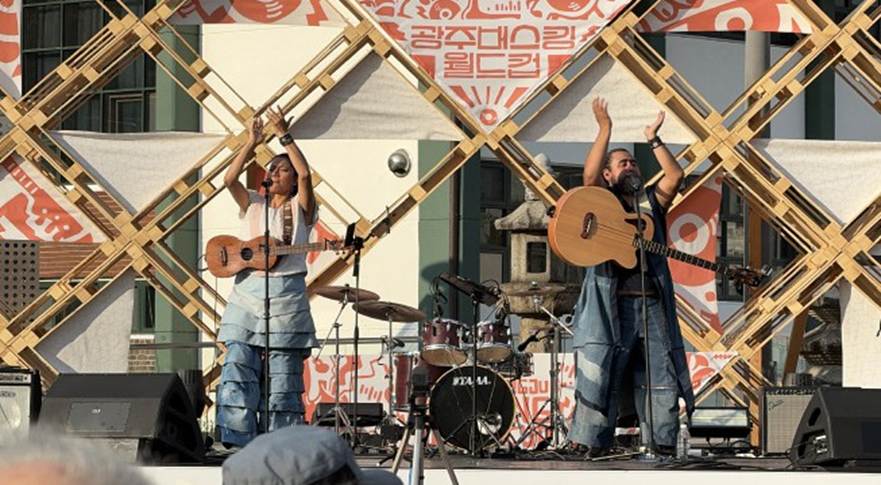
BuenRostro performing on stage during the Gwangju Busking World Cup 2026 semifinals at 5.18 Democracy Square. (Vibhanshu Maurya)
Their story began with dance. Galván had been dancing since childhood, and the two met through a group devoted to traditional Mexican dance. They initially performed traditional repertoire before forming BuenRostro and developing their own compositions. They wanted to explore other music they loved without losing the sounds that had shaped them.
Dance remained central to that process. Salsa, cumbia, and other rhythms became part of their musical vocabulary, alongside influences drawn from different regions of Mexico. They wanted people to listen and dance. Dancing was part of their performances.
The band’s name, BuenRostro, means “good face.” But Mota said it does not mean they must always be happy. They grew up during political and social crises. For them, the name means finding good in people and everyday life, even when times are difficult. “Even in the darkness, we can also find some light,” she said. That outlook allows celebration and criticism to share space in their music. Their songs can invite people to dance while also asking them to think about the world around them.
Both musicians come from San Pedro Atocpan, in Mexico City’s Milpa Alta area. As Galván described their hometown in Spanish, Mota interpreted his explanation into English. They spoke of a community whose surrounding mountains had helped preserve traditions, while its location within Mexico City exposed them to music and ideas from much farther away. Mota described growing up “in between both worlds.” Their community helped them stay connected to local traditions, while Mexico City exposed them to many kinds of music. “BuenRostro draws on both.”
They call the result “Mexican post-folk.” For Mota, post-folk describes how traditional music changes as it meets new influences. They take from different parts of Mexico, she explained, rather than presenting themselves as representatives of one particular regional tradition. Through Mota’s interpretation, Galván described post-folk as freedom to create from traditional rhythms while being nourished by contemporary sounds.
Their instruments make that relationship audible. The jarana jarocha, which they identified as an guitar-like stringed instrument from Veracruz, brings a recognizable traditional sound into their performances. Electric bass provides a rhythmic foundation, while zapateado, or percussive footwork, allows dance itself to become part of the music. The body contributes to the rhythm as directly as an instrument does.
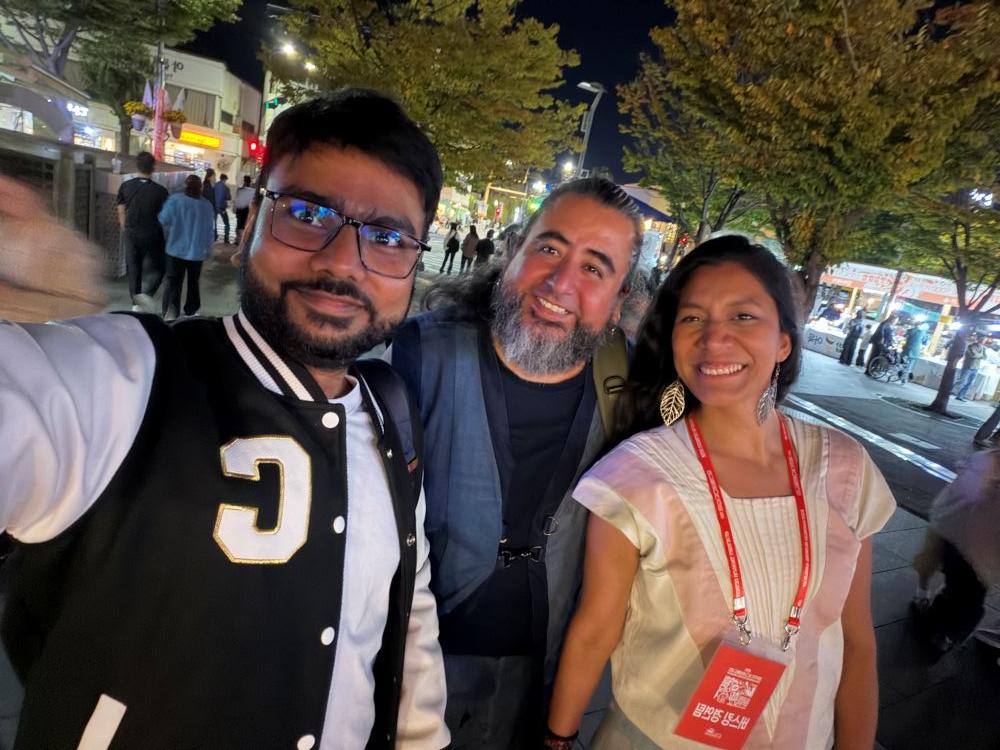
A selfie with BuenRostro after the interview. (Vibhanshu Maurya)
Although Gwangju audiences encountered two musicians, BuenRostro is a seven-member band. Traveling as a duo is one way of making international appearances possible. Bringing an entire group overseas presents financial and logistical difficulties, and some opportunities can accommodate only a smaller lineup. They enjoy both formats, Mota said, although they miss their bandmates. That adjustment also affects the repertoire. Preparing for Gwangju meant choosing songs that could convey their rhythmic energy, celebration, and social concerns within a short set. Selecting a cover was particularly challenging. One they had previously performed depended on the full band to produce the sound they wanted, so they had to find another option.
The performance was only the visible part of their work. As independent musicians, they also handle booking, management, editing, and social media. Galván found the Gwangju application, and they submitted a performance without knowing whether anything would come of it. They were excited to be selected, but then had to decide which songs could best represent the band. Their tour’s name, Desde Aquí, means “from here.” The name reflects their hope of carrying music from their hometown to listeners around the world. Coming to Asia had been a longstanding goal. Korea represented an important first step, and the connections made during the visit offered reasons to hope for further opportunities.
“The challenge was fltting 16 years of music-making into a 20-minute performance.”
When I asked what listeners who did not understand Spanish might miss, the conversation turned to a song whose title Mota translated as “Footprints.” Completed during the pandemic, it concerns people we no longer see. Some have died, but others have simply disappeared from our daily lives as work, obligations, and postponements accumulate. She described a familiar promise: to meet soon, perhaps just to have a coffee, only for the meeting never to happen. The song asks people to make time while they can. Even an hour matters. Without that explanation, I might have heard the song’s mood while missing the everyday regret behind it. Its subject required no knowledge of Mexico to recognize.
Another song addresses humanity’s destructive behavior and the contradictions of social media. Social media platforms are meant to connect people, but they can also encourage addiction, manipulation, and misinformation. These concerns sit alongside the warmth and movement in BuenRostro’s music. Understanding them adds another dimension to a performance that might initially register simply as energetic or joyful.
Their first experience of Korea also brought moments of familiarity. In markets and family restaurants, they encountered warmth that reminded them of home. Mota compared the welcoming restaurant owners to “our aunties,” describing the feeling of being invited in and looked after by both. The pleasure came from those ordinary exchanges as much as from arriving somewhere new.
Mota said Galván was struck by how their music connected them with people so far from home. She recalled a listener from Peru once telling them that he could hear his own music within theirs. For her, such encounters suggest that people have more in common than the divisions between countries might lead them to believe.
The festival announced the competition results on Sunday. France’s Valérie Ékoumè took first place, followed by Korea’s Komagens, Australia’s Saije, and Korea’s Sloe-Jean. BuenRostro did not make it to Sunday’s final. Even without advancing, they introduced their music to Korean audiences and made connections they hoped would lead to future opportunities.
For me, the interview gave the festival a depth that was difficult to find while moving between performances. It also clarified the limits of listening across languages. Rhythm can draw us toward unfamiliar music, but the words may contain memories, arguments, and experiences that remain unheard until someone explains them. Taking time for that conversation changed what I understood about BuenRostro.
As we finished, Mota pointed to the musicians who have yet to find an audience. She encouraged people to listen to independent artists in their own communities before fame makes them easy to notice. Many worthwhile projects, she said, only need “a pair of ears.” That invitation felt relevant beyond the competition. The festival brought musicians from around the world to Gwangju, even though this year’s event felt smaller. Listening to the performance was only the beginning. Learning what shaped the music made me want to listen more closely. BuenRostro had traveled from San Pedro Atocpan with songs I could not fully understand. After our conversation, I had more reasons to listen.

(Gwangju Donggu Culture and Tourism Foundation)
Sources
¹ Jang, H. (2026, January 29). 글로벌 음악축제 ‘광주 버스킹 월드컵’ 올해도 계속된다 (Global Music Festival “Gwangju Busking World Cup” Continues this Year]. Gwangju Ilbo. https://v.daum.net/v/20260129002453763
² Lee, S. (2026, April 7). ‘본선 진출 상금 500만원’ 광주버스킹 월드컵 참가자 모집 (5 Million Won Prize for Reaching the Finals: Gwangju Busking World Cup Calls for Participants). News1. https://www.news1.kr/local/ gwangju-jeonnam/6128183
The Author
Vibhanshu Maurya, originally from India, is pursuing his PhD at Chonnam National University. He is a writer for the Gwangju News, where he writes about science, people, culture, and the international community in Gwangju.
Cover Photo: BuenRostro Duo, Abigail Mota and Alfredo Galván. (BuenRostro)