



Inside the Gwangju News: Systematic Scientist and Scrupulous Scrivener – Saqib Sharif
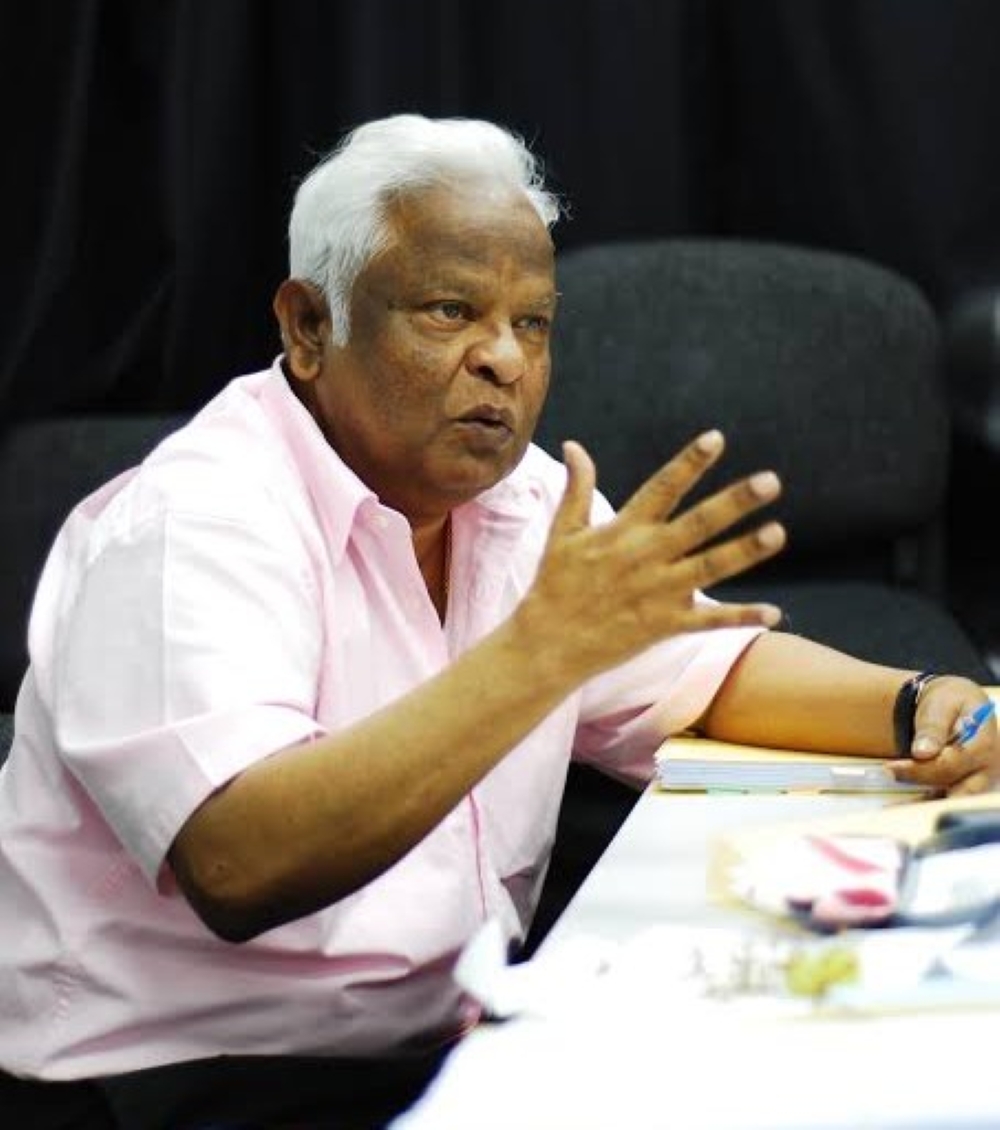
Each month, this column spotlights one of our regular contributors to the Gwangju News, giving readers an opportunity to learn more about the diverse voices behind the magazine. These writer profiles take the form of interviews, offering a window into their talents, perspectives, and stories. This issue’s interview is with Gwangju News writer Dr. Saqib Sharif. — Editor
Gwangju News (GN): Thank you, Saqib, for arranging time for this interview.
I know that you have recently been preoccupied by a number of unexpected events. Would you begin by giving us some background information on you before you came to Korea?
Dr. Sharif: Thank you, Dave. I was born and raised in Pakistan, where I developed an early curiosity about how things work and why nature behaves the way it does. That curiosity led me to study physics at one of Pakistan’s leading universities. After graduation, I received an EPSRC fellowship to study plasma and laser physics at Queen’s University Belfast in the UK. That experience broadened my scientific horizons and gave me the opportunity to work in an international research environment. Looking back, it was the beginning of a journey that would take me across disciplines, countries, and eventually into writing for a local English-language magazine.
GN: What was it that made you decide on coming to Korea when there are so many other countries to choose from?
Dr. Sharif: In 2015, a former classmate from Queen’s University Belfast invited me to consider pursuing doctoral studies in Korea. It was an opportunity to continue my research in a new academic environment while experiencing a country I knew relatively little about. I joined the Gwangju Institute of Science and Technology (GIST) in February 2016 as a PhD researcher. At the time, I could not have imagined how significantly that decision would shape both my professional and personal life.
GN: What specific area did you do your research in?
Dr. Sharif: At GIST, my research focused on high-power lasers. Although I was unable to complete my doctoral thesis there, I continued my academic journey at Chonnam National University, where I completed a PhD in mechanical engineering. My research focused on the control and navigation of micro- and nanorobots using magnetic fields. It was an exciting area because it brought together engineering, physics, and the challenge of controlling extremely small devices. My academic path was not entirely straightforward, but it taught me an important lesson: Sometimes, changing direction is not the same as giving up. It can be a way of finding the right path forward.
GN: It’s been a number of years since you completed your doctoral work, and I believe you have spent all of that time in Korea also. Where have you worked and what projects have you worked on?
Dr. Sharif: What I find particularly rewarding about research is that it requires both systematic thinking and a willingness to question assumptions. Every project brings its own uncertainties, and progress often comes through patience, collaboration, and learning from unsuccessful attempts. My first post-PhD job was at Shinsung Tech in Gwangju, where I designed medical devices and tested those devices for practical applications. I recently joined GIST again but this time as a postdoc researcher.
GN: You’ve now been living in Korea for over ten years – since 2016. What is it about Korea that keeps you here? It’s different from your home country in so many ways.
Dr Sharif: Professionally, Korea has also given me opportunities to continue developing as a researcher. Personally, more than a decade here means that many of my experiences, friendships, and memories are now connected to this country. Home is not always a single place on a map. Sometimes, it is also the place where you have spent years growing, adapting, and building a life.
GN: As a follow-up question, what is it about Gwangju that keeps you in this city?
Dr. Sharif: Gwangju has a character that I have come to appreciate. It has the facilities and academic environment of a modern city, yet it does not feel as overwhelming as some of the larger metropolitan areas. Its cultural identity, history, food, and community life give it a distinctive personality. As someone who has spent much of his professional life in research environments, I also appreciate having a city where I can step away from work and experience a different side of life. Over the years, Gwangju has become more than the place where I work or live; it has become a place I feel connected to.
GN: And what was it that brought you to the Gwangju News?
Dr. Sharif: Science has trained me to observe carefully, ask questions, and look for explanations. Writing offers another way to put those habits to use. I was drawn to the Gwangju News because it provides a platform for sharing stories, ideas, and experiences with the international community here. Living in another country can sometimes feel isolating, especially when you are still learning how its society works. Local English-language journalism helps bridge that gap by introducing readers to people, places, and issues they might otherwise overlook. Contributing to the magazine allows me to participate in the community in a different way from my work as a scientist.
GN: So, you see a connection between doing science and writing for a community magazine.
Dr. Sharif: Absolutely. At first glance, science and writing may appear to belong to different worlds, but both depend on careful observation, clear thinking, and attention to detail. In research, you need to distinguish evidence from assumption and communicate your findings accurately. Writing requires a similar discipline, although it also asks you to consider how a reader will experience the information. A scientist may be satisfied with a technically correct explanation, but a writer must also ask whether that explanation makes sense to someone encountering the subject for the first time. For me, the two activities complement each other.
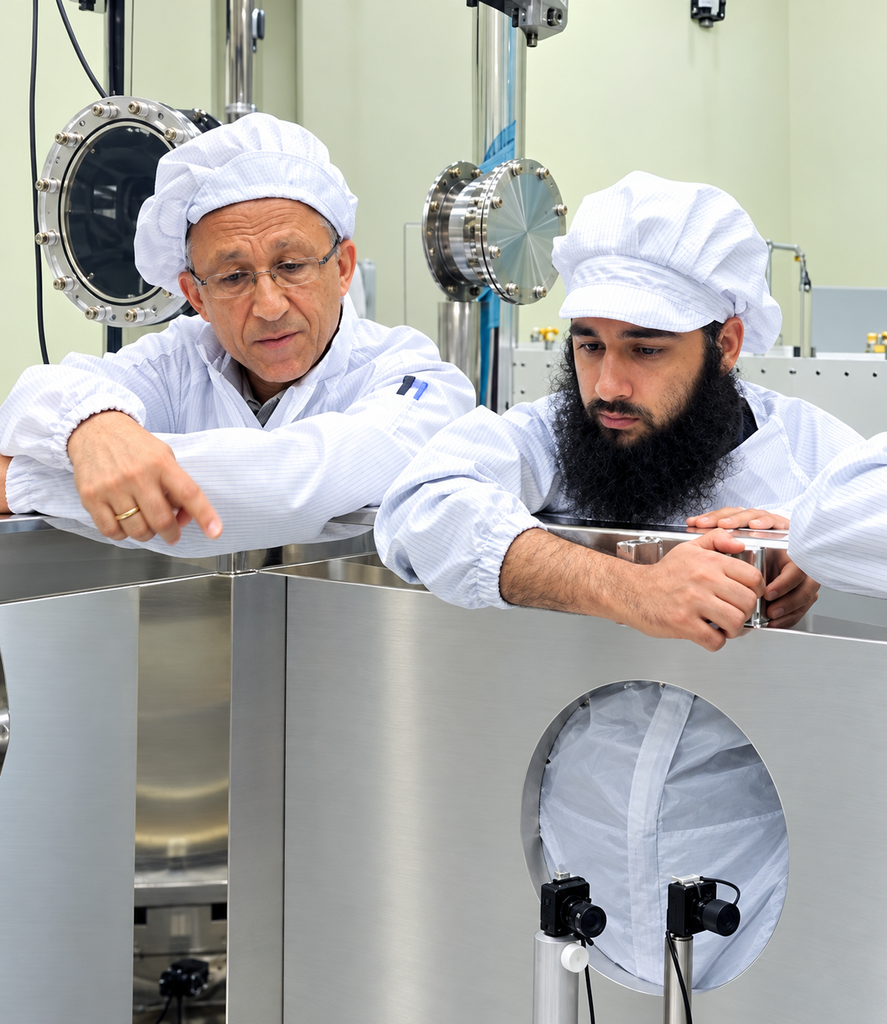
Dr. Saqib Sharif with Prof. Sargis Ter-Avetisyan at the Center for Relativistic Laser Science’s Ultrashort Quantum Beam Facility, GIST (2016).
GN: What do you like to do whenever you have some free time, such as on weekends or on holidays?
Dr. Sharif: On weekends, I like going on long drives and exploring new places. Living in Korea has given me plenty of opportunities to discover places and experiences that I might never have encountered otherwise.
GN: Looking into your crystal ball, what do you see yourself doing in, say, ten years from now?
Dr. Sharif: Science will undoubtedly remain important to me, but I also hope to develop further as a writer and communicator. Scientific knowledge is valuable, but its value increases when we can explain it clearly and make it accessible to others. Ten years from now, I hope to be looking back on a life in which I have continued learning, contributed to worthwhile projects, and told a few stories that helped people understand the world. I am also planning for a professorship in the future.
GN: Do you have a bucket list?
Dr. Sharif: I do, although I would say that my bucket list is more about experiences than ticking off destinations. I would like to travel the world and experience more cultures.
GN: To wrap up this interview, is there anything you would like to say to our readers?
Dr. Sharif: I would encourage people to remain curious about the places where they live and the people they meet. It is easy to become absorbed in our own routines, but a city becomes much more interesting when we take the time to learn its stories and listen to different perspectives. For those living far from their home countries, I would also say that adapting to a new place takes time, and it is perfectly normal for that journey to have unexpected turns. Sometimes, the experiences we did not plan for become the ones that shape us most. I am grateful to the Gwangju News for giving me the opportunity to share stories with its readers, and I hope to continue contributing to that conversation.
GN: Thank you, Saqib.
Interviewed by David Shaffer.
(Photographs courtesy of the interviewee)
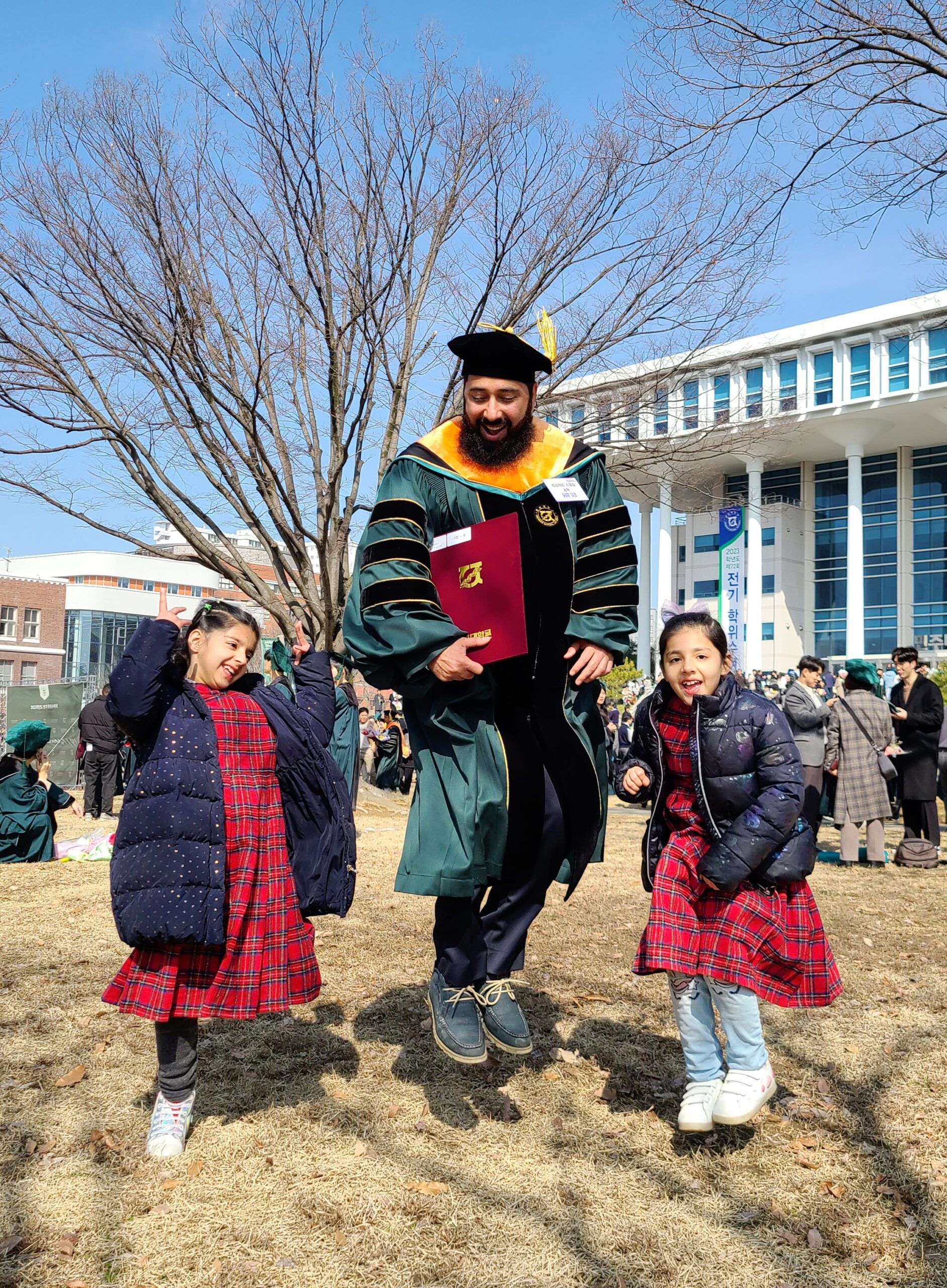
Cover Photo: Happiness at CNU’s PhD graduation ceremony.