


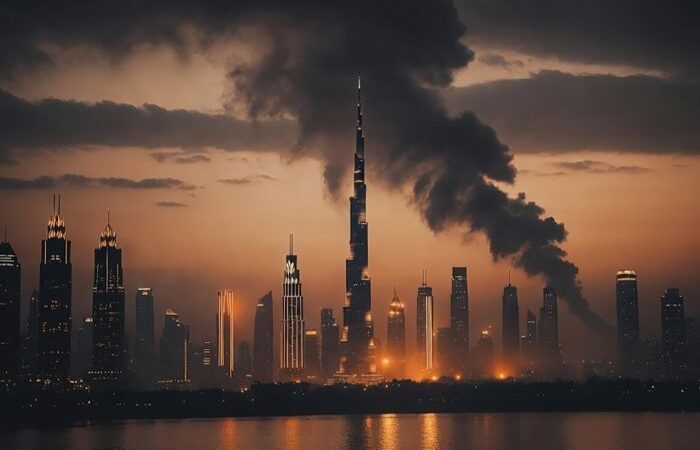
Living at the Edge of Conflict: A Resident’s Account from Dubai During the US-Iran War
The brunch reservation was for one o’clock. The news alert arrived at half past twelve. Another escalation, another set of coordinates neither of us could place on a map without reaching for our phones. My husband read it aloud, we exchanged a look across the kitchen island, and then, almost guiltily, we went to brunch anyway. This is, I have come to understand, the defining psychological posture of expat life in Dubai in 2026: carrying the weight of the world in your pocket while the waiter refills your sparkling water.
I have lived in this city for four years. I came from Delhi for an IT job that paid three times what I was earning back home, and like most of the 3.5 million Indians in the UAE, I stayed back. I stayed for the tax-relaxed salary, for the ease, for the extraordinary cleanliness of a place where the metro arrives on time and the malls are cool even in July. I stayed because, over the years, Dubai stopped feeling like an assignment and started feeling like mine.
But the Middle East has a way of reminding you of its geography, no matter how hermetically sealed your tower block. The tensions between the United States and Iran have been building for years, but the last several months have produced a different quality of anxiety – sharper, more personal. When missiles passed over the Gulf before, they were abstractions, happening to someone else’s sky. Now the conversations at school pickup have changed. The mothers – British, Indian, Filipino, Lebanese – share information in WhatsApp groups with a velocity and a seriousness that feels new. Emergency numbers. Embassy registration reminders. What to put in a go-bag, and whether a go-bag is alarmist or simply sensible.
The Particular Unease of the Indian Expat
Indians occupy a strange and specific position in this anxiety. We are, numerically, the largest expatriate community in the UAE. We are embedded in every sector: in finance, construction, hospitality, and medicine. Many of us have been here long enough to have built a life that is not obviously portable. My daughter was born in a hospital twenty minutes from where I am writing this. Her first words were in English and Hindi simultaneously. She thinks of Jumeirah as her neighborhood in a way that Cannaught Place, the neighborhood of my own childhood, never quite was for me.
When India’s Ministry of External Affairs issues advisories, we read them the way you read a doctor’s note: looking for reassurance between the official lines. The Indian government has been scrupulous in its neutrality, maintaining working relationships with both Washington and Tehran, and there is a particular relief that comes from holding an Indian passport in this region; it is not a document that makes you a target. But neutrality only protects you from politics. It does not protect you from a miscalculation, a stray trajectory, the kind of accident that history is full of.
What the City Tells You, and What It Doesn’t
The UAE government is extraordinarily good at calm. This is not cynicism; it is genuinely one of the city’s most sophisticated achievements. The communicationsaremeasured. Theinfrastructure of daily life continues without interruption. The financial markets have wobbled but held. There are no queues at petrol stations, no empty shelves. The fountains at the Dubai International Financial Centre still light up on schedule. And yet there is information that the city does not share with you. The military logistics. The back-channel diplomacy. The calculations being made at levels far above the brunch-and-metro daily life the rest of us inhabit. We are guests here, brilliantly hosted, mostly cherished, but guests nonetheless. And guests do not always get to know the full story of the house.
I spoke recently with a colleague, Joseph, who has worked in Dubai’s maritime sector for eight years, and he said something that stayed with me. “The thing about this city,” he said, “is that it was built on confidence. The confidence is real but it is also maintained. And in a crisis, you can’t always tell where the real ends and the maintained begins.” He is not leaving. Neither am I. But we are both paying attention in ways we weren’t before.
The Question We Don’t Ask Out Loud
There is a question that circulates, unspoken, in the Indian expat community: At what point do you go back? Not as defeat, most of us have stopped thinking of return as failure, but as a practical matter – the trigger that would move it from theoretical to real. Some people have a number: a specific escalation, a particular advisory level. Others discover, when pressed, that they don’t have a plan at all, that they have been living in the confidence of the city so completely that a contingency was never seriously worked out.
My mother calls from Delhi every few days now. She sends me news articles, sometimes days old, as though the recency is irrelevant and the content is what matters. She is not wrong. The content is “We are watching, we are worried, come home if it gets worse.” What “worse” means, for her, for me, for the city, is the thing none of us can quite define. So, we live in the space between normal and worse, the way people always have, with our brunch reservations and our WhatsApp groups and our children who think this city of light and ambition is simply, straightforwardly, where they live.
Last week my daughter asked me, with the directness of a ten-year-old who has absorbed the ambient tension without knowing its name, whether Dubai was safe. I told her it was. I told her that the city was very well run, that the leaders were careful people, and that we were far from where the trouble was. All of this is true. I believed it as I said it. I still do, mostly. But I was also, for a moment, aware of myself performing the same thing the city performs: the calm, the confidence, the maintenance of an unreality that is also, in its own way, the most practical thing available. You live here, or you don’t. And if you live here, you choose, each morning, to believe in the skyline.
The Author
The author is an Indian living in Dubai, United Arab Emirates. Due to restrictions on expat residents, they prefer to remain anonymous.
Cover Photo: Dubai skyline. (GN with Grok AI)