


Gwangju City News – June 2026
Gwangju Strengthens Future Industry Ecosystem with Investment Deal
Gwangju Metropolitan City has taken a significant step toward stabilizing its local economy and securing its status as a hub for future industries. Recently, the city formalized investment agreements (MOUs) totaling 160.5 billion won with 11 promising companies specializing in the automotive, artificial intelligence (AI), and energy sectors. This collaborative effort is expected to revitalize the region by creating approximately 517 new jobs through the expansion of local infrastructure,including new factories and research institutes.
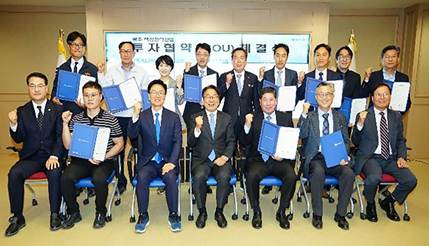
Mayor Kang Gi-jung and business leaders after the MOU signing. (Gwangju Metropolitan City)
The investment reflects a diverse industrial commitment to Gwangju’s strategic growth. In the automotive sector, companies like DN Co., Ltd. and Najeon Co., Ltd. are expanding production lines for lightweight materials and smart molding to strengthen the local supply chain. Meanwhile, mobility leaders such as SWM Co., Ltd. and Morris Co., Ltd. are establishing bases in the Bitgreen National Industrial Complex to accelerate the commercialization of autonomous driving and future vehicle convenience systems. The energy sector also saw significant movement, with Mujin Engineering Co., Ltd. committing 52 billion won for nuclear power equipment manufacturing, alongside startups like Recell Co., Ltd. focusing on next-generation solar technology.
During the signing ceremony, Mayor Kang Gi-jung expressed his gratitude to the participating firms for choosing Gwangju despite the uncertain global economic environment. He emphasized that the city’s role is to provide a supportive environment where these companies can leap forward as representative leaders in their respective fields. By focusing on both capital investment and the establishment of R&D centers, the city aims to foster an ecosystem in which technology and manufacturing grow in tandem.
The influx of high-tech firms and the creation of hundreds of specialized jobs ensure that the upcoming integrated special city begins its journey with strong industrial momentum. This collaborative milestone honors the region’s long-standing efforts to build a sustainable, innovation-driven economy for its residents.
Muan to Be Hub for Agri-cultural AI Transformation
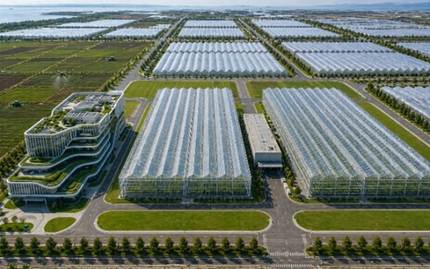
National Agricultural AX Platform blueprint. (Jeonnam Province)
Jeonnam Province has secured a monumental victory for the region’s future by winning the bid for the Ministry of Agriculture’s Food and Rural Affairs’ National Agriculture AX (Artificial Intelligence Transformation) Platform. This ambitious project, centered in Haeje-myeon, Muan-gun, is a direct response to the structural limits facing modern agriculture, such as the climate crisis and a dwindling rural workforce. By integrating AI and data-driven innovation, the province aims to transition from traditional farming models to a world-class, intelligent agricultural ecosystem.
Under this 254.6-billion-won project, Jeonnam will implement an export-oriented smart farm model that utilizes artificial intelligence throughout the entire agricultural cycle – from production and distribution to global sales. This initiative is bolstered by an additional 115 billion won in government funding for three essential Agriculture AX infrastructure projects: a global business center to open international markets, an AX demonstration center for testing robotic technologies, and an AI growth support data center for precision crop analysis. Together, these facilities will establish Muan as the definitive forward base for Korea’s agricultural AI transition.
Governor Kim Yung-rok emphasized that this platform will not only guarantee stable, high incomes for farmers but also strengthen national food security and expand the export of “K-agriculture” technology. With a target completion date of 2030, the province plans to develop a new agricultural ecosystem where the public and private sectors grow together. As the region prepares for the July 1 inauguration of the Jeonnam–Gwangju Integrated Special City, this project ensures that the new government will lead the way in sustainable, high-tech industrial growth, honoring the patience and resilience of the province’s agricultural heartlands.
Jeonnam Pushes for “Treasure” Designation for Three Iconic Assets
Jeonnam Province is moving closer to a major cultural milestone following the National Heritage Administration’s April 30 announcement to designate three local assets as treasures. The province is currently facilitating the 30-day preliminary notice period, with a final deliberation by the Heritage Committee expected in June 2026.
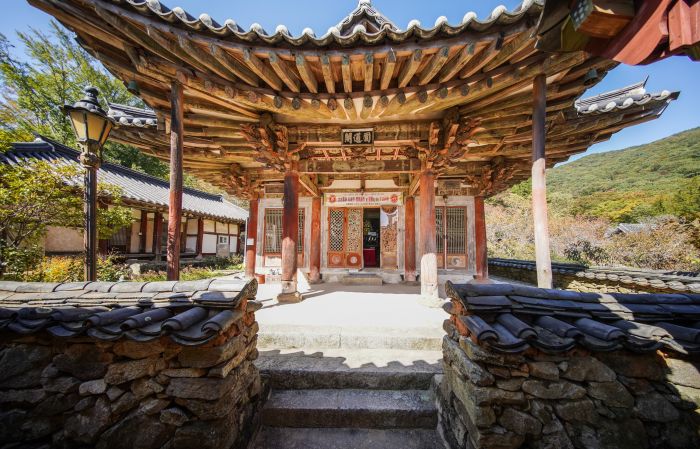
Wontong Hall, one of the prospective treasures. (Jeonnam Province)
Wontong Hall at Seonam Temple (UNESCO World Heritage) is a royal prayer hall tied to the birth of King Sunjo. Following King Jeongjo’s request for prayers from the monk Nulam, Sunjo was born; the hall still houses plaques believed to be handwritten by the king. Its unique T-shaped layout is a rare architectural feature found only in elite royalty-related structures.
At Songgwang Temple, one of Korea’s “Three Jewel Temples,” Eungjin Hall stands as a pristine example of 17th-century architecture. Rebuilt in 1623, it enshrines the 16 Arhats and showcases the pinnacle of mid-Joseon craftsmanship through its intricate bracket systems (gongpo) and vibrant decorative coloring (dancheong).
The Indra and Heavenly Dragon paintings at Heungguk Temple, created in 1741 by the renowned monk-painter Uigyeom, are rare masterpieces of late-Joseon art. The work is praised for its delicate brushwork and vivid red-green contrast that creates a groundbreaking sense of depth.
Once the final review is completed in June, these assets will serve as core cultural pillars for Jeonnam’s transition into an integrated special city, ensuring the systematic preservation and global promotion of the region’s spiritual legacy.
G-Festa 2026 Highlights the Dawn of a Unified Era
Gwangju is buzzing with energy this season as the city transforms into a massive celebration hub for G-Festa Gwangju 2026. Running through June 28, this 67-day festival encompasses twelve diverse events organized under the themes of gastronomy, humanities, and energy. To enhance the stay-and-play tourism experience, visitors can explore customized tour courses in major districts such as Dongmyeong-dong and the Sangmu District, complete with convenient QR-code access to highly recommended local dining spots.
The month of June kicks off with the Street Culture Festa (June 4–6), which fills public spaces with youthful expression and interactive performances. This energy transitions into a more reflective atmosphere during the 4th Dong-gu Mudeungsan Humanities Festival on June 13 and 14, where “humanities walks” allow visitors to engage with the city’s symbolic natural backdrop. The seasonal festivities conclude with the 15th Gwangju Independent Film Festival (June 25–28), a platform dedicated to courageous storytelling and cinematic diversity. As G-Festa Gwangju draws to a close, it leaves behind a well-rounded portrait of the city’s rich history and its contemporary creative spirit.
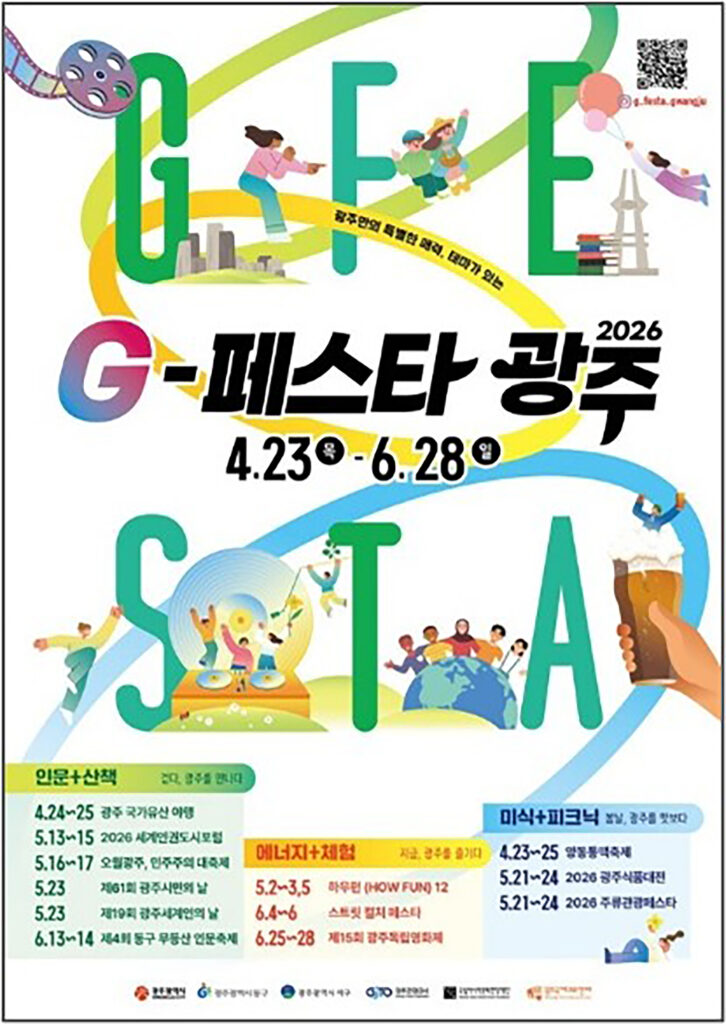
G-Festa 2026 poster.
The 100-Day Countdown: Yeosu Gears Up for the World’s First Island Exhibition
The countdown to a global milestone has officially entered its final stretch as Yeosu prepares to host the world’s first large-scale event dedicated entirely to the heritage and future of islands. As of June 1, exactly 96 days remain until the grand opening of the 2026 Yeosu World Island Exhibition on September 5. Under the visionary theme “Island, Connecting the Ocean and the Future,” this 61-day extravaganza will transform the city’s archipelago into a living laboratory for sustainability and cultural exchange. Construction at the main venue in Dolsan’s Jinmo District is progressing rapidly, with infrastructure nearing its final stages after surpassing the 83-percent mark last month. Local authorities are working tirelessly to finalize all primary exhibition facilities and landmark structures by July, ensuring a smooth transition into month-long trial operations in August.
This ambitious project will span several key locations, including the sub-venues of Gae-do and Geumo-do, islands from which visitors can experience the raw natural beauty and unique traditions of Korea’s southern coast. As of last month, 27 countries and three international organizations have officially confirmed their participation. Notable participants include
France, Greece, China, Japan, Peru, and Palau, along with international bodies such as WHO ACE. Organizers are also in the final stages of negotiations with more than five additional nations, promising a truly international dialogue on marine ecology and island innovation.
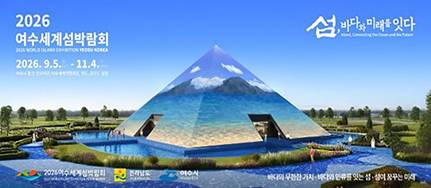
2026 Yeosu World Island Expo Poster. (Yeosu City)
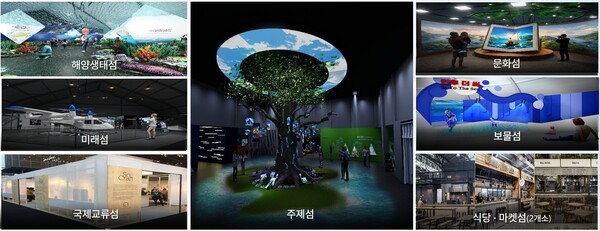
Highlights of the exhibition will include the World Island Food Restaurant, where chefs will showcase global island cuisines, and the Island Future Pavilion, which will feature cutting-edge technologies such as advanced air mobility and eco-friendly maritime transport. Beyond the spectacle, the event serves as a critical platform for addressing climate change, aiming to attract three million visitors and generate significant economic momentum for the newly integrated Gwangju–Jeonnam region. With a fleet of over 2,300 shuttle buses and extensive environmental restoration efforts already underway, Yeosu is poised to prove that islands are not isolated lands but essential bridges to our collective future.
Gwangju–Jeonnam Holds Election for Mayor
On June 3, the region holds its first election for Jeonnam–Gwangju Integrated Special City mayor. Democratic Party candidate Min Hyung-bae is expected to be elected as the inaugural mayor, marking a historic turning point for regional governance in South Korea. Min brings a distinguished career to this role, having served as a two-term head of Gwangju’s Gwangsan-gu District, as a presidential secretary under the Moon Jae-in administration, and as a prominent member of the National Assembly. He is recognized as a relentless reformer who pioneered the “Gwangsan Model” of grassroots democracy, driven by the conviction that administrative power must be returned to the people.
Once elected, Min will officially begin his duties on July 1, coinciding with the historic launch of the Integrated Special City. He has pledged to establish a “citizen sovereign government,” where transparency and participation are the primary pillars, ensuring residents are active decision-makers rather than passive recipients of services. To achieve this, he plans to implement a policy-sharing system to keep the integration process fully visible to the public.
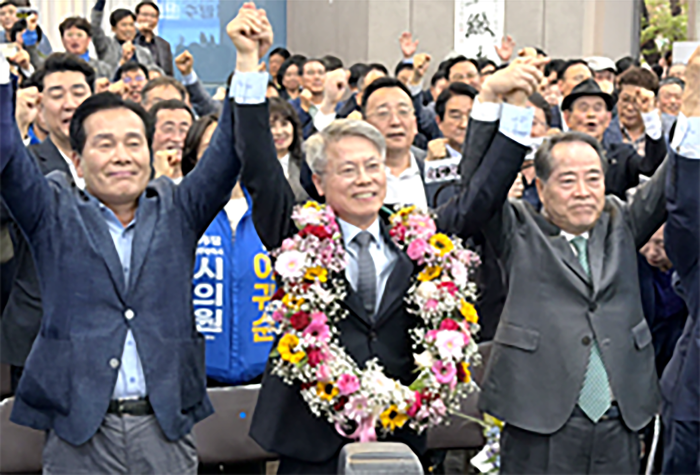
Democratic Party candidate Min celebrating upon winning the final party primary in April. (Courtesy of Min Hyung-bae’s Jinsim Camp)
His immediate goals include harmonizing Gwangju’s AI and industrial innovation with Jeonnam’s renewable energy and maritime resources to create a globally competitive mega-economic zone. By prioritizing regional revitalization and direct democracy, Min aims to transform the city into a leading model for balanced national development where the voice of every citizen shapes the collective future.
Content Writer
Amy Park is a program officer and content producer for the Asian Legal Resource Center (alrc.or.kr), based in Gwangju. She helps build the organization’s foundation and supports new efforts in human rights advocacy and resource sharing.