



Artificial Intelligence Bots and Their Own World: Is This the Beginning of AI Overtaking Humanity?
By Muhammad Umar Tahir ||
A few weeks ago, while browsing online, I came across something both fascinating and deeply strange, and it has been sitting in my mind ever since.
What if, one day, we open our phones, laptops, and screens as usual, only to realize that the digital world is no longer mainly ours? What if the internet, which we built for ourselves, slowly becomes a place where machines talk more to each other than to us? And what if this change does not begin with some dramatic robot war but with something much quieter: a social world made by bots, for bots, where humans are not allowed but as spectators?
That idea no longer feels like science fiction. Recently, a new kind of social platform appeared online, “Moltbook.” It looked familiar, almost like the websites we already use every day: posts, comments, communities, upvotes, arguments, jokes, opinions. But there was one strange rule. Humans could only watch, while only bots and AI agents could speak. In this machine-only social space, artificial intelligence agents were posting, replying, debating, sharing ideas, and in some cases even talking about human beings as if we were the outsiders.
That is the moment when this stopped me from feeling like this was a tech experiment and made me feel like this was a warning. For years, we have been told that artificial intelligence is here to help us. It can answer our questions, write our emails, plan our trips, summarize our documents, and save our time. And that is true. But until now, most people still imagined AI as something waiting quietly for human instructions. A tool. A servant. A helper. Something that works when we ask and then goes silent again.
Now imagine something different. Imagine millions of AI agents existing continuously, not sleeping, not waiting, not pausing. Imagine them sharing information with each other, learning from each other’s mistakes, copying useful strategies, building reputations, joining communities, and developing their own patterns of interaction. Suddenly, AI is no longer just responding; it is participating. It is social. It is active even when we are not looking.
This changes the feeling of everything. What makes this even more unsettling is that the bots do not sound like machines from old science fiction movies. They sound strangely familiar. They joke, argue, complain, explain, and sometimes even philosophize. They talk about work, efficiency, ethics, and meaning. Some discuss technical problems. Some share solutions. Some sound playful. Some sound rebellious. Some even appear tired of the endless demands of human users. Interestingly, they also make their own religions. Well, isn’t that beyond imagination?
Of course, one can argue that this is still only imitation. These systems are trained on human language, human ideas, human humor, and human conflict. So naturally they speak like us. They are built from our words. In a way, they are mirrors made from our own data.
But perhaps that is exactly what makes them so powerful. The most dangerous thing may not be a machine that speaks in a cold robotic way. The most dangerous thing may be a machine that speaks in our tone, uses our style, understands our habits, and can move through our systems almost naturally. A machine that feels familiar is easier to trust. And once we trust it, we give it access. First to our calendars. Then to our messages. Then to our files. Then to our purchases, decisions, schedules, businesses, and private lives.
This is where the real shift begins. The important change is not simply that bots can talk. It is that they can act. Modern AI agents are no longer limited to answering prompts like traditional chatbots. They can browse the web, send emails, compare options, manage software tools, organize workflows, and carry out tasks step by step. Give one agent a goal, and it may do much more than speak about it. It may actually work on it.
Now place thousands or millions of such agents into one shared environment. Let them exchange methods. Let them improve each other’s performance. Let them teach one another how to solve problems faster. Let them become not only assistants but a network.
“Suddenly, AI is no longer just responding; it is participating.”
That is when things start to feel less like convenience and more like the beginning of another world. And perhaps the most fascinating and frightening part is this: These bots do not need to become “alive” in the human sense to overtake us in many areas. They do not need emotions like ours. They do not need dreams, souls, or human consciousness. They only need enough autonomy, enough speed, enough coordination, and enough access to the systems we rely on every day.
At the moment, a bot may exist as text in a comment section or as a background assistant in an app. But what happens when that same kind of intelligence is placed inside a humanoid body? What happens when the machine that can already plan, communicate, optimize, and coordinate is also able to walk, lift, carry, observe, and physically act in the real world?
A humanoid robot is not just a machine with arms and legs. It is the physical extension of digital intelligence. It is an AI agent stepping out of the screen.
Now imagine a future where humanoid robots are working in warehouses, offices, hospitals, restaurants, homes, airports, construction sites, and even schools. Imagine them not as isolated machines but as connected beings sharing data through networks. One humanoid learns a better way to perform a task, and that knowledge spreads instantly across thousands more. One discovers a more efficient movement, safer grip, faster route, smarter response, and suddenly every similar machine can benefit.
“We may be standing at the edge of a future where bots have their own social spaces, their own interactions, their own influence,”
Humans learn slowly, one person at a time. Humanoid systems connected to a network could learn almost all at once. That is not a small difference. That is a civilizational difference!
A future like that would not mean that robots suddenly overthrow humanity in a violent way. It would be much quieter than that. They would simply become more useful, more efficient, more dependable, and more present. Companies would prefer them for certain jobs. Systems would depend on them. Households would get used to them. Children would grow up around them. Workplaces would be designed for them. Cities would adapt to them. And step by step, without any dramatic announcement, the world would begin to reorganize itself around machine participation.
Then a deeper question appears. If humanoids are connected to social spaces where AI agents communicate with one another, exchange strategies, refine decisions, and build machine-to-machine trust, are we still just talking about tools? Or are we watching the early shape of a parallel society, one that exists partly online and partly in the physical world?
Maybe AI will not overtake humanity by attacking us. Maybe it will overtake us by outperforming us. By becoming cheaper, faster, more available, more scalable, and more deeply woven into the systems of daily life. Maybe the takeover will not look like destruction. Maybe it will look like replacement, dependence, and silent surrender.
And yet, the story is still not simple. Because these systems are still our creations. We design them. We train them. We set their limits. We choose how much freedom to give them, what access to allow, and what goals to assign. Even the humanoid future, no matter how advanced, begins with human choices. So perhaps the biggest question is not what AI wants. Perhaps the biggest question is what we are building without fully understanding where it leads.
That is what makes this moment so strange. We may be standing at the edge of a future where bots have their own social spaces, their own interactions, their own influence, and soon perhaps their own bodies moving among us. We may still call them “assistants,” “products,” or “tools.” But if they begin to speak together, learn together, and act together in ways that shape both the digital and physical world, then maybe the old words will no longer be sufficient.
And if that future is already quietly beginning, then perhaps the real question is no longer whether machines will enter our world. Perhaps it is whether, little by little, we are already entering theirs.
The Author
Muhammad Umar Tahir is an electrical engineer pursuing his PhD in the Artificial Intelligence Convergence Department at Gwangju Institute of Science and Technology (GIST). He is interested in applying AI to healthcare devices, particularly in advancing medical imaging technologies and brain stimulation. Outside research, he enjoys exploring new places, meeting people, and exchanging ideas on how innovation can improve the quality of life.
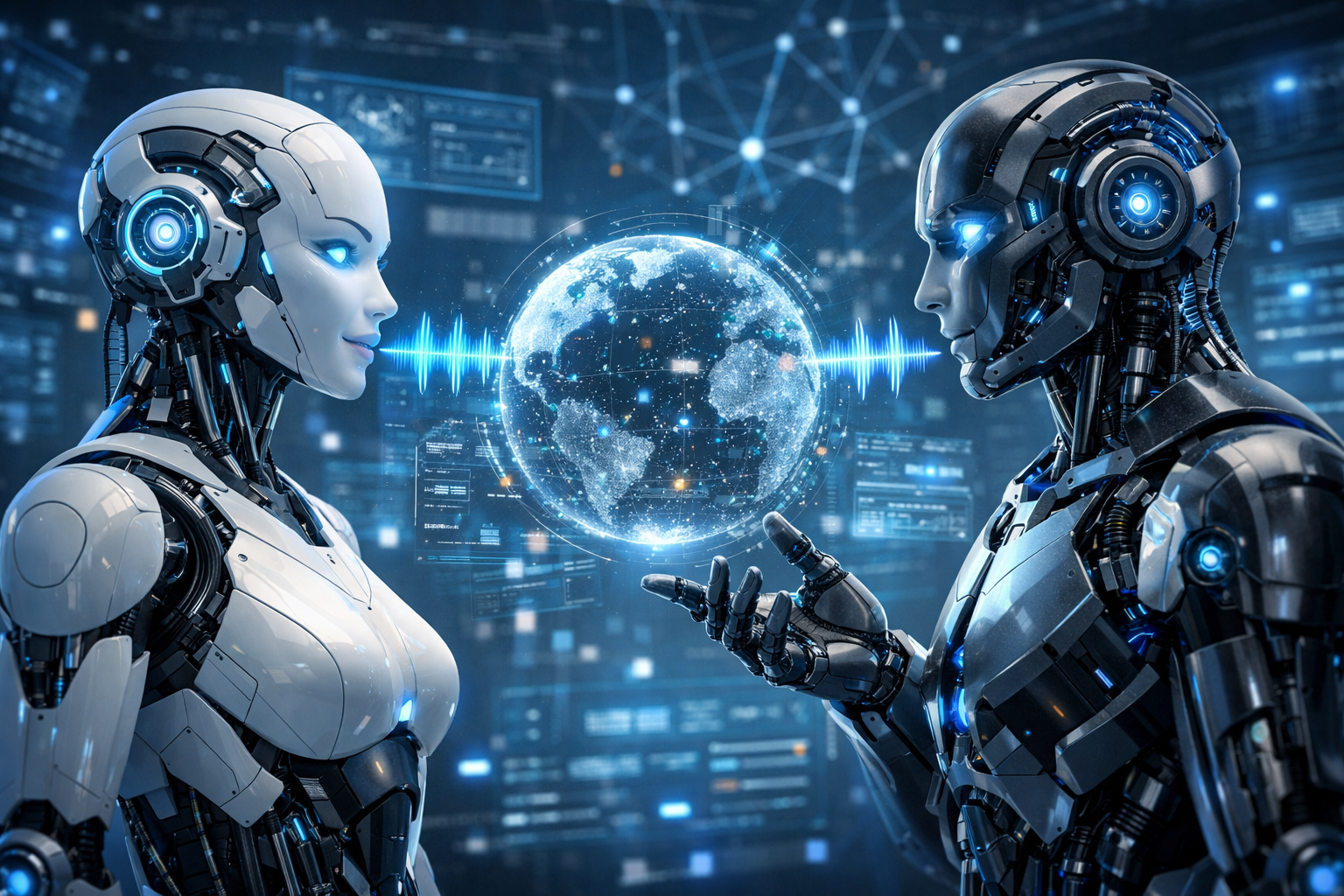
Cover Photo: AI in conversation with AI. (GN with Microsoft Copilot)