





Privacy in the Dawn of AI: A Concept We Still Pretend to Understand
By Saqib Sharif ||
The paid content subscription platform OnlyFans recently surpassed 350 million subscribers and reportedly generated around 7.2 billion US dollars in revenue in 2025 alone. Around the same time, more than 120,000 internet-connected cameras in South Korea were hacked, with private footage quietly sold online for a few thousand dollars. These two facts sit uncomfortably close to each other. One represents privacy willingly traded for money and attention; the other, privacy stolen with barely any resistance. Together, they raise an awkward question that feels increasingly difficult to answer: What exactly is this thing we still call privacy?
In today’s online world, privacy has become less of a boundary and more of a negotiation. Almost everyone is connected, visible, searchable, and archived. Smartphones, social media platforms, cloud services, and smart devices have woven the internet into the most ordinary parts of life. We document our meals, our children, our relationships, our frustrations, and our celebrations, often without pausing to consider where these moments go once they leave the screen.
The Comfort of Being Watched
Social media did not force people to give up privacy. It invited them to. The invitation was attractive: connection, recognition, belonging, and sometimes income. Over time, sharing became normalized. Posting personal moments no longer felt risky but routine. Privacy settings provided a sense of control, even if that control was partial and fragile.
Psychologically, this created a new mindset. Privacy stopped feeling like a default condition and started feeling like an optional feature. People learned to accept that being visible was the price to pay for participation in modern life. As long as nothing visibly went wrong, the system felt safe enough. But the online world does not forget. Photos, videos, and casual comments live far beyond their original context. Even content meant for small audiences can be copied, stored, and resurfaced years later. The sense of intimacy offered by digital platforms often hides the reality that the audience is never fully known.
When AI Enters the Picture
Artificial intelligence has fundamentally changed the meaning of privacy online. The issue is no longer just what people share but what machines can do with what already exists. AI systems analyze faces, voices, gestures, and patterns at a scale that turn fragments of personal data into complete digital profiles.
Deepfake technology represents a turning point. With only a handful of publicly available photos or a short video clip, AI can generate realistic images and videos of people in situations that never happened. Voices can be cloned from seconds of audio. Facial expressions can be mapped, copied, and animated with disturbing accuracy.
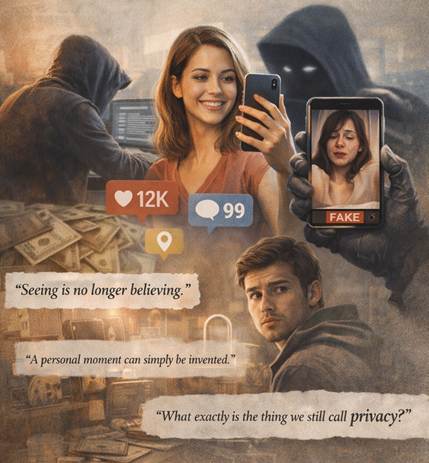
What makes this especially alarming is how easy it has become. Deepfakes are no longer confined to research labs or highly skilled specialists. User-friendly tools and apps now make it possible for almost anyone to fabricate convincing content. A personal moment does not need to be recorded to exist online. It can simply be invented.
The End of Visual Certainty
For decades, photos and videos were treated as evidence. In the online age shaped by AI, that trust is collapsing. Seeing is no longer believing. At the same time, proving that something is fake often requires more effort than creating the fake itself.
This creates a new psychological burden. People must now worry not only about what they share, but about what others might create using their identity. Even those who carefully avoid posting personal content are not fully protected. A face visible in a group photo, a voice heard in a public video, or an image taken without consent can be enough.
Privacy, once about control over personal information, now extends to control over one’s digital existence. The fear is no longer exposure alone but impersonation.
Living in a Permanently Connected World
Despite these risks, disconnecting is not a realistic solution. The internet is deeply embedded in work, education, healthcare, and social life. Most people continue to participate, aware of the dangers but unwilling to disappear. This creates a quiet tension between acceptance and discomfort.
In this environment, privacy becomes psychological rather than absolute. People adapt. They rationalize. They hope they will not be the next target. Incidents like hacked cameras or viral deepfakes feel distant until they are not.
Redefining Privacy for the Future
In a fully connected world, privacy can no longer mean secrecy. It may instead come to mean protection from misuse, accountability for those who manipulate digital identities, and the right to challenge synthetic content. As AI grows more capable, societies will need to rethink privacy, not as hiding but as safeguarding human dignity.
The uncomfortable truth is that privacy today is fragile by design. It survives not because systems protect it but because most people behave responsibly most of the time. When that assumption fails, the consequences can be deeply personal and irreversible.
Perhaps the real question is not whether privacy still exists but whether we are finally ready to admit how easily it can be bought, sold, fabricated, or stolen in the online age.
Web Sources
- BBC News – More than 120,000 home cameras in South Korea hacked to record “sexploitation” footage. https:// www.bbc.com/news/articles/cj01q6p7ndlo
- Euro News – OnlyFans generated $7.2 billion in payments from subscribers (gross) in 2024.https://www. euronews.com/business/2025/08/25/onlyfans-takes-72bn-from-subscribers-in-2024-as-adult-site-booms
- Anadolu Ajansi – Deepfake crimes among South Korean teenagers have nearly doubled from 2020 to 2024. https://www.aa.com.tr/en/asia-pacific/deepfake-crimes-among-south-korean-teens-ne=arly-double-in-4-years/3688330?
The Author
Saqib Sharif is a robotics engineer with a PhD in mechanical engineering, specializing in the design of smart healthcare devices and microrobots. With a strong background in medical technology and innovation, he is passionate about creating solutions that enhance smart healthcare. Dr. Sharif has been living in Gwangju for the past ten years. Currently, he serves as a senior researcher at Shinsung Tech Pvt. Ltd., Gwangju.
Cover Photo: The internet remembers everything she forgets to hide. (GN with Google Gemini)