Cities of Dignity: Human Rights Forum Returns to Gwangju
By Luis Andrés ||
As May approaches, Gwangju prepares for the most meaningful month on the city’s calendar. May is when we remember the May 18 Democratic Uprising, when ordinary citizens stood up for democracy, dignity, and human rights in 1980. What began as a local movement against authoritarian rule eventually became one of the defining moments in Korea’s democratic history.
Today, May in Gwangju is not only about remembering the past; it is also about reflecting on the present and imagining the future. Throughout the month, the city hosts commemorations, exhibitions, academic discussions, and cultural events that explore the meaning of democracy and human rights in our time. Among these events, one of the most internationally significant is the World Human Rights Cities Forum (WHRCF).
Since 2011, Gwangju has hosted this global gathering where activists, academics, survivors, policymakers, and members of civil society come together to discuss how human rights can be protected and promoted at the local level. In many ways, the forum is a meeting point for people who believe that democracy does not only live in constitutions or national politics but also in the everyday life of cities.
The concept at the center of the forum is that of “human rights cities.” These are cities that commit themselves to implementing the principles of the Universal Declaration of Human Rights through local governance. That may sound abstract, but in practice, it means developing policies that protect dignity, equality, participation, and inclusion in areas such as housing, education, urban planning, and public services.
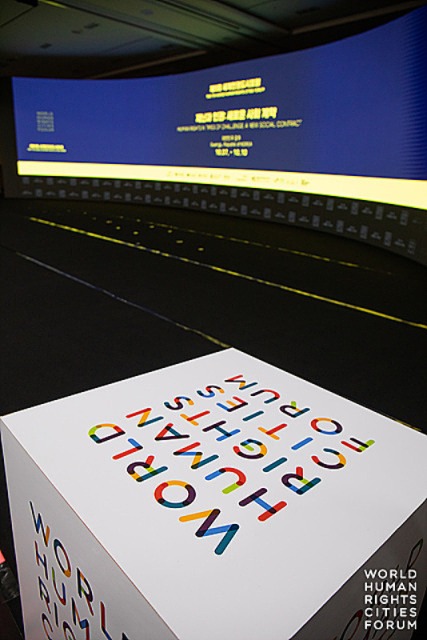
2021 World Human Rights Cities Forum.
The idea gained global recognition in 2011, when the first forum took place in Gwangju and the Gwangju Declaration on Human Rights Cities was adopted. The declaration encouraged cities around the world to incorporate human rights principles into municipal governance and highlighted the responsibility of local governments in protecting the dignity of their citizens. Since then, the forum has grown into one of the most important international spaces for dialogue on human rights at the urban level.
Over the years, the WHRCF has welcomed participants from dozens of countries and institutions. Local government leaders, international organizations, universities, and civil society groups gather annually to exchange experiences and discuss emerging challenges. The forum has also attracted prominent international figures, including former Chilean president and former United Nations High Commissioner for Human Rights Michelle Bachelet, who participated while serving at the UN.
The diversity of participants reflects the growing recognition that cities play an increasingly important role in advancing human rights. Several municipalities around the world have begun identifying themselves as human rights cities, including Madrid in Spain, Nuremberg in Germany, Rosario in Argentina, Bandung in Indonesia, and Timbuktu in Mali.
Cities constantly face new challenges: migration, inequality, discrimination, climate change, and political polarization. Urban life is dynamic, and so is the understanding of rights. New social realities emerge, new voices demand recognition, and new policy approaches become necessary. That is precisely why spaces like the World Human Rights Cities Forum remain so important.
Gwangju itself is often presented as a model human rights city because of its democratic legacy. But like any city, it is also a place that continues to learn. Issues such as discrimination based on gender or sexual orientation, xenophobia, and racism remind us that building a truly inclusive society is never a finished project. Trust me, as someone who has lived here long enough, I have seen both the inspiring moments and the uncomfortable ones.
Yet this is precisely what makes the forum meaningful. The WHRCF is not only a stage where cities celebrate their achievements; it is also a space where they reflect on their shortcomings and exchange ideas on how to do better.
Over the years, the forum has addressed a wide range of themes, from the right to the city and social inclusion to climate justice and sustainable development. Each edition reflects the challenges that cities are facing at a particular moment in time.
This year’s theme may be one of the most timely yet: “Human Rights Cities Against Authoritarianism and Populism.” For decades, discussions about authoritarianism and populism often referred to regimes that openly rejected democratic institutions. These were usually associated with military dictatorships or political systems where elections, separation of powers, and civil liberties were openly suppressed. In that framework, authoritarianism was understood as the opposite of democracy. Today, however, the political landscape is far more complicated.
Around the world, political movements have emerged that operate within democratic institutions while simultaneously weakening them. Elections continue to take place, constitutions remain formally intact, and parliaments still meet. Yet the spirit of democratic governance can erode in subtler ways: Independent institutions are delegitimized, political opponents are framed as enemies, and minority groups are portrayed as threats to national identity.
In this sense, the traditional categories of populism and authoritarianism no longer fully capture what is happening in many parts of the world. What we increasingly see are hybrid political environments where democratic procedures coexist with growing pressures on pluralism, minority rights, and civil liberties. In such a context, cities play an especially important role.
Local governments are often closer to the everyday experiences of citizens and, therefore, have the ability to respond to social tensions in practical ways. Through urban policies that promote inclusion, protect vulnerable communities, and encourage civic participation, cities can act as laboratories for democratic resilience.
Gwangju itself is a powerful reminder that democratic transformation can begin at the local level. The events of May 1980 showed how civic courage within a city can inspire a broader democratic awakening.
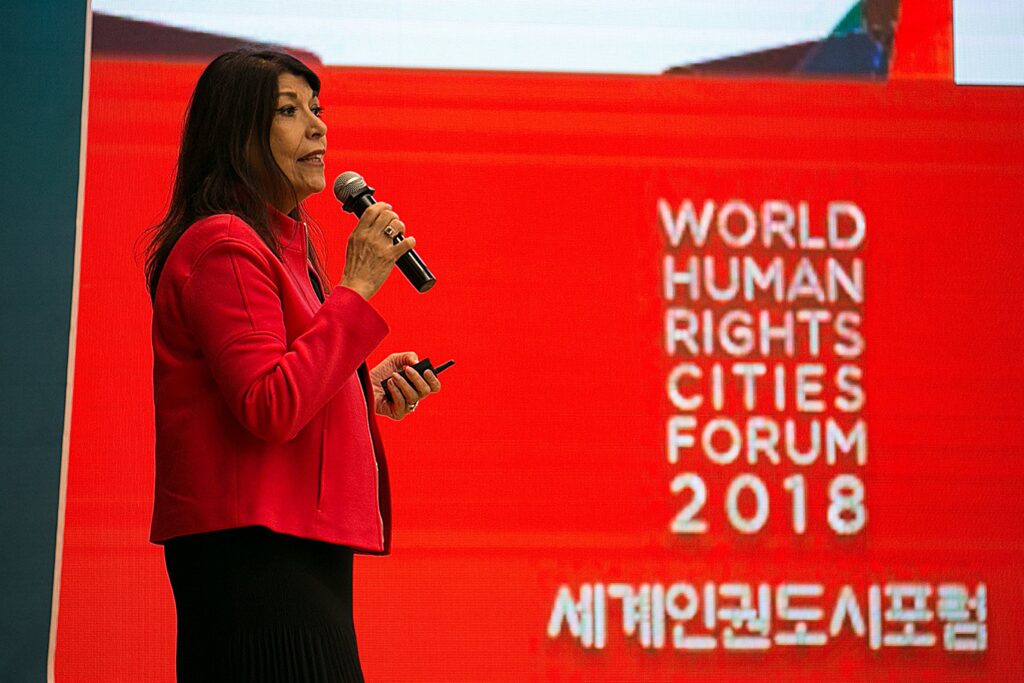
Shams Asadi, HR Commissioner of Vienna in 2018 at the WHRCF.
Through education, community networks, public participation, and inclusive urban spaces, cities can resist division and help rebuild the social fabric. When communities work together to protect dignity and equality, they strengthen democracy from the ground up.
At a time when the global political climate often feels uncertain, the World Human Rights Cities Forum offers an important reminder: Democracy cannot exist without respect for human dignity. No political or economic objective should justify ignoring the rights of others – whether within our borders or beyond them.
In Gwangju, the spirit of May continues to remind us that defending human rights is not only a political commitment. It is also a shared responsibility among citizens, communities, and cities across the world.
The Author
Luis Andrés González is a Mexican GKS scholar and master’s student in cultural anthropology at Chonnam National University. He advocates for LGBTQ+ rights and gender equality, and explores global affairs through pop culture. He is the founder of Erreizando, a digital magazine. Instagram: @luisin97 / @erreizando
Photographs courtesy of WHRCF.
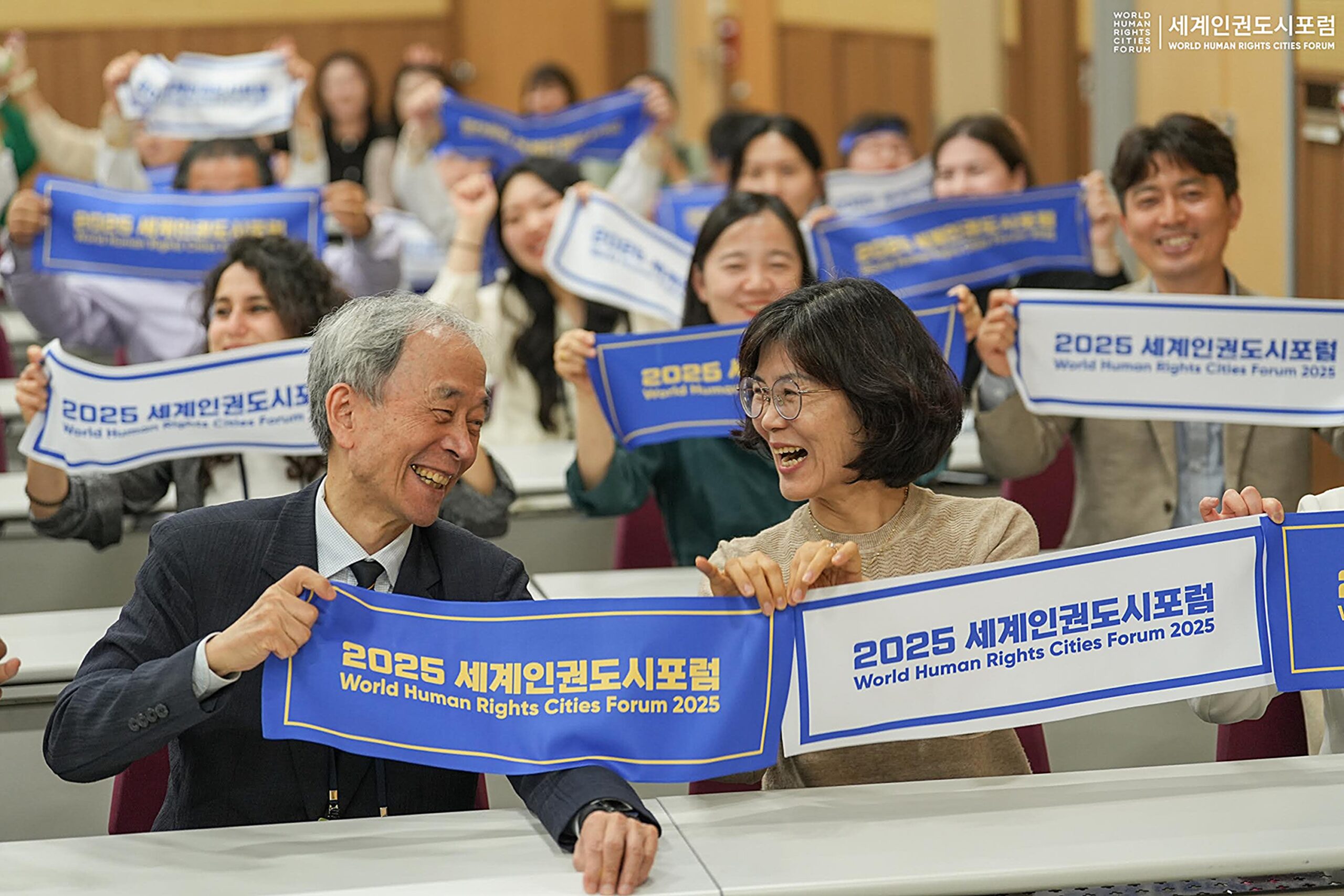
Cover Photo: WHRCF 2025 participants displaying banners at the forum’s closing ceremony.