

Dasan’s Hut: An Exiled Philosopher’s Gangjin Home
By Don Baker ||
About an hour south of Gwangju, on Jeonnam’s southern coast, you can find the small county of Gangjin. For such a small county, with a population of only around 32,000, there is a lot for those interested in Korean history and culture to see there. For example, around 900 to 600 years ago, Gangjin was a major site for the creation of the famous celadon pottery of the Goryeo Dynasty, with its unique inlaid designs. There is now a celadon museum on a site where many of the kilns that produced those works of art were located. Some of Gangjin’s celadon pottery was used for making and drinking tea. We can surmise that some of the tea thus enjoyed was the well-known green tea of Gangjin. To learn more about this tea and how it is grown, you can visit the Gangjin Tea Garden.
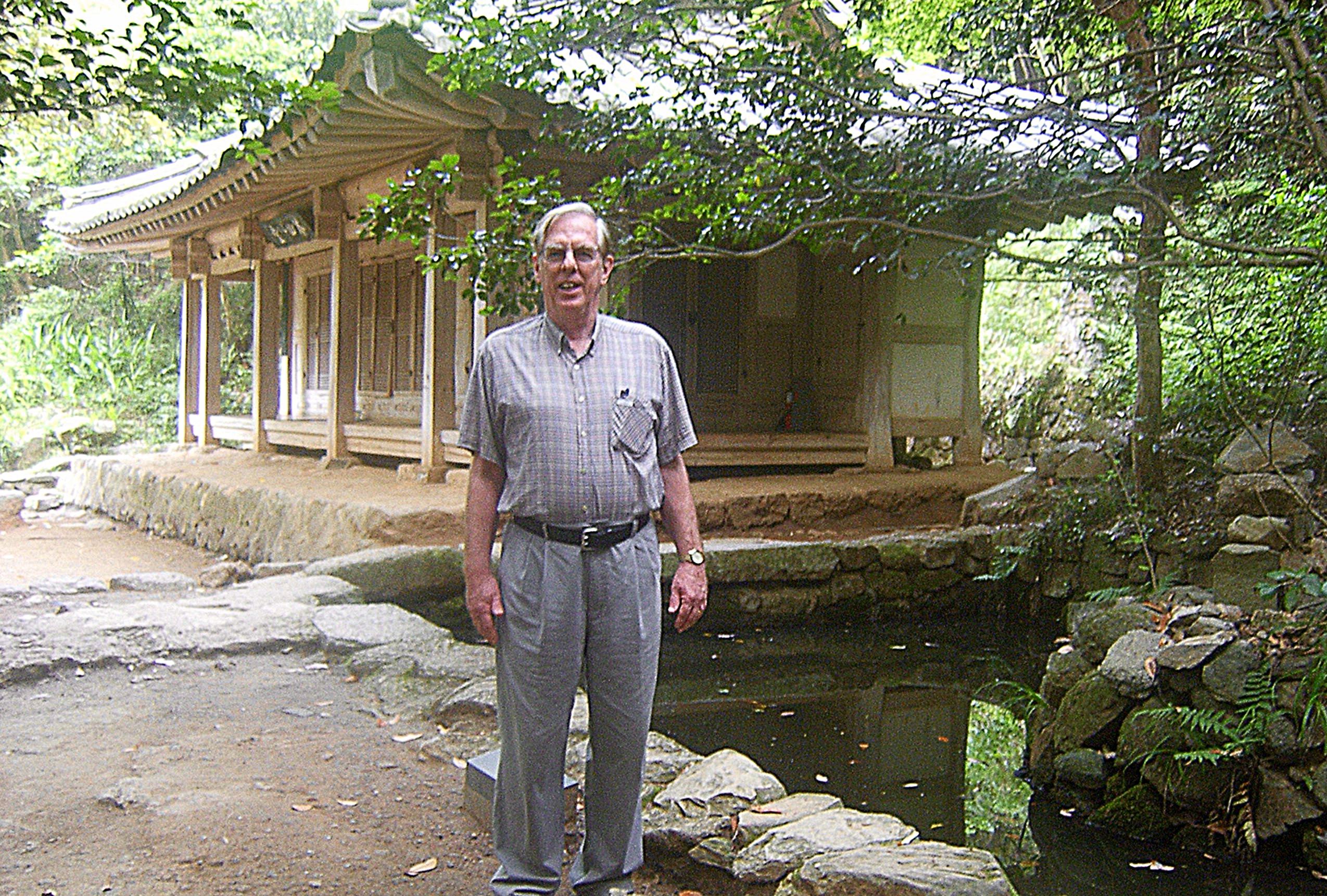
There is also a hill in Gangjin county, not far from the town of Gangjin, called Dasan (“Tea Mountain”). However, that hill is not known for its tea as much as it is for a man who enjoyed the tea grown there while he was in exile from Seoul over two centuries ago. That man is the famous Neo-Confucian scholar Jeong Yak-yong (정약용, 1762–1826), better known by his pen name Dasan. If you have a chance to visit Gangjin, you can drop by Tea Mountain and see the reconstructed hut, called Dasan Chodang, where Dasan lived for most of the 18 years that he was in exile there. That is also where Dasan wrote most of the poems, essays, and books that have gained him recognition as not only the most prolific writer in all of Korean history but also one of the most creative.
Dasan’s Complete Works, in a recent definitive edition, fills 37 volumes. Everything in those 37 volumes, except for modern scholarly introductions, is in Classical Chinese. That was the language Dasan wrote in because he was a Confucian scholar, and Confucian scholars at that time considered the Korean script appropriate only for what they considered less respectable forms of writing such as fiction and letters to female family members.
However, despite what appears to us today to be a rather old-fashioned attitude toward what script to use, there is much in Dasan that merits our admiration. For a Confucian scholar, he had an unusually wide range of interests – and expertise. He was a poet and an architect, a philosopher and an engineer, and a guide to public administration as well as a medical researcher. Moreover, he had a practical bent, which makes him appear almost modern and is the reason Koreans today consider him the culmination of a practical learning trend in Joseon Confucianism.
Dasan’s architectural skills are visible today if you visit the Hwaseong Fortress in Suwon. Dasan designed it, at the request of King Jeongjo. He also showed there his talent for engineering by assembling pulleys and cranes to lift into place the large stones needed to build that fortress. His foray into medical research is not as easy to find. For evidence of that, you have to look at his Complete Works. There you will find his essay on measles and smallpox as well as his record of introducing from China a method of smallpox immunization unknown to Koreans before his time.

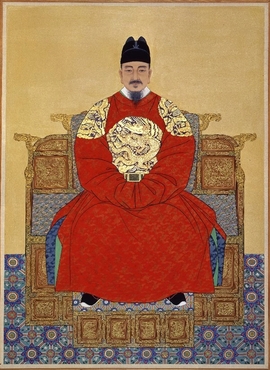
Portrait of Dasan, Jeong Yak-yong.¹
His other talents are more typical of a Joseon Confucian scholar. A Confucian scholar was expected to write a lot of poetry. That is why the collected works of Korean Confucian scholars normally begin with a volume or two of poems written in Classical Chinese. (Poems written in Korean would not be included in such a collection of respectable writings.) Nor would it be unusual for a Confucian scholar to write on matters of politics and government administration. However, it was unusual to do as Dasan did and write one large manual for local government officials and another large manual for central government administration. Even more unusual is that he also produced a guide to forensic medicine, believing that it was important for officials to be able to distinguish between a natural death and one that was the result of foul play.
However, it is in his philosophical writings that his creativity shines the brightest. Though he remained a Confucian philosopher, he pushed against the boundaries of what Confucianism meant in 18th- and 19th-century Korea. He stripped away from the Confucianism of his day the metaphysical elements that had been added in China a few centuries earlier. Instead, he tried to uncover what he believed was the original moral message of Confucius and his immediate disciples. He did that by demoting li, often translated as “principle,” from its elevation to the primary force behind moral behavior down to nothing more than guidelines for acting appropriately. He insisted that moral behavior originated not from li stimulating human actions but instead in decisions human beings made to act in accordance with li, and then exerting the necessary effort to do so.

The tea fields of Gangjin.²
But that is not why he had to spend 18 years in exile in Gangjin, away from his family in Seoul and blocked from the official career in which he had once seemed to be a rising star. He was exiled because he was a founding member of the first Christian community on Korean soil. When he was in his 20s, he was drawn to books written by Catholic missionaries in China and imported into Korea before there were any missionaries there. As he later explained to his king, when he was trying to dismiss the importance of his involvement with Catholicism as a youthful indiscretion, he wrote,
“When I read Catholic writings, I was still a young man, barely out of my teens. Reading books by Europeans was the popular thing to do at that time. … We all read those books back then and talked about them among ourselves in order to gain a reputation for being well-informed and well-read. As I was still young, all I really cared about was having others think that I was as bright as the best of them. That is why I joined the crowd that was reading such books and talking about them.”
However, in 1791, Korea’s small group of Catholics learned that Catholics were not allowed to use the spirit tablet essential to Confucian ancestor memorial services. That was a violation of the law that required the use of such tablets in those mandatory rituals. Dasan’s cousin, also a new Catholic, was executed that year when he held a funeral service for his mother without a spirit tablet. Catholicism had become an illegal religion. That was when Dasan decided to leave the beleaguered Catholic community.
However, when a major anti-Catholic persecution broke out in 1801, Dasan was arrested and then exiled for his involvement with that illegal religious community more than a decade earlier. That is how he ended up in Gangjin. No longer able to pursue a career as a civil servant, he turned to scholarship. Most of the writings in his Complete Works were penned in his hut over his 18 years in Gangjin. They include his interesting insertion of God, whom he called the Lord of High (a term taken from ancient Chinese classics), into Confucian philosophy, which normally doesn’t discuss supernatural beings. Revealing some remnants of his early involvement with Catholicism, Dasan argued that the best way to be a good Confucian, one who acts in conformity with the strict Confucian moral principles, was to assume that the Lord on High is aware of one’s every thought and action. Dasan argued such as assumption would inspire him and others as well to exert the effort necessary to live a moral life.
A visit to Dasan’s hut, and to the nearby Dasan Museum, is well worth the trip for anyone who wants to learn more about Korea’s past and also show their respect for one of the most remarkable individuals in all of Korea’s long history. Enjoy some Gangjin tea while gaining some insight into life in Joseon Korea.
If you would like to learn more about Dasan, and two also remarkable brothers of his, you can watch Prof. Baker’s retirement lecture on YouTube.³
- ¹ Painting restoration by OpenAI.
- ² Photo credit: National Folk Museum, Folk News, 1-313.
- ³ The YouTube video lecture can be viewed at https://www.youtube.com/watchv=u7OFHOqJDBM&t=500s
The Author
Don Baker taught English in Gwangju as a U.S. Peace Corps volunteer from 1971 to 1974. He later earned a PhD in Korean history from the University of Washington and has been teaching Korean history and culture at the University of British Columbia since 1987. One of Dr. Baker’s main academic interests is Dasan, and though he will retire at the end of this semester, he plans to continue studying this amazing Joseon period philosopher.
Cover Photo: Dr. Baker at Dasan’s hut in Gangjin. (Courtesy of the author)