

2001: A Place Odyssey
By Julian Warmington ||
In 2001, everything was different. Desktop computers were expensive, cigarettes cheap, cell phones black and white, and tiny flip phones were cool. The mighty Daewoo Tico ruled the unruly streets of South Korea.
There were about three espresso coffee shops in the whole country. Every café menu listed the same four items. Cities smelled of stale cigarette smoke – especially in PC rooms. Shrek emerged from the silver screen alongside JSA: Joint Security Area.
Meanwhile, in a dark, dusty office somewhere above Geumnam Street, a lone Chinese language graduate found herself trying to write a newsletter in her third language, for a proposed “community” of English speakers living around Gwangju. The small office she staffed was that of the then two-year-old Gwangju International Center (GIC), and the newsletter was named the Gwangju News.
The new organization mostly ran inexpensive Korean language lessons and offered weekend trips to idyllic, historical spots around the province. Random foreigners wandered through the NGO’s quiet doorway. Some were social refugees: strangers in a strange land seeking connection outside the stench of a pub and the social gaze of a church.
The Chinese language grad sweet-talked some English language speakers to help with that worrisome task she was charged with: the Gwangju News. I joined the group just after it started.
The first issues were aspirational even for what was literally just a newsletter: a single sheet of A3 paper, black and white, folded into quarters. It included two or three brief paragraphs about people in the organization alongside random facts on Gwangju and the surrounding province.
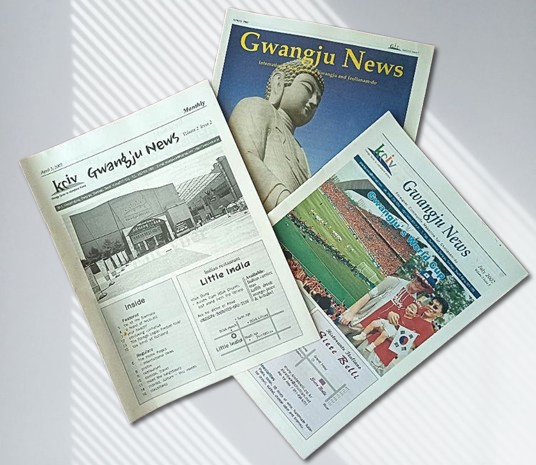
Early issues of the Gwangju News, April 2002, July 2002, and January 2005 (counterclockwise from left).
Our group met to brainstorm story ideas and encourage each other to volunteer to write fresh articles.
Then, one day at the start of the year, a GIC board member loaned the group a first-generation digital camera. It took four AA batteries to take four photographs before the batteries would need replacing. New stories sometimes had photos of people with their eyes closed, blinking at the flash, if you didn’t have spare batteries to take another shot or two.
Still though, that camera was a catalyst. It was more than just symbolic. It was a sign: a sign of trust in people, of faith in ability to cooperate, and of encouragement to get out and use it. And, it also really was cutting-edge tech for the time. Batteries were cheap. Suddenly, it amped the potential for that newsletter right up to ten.
Some people wanted to use the camera; others wanted to pose for it. Some wanted to write descriptions of life around town; others to talk. People volunteered to write or introduce someone who had a story. Moving to compact magazine format seemed logical.
To fill out pages, there was always something new happening and fascinating people to meet, from Korea and beyond. One was Lee Jae-eui whose kind eyes and slender shoulders told almost as much as his book describes of being caught up within the May 18 maelstrom.
For those of us new to the land, interviews with local artists, store owners, students all had revealing stories to share with insights into the culture, and the text also helped English language students read their reality in the language while learning about the variety of immigrants around the city.
A group of young male Mexican engineers found themselves designing and building the subway line. Young brides from Southeast Asia married local farmers. Farm and factory laborers came downtown to buy international phone call cards and imported foods on their half day off. Others were hired implants for sports teams, or traveling sales reps. One lanky older British rocker bloke was a journalist from The Japan Times who had come to Korea to survey stadiums, bars, and cafés before the co-hosted Korea–Japan World Cup the next year.
The 2002 World Cup had a huge influence on South Korea well before the first kickoff, and technology was also changing fast with the new century. By the end of 2001, new digital cameras were available in Shinsegae Department Store and elsewhere in Seoul. They needed only two AA batteries! They could take dozens more photos! Two whole megapixels! They came with a 2-inch, 64-MB memory card! And a 1.5-inch digital monitor display!
More important were the people though. The British guy wrote about the new stadium looking like a massive UFO parked for the night with its lights on. Friends and buddies were cajoled into proofreading. The genteel retired linguistics professor Shin Sang-soon wrote a regular column explaining his favorite quirky language expressions and historical events.
And then there was the kind local business owner listening to the enthusiastic business student as she over-explained the novel concept of Gwangju News as a budding magazine, even after they’d already agreed to buy advertising space; she was so dedicated to reciting her pitch accurately that she didn’t realize she’d already made the sale!
Café and bar owners provided countertop corners where freshly published, thin black-and-white “magazines” would be placed. In the coming months, they’d have more pages to fill them out. Then, more copies were printed. And soon, the front cover had color: black, white, and red!
The magazine was on a roll.
It was amazing to watch the effect of hosting a few games of soccer for the 2002 World Cup on Korean culture. The Gwangju News dressed up in its best for it too: The new year saw more pages, a larger format, growing the team of volunteers, a new used computer in the office, and full color!
Bouncing on Geumnam Street in a wall-to-wall sea of ecstatic citizens wearing the national team’s red, chanting and singing the night away, was probably the single most exciting event of shared community in twenty years on the peninsula.
But finding folks to work with, creating teams, figuring out organizational strategies, and together building publishing processes – seeing a genuine community form through shared interests and shared information within a lasting “hard copy” document offering functionality and beauty – all of it was deeply rewarding.
I thank the GIC for its faith in and support for the community, in which the Gwangju News has played a significant role over the years. And I extend congratulations to all who have been involved in the planning, the writing, the editing, and the development of the Gwangju News as it celebrates 25 years of service to the community.
(GN with Microsoft Copilot)
The Author
Julian Warmington is a teacher from Aotearoa New Zealand. He taught at Korean universities for 20 years. He lived in Gwangju for ten years, loving the food, the family of black squirrels in the Jisan-dong forest, and cycling down Mudeung Mountain at night. Julian was also an early writer, editor, and promoter of the Gwangju News.
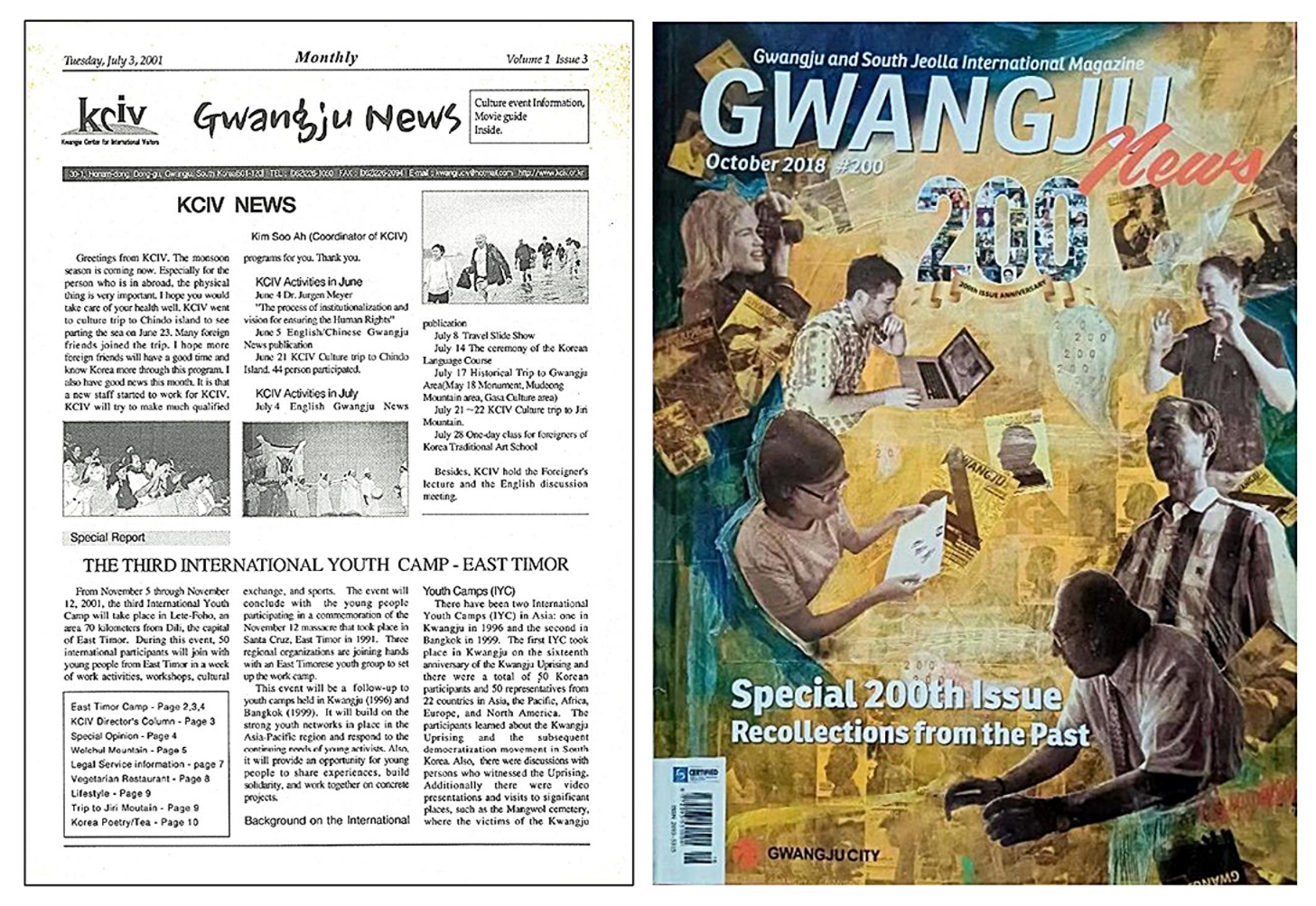
Cover Photo: A comparison of the 8-page Issue 3 (2001) with the 80-page 200th anniversary issue (2018, right).