





The Environment: What’s New in the World of Renewable Energy?
By Chung Hyunhwa ||
Energy supply is often cited as the biggest challenge in the AI era. It is believed that with AI, we will soon be able to more rapidly solve the pressing issues we face in various sectors, but can we afford the power that would be required to do the solving? Is it possible to achieve net-zero carbon while using AI to assist us? Energy needs are great, but we still need safe and clean energy in these times of climate crises. There are advocates of nuclear energy who consider it to be the answer, as renewable energy has a big problem with intermittency. True, the sun does not always shine, and wind does not always blow. Let’s examine whether we are any closer to overcoming these challenges today.
More Efficient Solar Panels
Solar panels consist mainly of a glass surface covering a silicon layer that generates electricity from captured sunlight. Just a few years ago, solar panels converted only about 17 percent of sunlight into electricity. Now the majority of solar panels on the market are already at 21 to 24 percent efficiency. The maximum efficiency of silicon solar panels is known to be 27 percent, which was believed to be the limit until the breakthrough tandem cell technology was introduced. Tandem panels are multi-layered with different materials, and panels using silicon and a mineral named perovskite are in the spotlight. These panels are made by adding perovskite to the ordinary silicon layer. They absorb blue light, which silicon alone cannot absorb and thus generate more electricity. Theoretical efficiency is expected to be 44 percent, and is currently at 33 percent. Although durability still needs improvement, this breakthrough could be a game-changer in the history of solar energy.
Floating Offshore Wind Power Plants
Wind power systems are often found on top of mountains, on the seashore, or in the sea near the coastline. Because of limited land availability, more turbines are being installed offshore, but it is not always easy to fix the system to the seabed, especially when the turbines are far from dry land. New floating-platform technology makes installation easier and faster. The wind turbines sit on buoyant platforms anchored to the seabed with flexible mooring lines. Ship-building companies and marine engineering companies are collaborating on this.
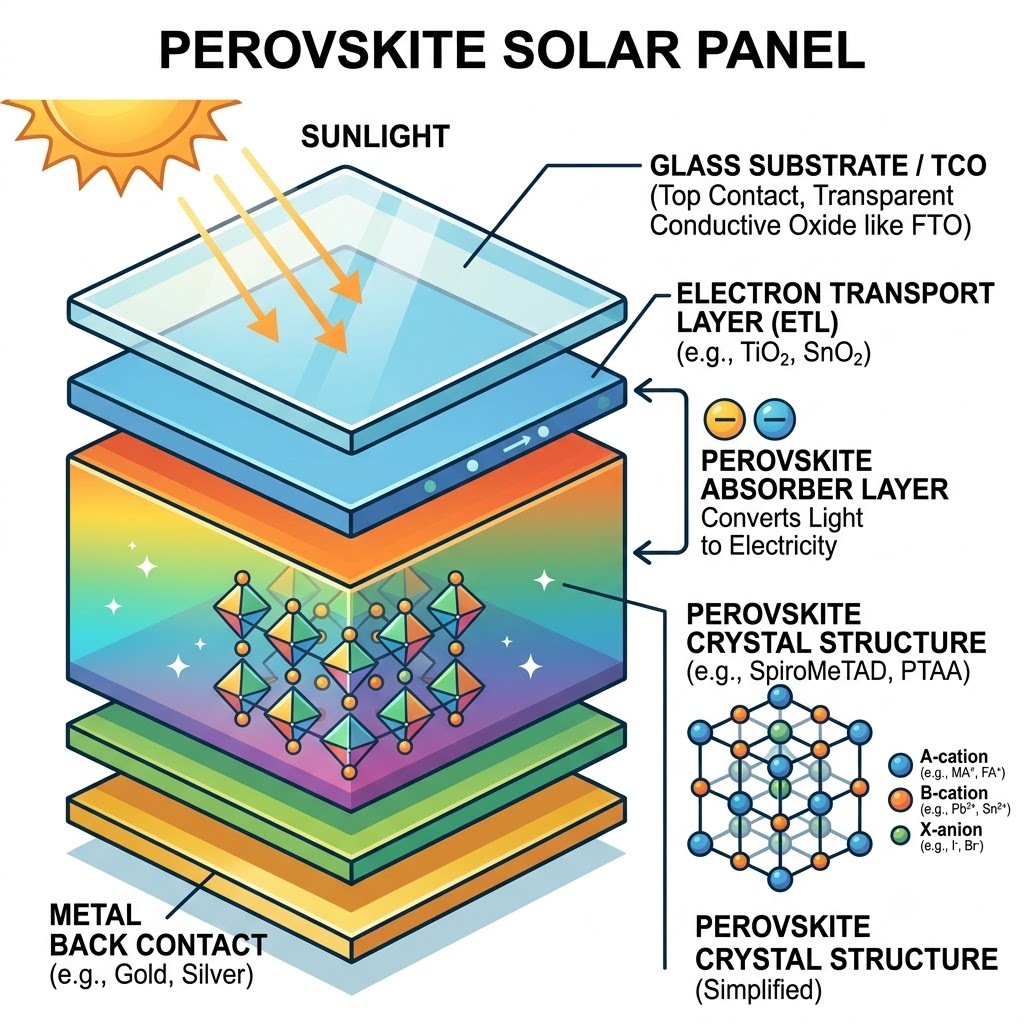
(GN with Google Gemini)
Ways to Solve Intermittency
To deal with the intermittency of renewable energy, storing leftover energy is the way to go. Energy storage systems (ESSs) often use high-performance lithium-iron-phosphate (LFP) batteries that are safer and cheaper than nickel-cobalt-manganese (NCM) batteries, but there are also thermal and mechanical systems as well. One thermal system is the liquid air storage system, which exploits the volume difference of air between its liquid and gaseous states. Using the leftover electricity, air is compressed to become liquid at the low temperature of –196°C to be stored in thermal energy storage tanks, and when there is a need for power generation, the compressed liquified air is warmed to expand its volume by 700 times. The pressure from the expanding air turns the turbine to generate electricity.
Another thermal method is the sand battery system, which stores energy as heat in sand and later uses that heat to generate electricity. An example of the mechanical storage method is pumped hydropower. Using leftover electricity, water is pumped into a dam at a higher altitude, and the water pumped up is used for hydropower generation. Hydrogen should be counted as another method of storing energy. Using leftover electricity, water is separated into hydrogen and oxygen. The hydrogen is collected in tanks and can be used for generating electricity using catalysts without requiring combustion.
Smart Grids and Virtual Power Plants
Generating and storing energy matter, but using the energy efficiently also matters greatly. Smart grids and virtual power plants (VPPs) are what make this possible. Smart grids are two-way electricity networks that use digital meters and sensors, while the old system was only one-way energy distribution. In addition, AI-driven VPPs can coordinate all those scattered small-scale power generation facilities and storage sites, or even parked electric vehicles, connected to the grids to work like one big power plant. These maximize the efficiency in energy consumption.
In Closing
Honestly, I once also thought nuclear energy in the form of SMRs (small modular reactors) could become a perfect energy source, but I soon learned they still have technical challenges to overcome. SMRs cannot be built as cheaply as regular-sized nuclear power plants. Therefore, if SMRs are ever built, they are built only for specific purposes, such as for the places where no other energy sources are suitable. I am glad to know new renewable energy technologies are quickly evolving. I believe in human collaborative intelligence to drive progress toward economical, clean, and safe energy solutions.
The Author
Chung Hyunhwa, a native of Gwangju, recently worked for a local horticultural company. She led the international eco-hike group Gwangju Hikers at the GIC in 2020 and 2021. Previously, she taught English at Yantai American School and Yantai Korean School in China and worked in school administration at Branksome Hall Asia in Jeju. She holds a master’s degree in TESOL from TCNJ in the U.S. and has a license to teach Korean. She loves plants, birds, dogs, and repurposing items creatively.
Cover Photo by GN with Google Gemini.