




The New Generation of AI Tools: A Glimpse into the Future
By Muhammad Umar Tahir ||
A few weeks ago, I was sitting with a friend when he made an interesting request. Knowing my interest in artificial intelligence, he asked, “Why don’t you introduce some of the newest AI tools in your next article? People always hear about AI, but most of them don’t know what the latest tools can actually do.”
At first, I thought it would be easy. I would simply collect a list of newly launched AI tools and share them. However, the more I looked into it, the more difficult the task became. New AI tools are being released almost every week. Some focus on productivity, some on creativity, some on education, and others on automation. By the time one tool becomes popular, an updated version or an entirely new competitor has already appeared.
That is why this article is not an attempt to identify the single “best” AI tool. In a field that changes this quickly, today’s best tool may be replaced tomorrow. Instead, I would like to share a selection of recently launched AI tools that caught my attention. These may not be the “best” in their categories but they are among the most recent, offering a glimpse into where technology is heading.
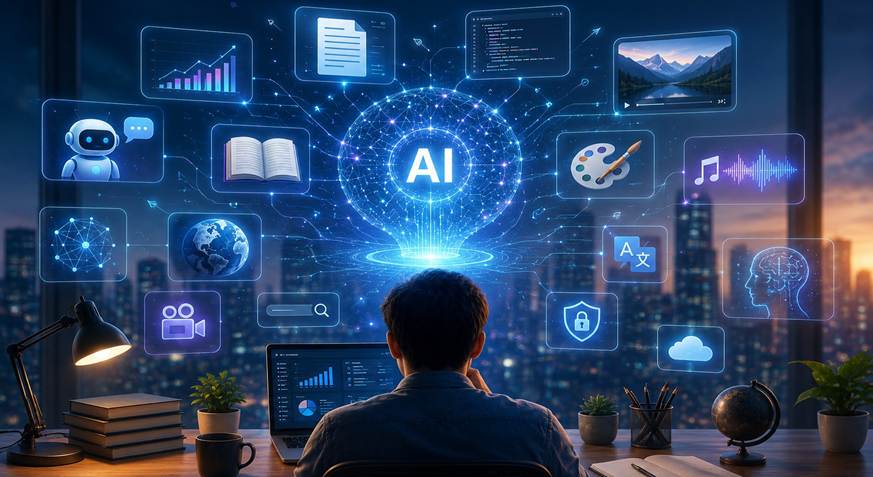
One thing became very clear while exploring these tools: Artificial intelligence is no longer limited to answering questions in a chat window. It is gradually becoming a digital coworker. Some tools can create videos; others can compose music, design presentations, repair damaged files, analyze documents, manage tasks, or even perform actions on our behalf. Looking at these developments, it feels as if we are witnessing the early stages of a major technological shift.
One category that is growing rapidly is AI assistants that can work alongside us. Tools such as Gemini Spark, Skygen, Workspace Agents ChatGPT, KiloClaw, and Workflows Mistral are designed to do much more than respond to prompts. They can organize tasks, connect with different applications, automate workflows, and help manage complex projects. Instead of asking AI a question and receiving an answer, users can increasingly assign objectives and allow the systems to complete multiple steps independently.
Another fascinating trend is the rise of creative AI tools. Not long ago, creating a professional video, animation, or music track required specialized software and years of experience. Today, tools such as Dreamina, Miraga AI, Gemini Omni, ChatGPT Images 2.0, BeatMV, AniJam AI, Google Flow Music, and Stable Audio 3.0 are making creative production more accessible than ever. A single user can transform an idea into an image, a video, an animation, or even a complete music composition within minutes.
Some of these tools feel almost magical. Miraga AI can transform a single photo into a realistic video sequence. BeatMV can analyze a song and automatically create a synchronized music video. AniJam AI can manage large parts of the animation process, from story concepts to final scenes. What once required an entire production team can now begin with a simple text prompt.
At the same time, a new generation of reasoning models is pushing AI capabilities even further. Models such as GPT-5.5 Instant, Claude Opus 4.8, Mistral Medium 3.5, DeepSeek V4, and MAI-Thinking-1 are designed to reason more effectively, follow complex instructions, and reduce errors. These systems are not simply retrieving information. They are increasingly capable of analyzing problems, generating solutions, and assisting with sophisticated tasks in research, coding, education, and business.
Beyond productivity and creativity, many new AI tools are solving practical everyday problems. Wondershare Recoverit helps recover deleted or damaged files. Wondershare Repairit can repair corrupted videos, photographs, audio recordings, and documents. FridgeSnap AI can analyze a picture of the contents of a refrigerator and suggest meals based on available ingredients. CalBye AI can estimate calories and nutritional values from a simple photograph of food.
These examples may seem small compared to advanced AI models, but they highlight an important point. Artificial intelligence is becoming useful in ordinary daily situations. It is moving beyond research laboratories and technology companies and becoming part of everyday life.
(Shubham Dhage via Pexels)
Another interesting development is the emergence of tools designed specifically for professionals. Capafy allows developers to add specialized skills to AI agents. HubSpot AEO helps businesses understand how AI systems perceive their brands. Cuey allows users to compare responses from multiple AI models side by side. EaseMate AI combines multiple leading models into a single platform for studying, working, and creating.
What surprised me most while exploring these tools was not any individual feature. It was the speed of progress. Only a few years ago, most AI discussions focused on whether machines could generate text. Today, the conversation has shifted toward autonomous agents, multimodal systems, intelligent assistants, advanced video generation, music creation, and real-time translation.
One of the most interesting aspects of these new AI tools is that they are not designed for a single type of user. A few years ago, advanced AI systems were mainly used by researchers, software developers, and technology companies. Today, that situation is changing rapidly. Students are using AI to summarize long documents, explain difficult concepts, and help them study more efficiently. Teachers are experimenting with AI-generated lesson plans and educational materials. Small business owners are creating marketing content, advertisements, and presentations without needing large teams or expensive software.
Content creators are perhaps experiencing one of the biggest transformations. In the past, producing a professional-quality video often required cameras, editing software, graphic designers, voice artists, and significant time. Today, a creator can generate images, videos, music, subtitles, and even translations using AI-powered tools. The barrier to creativity has become lower than ever before. A single person can now accomplish tasks that previously required an entire team.
The workplace is also evolving. Many professionals are beginning to use AI not only for writing emails or generating reports, but for managing complete workflows. AI assistants can organize schedules, summarize meetings, analyze documents, and automate repetitive tasks. Instead of replacing people, many of these tools are acting as digital coworkers that help employees focus on more important work. The relationship between humans and machines is gradually shifting from simple interaction to collaboration.
Another area that is changing rapidly is communication. Tools such as Palabra.ai demonstrate how language barriers may become less significant in the future. Imagine attending an international conference where participants speak different languages, yet everyone understands each other almost instantly. Such technologies have the potential to bring people closer together and create new opportunities for global collaboration.
At the same time, these developments raise important questions. If AI becomes capable of creating images, videos, music, software, presentations, and even business strategies, what skills will become most valuable in the future? Perhaps technical knowledge alone will no longer be enough. Creativity, critical thinking, judgment, and the ability to ask meaningful questions may become even more important. After all, though AI can generate answers, humans still decide which questions are worth asking.
Another observation that stood out to me while exploring these tools is how quickly expectations are changing. Just a few years ago, people were amazed when an AI system could generate a paragraph of text. Today, users expect AI to understand documents, generate videos, create animations, manage workflows, analyze data, and communicate naturally. What seemed impossible yesterday often becomes normal tomorrow. This rapid pace of progress is one of the defining characteristics of the current AI era.
Looking back at my friend’s question, I realize that asking “What is the best new AI tool?” may no longer be the right question. New tools appear so quickly that any answer may become outdated within months.
Perhaps a better question is this: As AI tools continue to grow more powerful, more autonomous, and more creative, how will we choose to use them? Because the future may not belong to those who simply use artificial intelligence. It may belong to those who learn how to work alongside AI.
The Author
Muhammad Umar Tahir is an electrical engineer pursuing his PhD in the Artificial Intelligence Convergence Department at Gwangju Institute of Science and Technology (GIST). He is interested in applying AI to healthcare devices, particularly in advancing medical imaging technologies and brain stimulation.
Cover Photo by GN with OpenAI ChatGPT.